
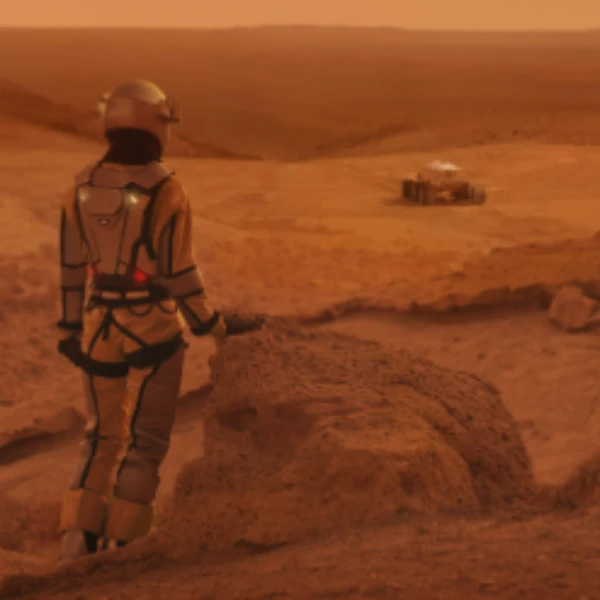
Will humans colonize Mars before 2050?
Yes refers to: Before 2050
Short Answer
1. Market Behavior & Drivers
- Orbital refueling demonstrations are vital for future Mars mission logistics.
- Mars life support and resource utilization systems have varied technology readiness.
- NASA's Moon to Mars initiative maintains stable overall exploration funding.
- Long-duration Mars missions pose significant physiological health risks to astronauts.
- Successful cargo missions are critical prerequisites for Mars colonization by 2050.
Who Wins and Why
| Outcome | Market | Model | Why |
|---|---|---|---|
| Before 2050 | 16.1% | 18.4% | Rapid advancements in propulsion, life support, and ISRU technologies could accelerate Mars colonization efforts. |
2. Price Chart
Historical Price (Probability)
3. Market Data
Contract Snapshot
The market resolves to "Yes" if a self-sufficient human colony of at least 10 people resides on Mars for at least one Earth year before January 1, 2050, with verification from listed news and space organizations. If this condition is not met by the deadline, the market resolves to "No." The market opened on June 27, 2025, and will close early if the "Yes" event occurs, or otherwise by December 31, 2049, at 11:59 PM EST.
Available Contracts
Market options and current pricing
| Outcome bucket | Yes (price) | No (price) | Last trade probability |
|---|---|---|---|
| Before 2050 | $0.19 | $0.84 | 16% |
Market Discussion
The market discussion is very limited, with the main viewpoint being a strong skepticism towards human colonization of Mars before 2050. The key argument for "No" is that Mars is an extremely harsh and uninhabitable environment, described as a "cold lifeless airless hellhole." There are no arguments presented for a "Yes" outcome, and some users express disbelief that such a bet is even being considered.
4. Trust Index
Order book is critically thin.
Primary risk· Trade quality
Includes the cost to trade: a $10,000 order can't be filled here because the order book is too thin.
Weighted blend with hard caps — a critically weak safety pillar, or a severe trading anomaly, caps the total regardless of the rest. Full methodology · About the Trust Index
5. When is SpaceX's Starship Orbital Refueling Demonstration Targeted?
| Target Completion Year | 2026 [1] |
|---|---|
| Propellant Quantity & Type | Hundreds of tons of liquid methane and liquid oxygen [1] |
| Impact on Mars Mission | Keeps crewed Mars mission on track for late 2030s [1] |
6. What is the Technology Readiness Level for Mars ECLSS and ISRU?
| Mars ECLSS Water Recovery Target | 98% [1] |
|---|---|
| Mars ECLSS Oxygen Recovery Target | 75% [1] |
| MOXIE Mars Oxygen Production Rate | 6 grams per hour [2] |
Sources (3)
- 1https://ntrs.nasa.gov/api/citations/20230002103/downloads/Environmental%20Control%20and%20Life%20Support%20System%20(ECLSS)%20Options%20for%20Mars%20Transit%20and%20Mars%20Surface%20Missions%20(ICES%202023)%20-%20Final%20Submission.pdfntrs.nasa.gov
- 2Assessing the Feasibility of a Martian ISRU Propellant Plant - NASA Technical Reports Server (NTRS)ntrs.nasa.gov
- 3https://ntrs.nasa.gov/api/citations/20250003730/downloads/Progress%20Review%20NASA%20Lunar%20ISRU_Sanders.pdfntrs.nasa.gov
7. Are NASA's Current Mars Funding Trends Sufficient for Colonization?
| NASA Total Budget FY2026-2027 | $24.4 billion (enacted FY2026) to $26.04 billion (requested FY2027) [6, 9, p [1]. ES-3] [2] |
|---|---|
| Moon to Mars Program Funding | ~$7.6 billion (requested FY2026) to ~$7.9 billion (requested FY2027-2031) [2, p [1]. 17; 9, p [2]. 17, ES-3] [3] |
| Mars Colonization Annual Need | ~$20-30 billion per year in 2030s (for comprehensive colonization) [1] |
Sources (5)
- 1https://www.nasa.gov/wp-content/uploads/2025/05/fy2026-budget-request-summary-briefing-finalv2-05292025-430pm.pdfnasa.gov
- 2https://www.nasa.gov/wp-content/uploads/2025/05/fy-2026-budget-technical-supplement-002.pdfnasa.gov
- 3https://www.nasa.gov/wp-content/uploads/2025/05/combined-mission-fact-sheets-finalv2-05302026-1207pm.pdf?emrc=6842749981efcnasa.gov
- 4Congress passes minibus spending bill that rejects proposed NASA cuts - SpaceNewsspacenews.com
- 5Minibus provides $24.4 billion for NASA for fiscal year 2026 - SpaceNewsspacenews.com
8. Are Current Countermeasures Effective for Long-Duration Deep-Space Missions?
| GCR Health Risks | Cognitive impairment, increased cancer risk, and central nervous system (CNS) damage [1] |
|---|---|
| Microgravity Health Risks | Fluid shifts, altered brain structure and position, immune system dysregulation, cardiovascular deconditioning, and musculoskeletal degradation [1] |
| Countermeasure Efficacy | Not sufficiently effective to keep health risks within acceptable limits for a 900+ day Mars mission [1] |
Sources (3)
- 1Frontiers | Long-term space missions’ effects on the human organism: what we do know and what requires further researchfrontiersin.org
- 2Radiation risk mitigation in human space exploration: a primer, a vision, and the state of the art | The European Physical Journal Plus | Springer Nature Linklink.springer.com
- 3https://ntrs.nasa.gov/api/citations/20240009831/downloads/NAS%20BPS%20Simonsen%20v4%20strives.pdfntrs.nasa.gov
9. What are the critical prerequisites for Mars colonization by 2050?
| Required Cargo Landings | At least two successful [1] |
|---|---|
| ISRU Production Duration | At least 23 Earth months [2] |
| ISRU Verification Requirement | Must occur before crewed mission departs Earth [3] |
Sources (5)
- 1SpaceX - A Closer Look at SpaceX’s Mars Plan - Aerospace Americaaerospaceamerica.aiaa.org
- 2About feasibility of SpaceX's human exploration Mars mission scenario with Starship | Scientific Reportsnature.com
- 3Mission Architecture Using the SpaceX Starship Vehicle to Enable a Sustained Human Presence on Marsliebertpub.com
- 4SpaceX Mars colonization programen.wikipedia.org
- 5Interplanetary Mission Design Handbook: Earth-to-Mars Mission Opportunities 2026 to 2045 - NASA Technical Reports Server (NTRS)ntrs.nasa.gov
