Short Answer

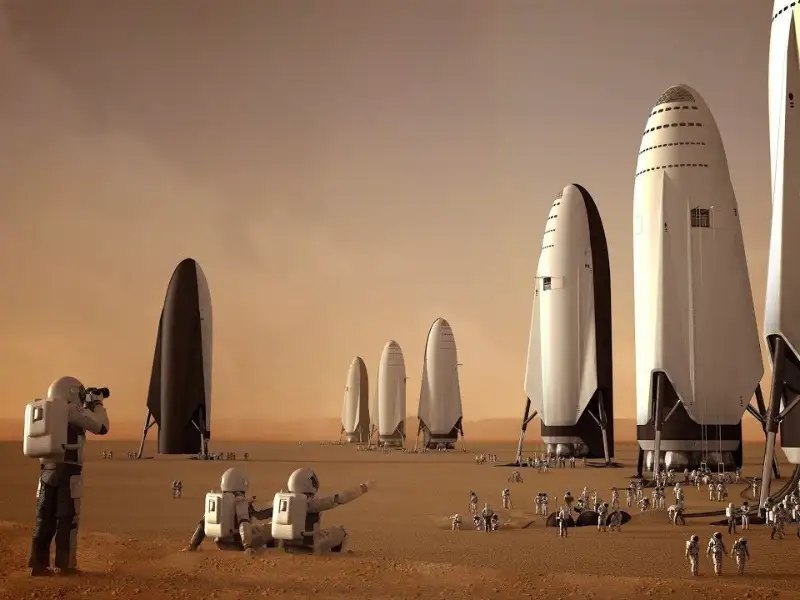
Both the model and the market expect Starship to launch humans to Mars before 2030, with no compelling evidence of mispricing.

1. Executive Verdict

  • SpaceX has not yet achieved full-scale orbital propellant transfer for Starship.
  • SpaceX has not publicly completed a full-duration Mars ECLSS ground test.
  • Three uncrewed precursor missions are essential before crewed Starship Mars expeditions.
  • FAA permits 64 annual Starship/Super Heavy launches across two sites.
  • SpaceX's Mars architecture integrates ascent capabilities within the Starship vehicle.

Who Wins and Why

Outcome Market Model Why
Before 2030 15.0% 10.6% Achieving a human Mars landing by 2030 requires resolving numerous unprecedented technical and logistical challenges.

2. Market Behavior & Price Dynamics

Historical Price (Probability)

Outcome probability
Date
This market has demonstrated a stable, sideways trading pattern since its inception. The price has been confined to a narrow 6-point range, with a support level established around 13.0% and a resistance ceiling near 19.0%. The market opened at 16.0% and currently sits at 15.0%, indicating very little directional change over the observed period. A notable movement was the dip to the 13.0% support level on April 22nd. Given the absence of specific contextual news, the direct cause for this price drop or other fluctuations cannot be determined from the provided data.
The total volume of 3,252 contracts suggests a moderate level of interest in the market. The sample data indicates that the move down to the 13.0% support level saw higher-than-average volume, which can imply stronger conviction from sellers at that time. Conversely, the most recent price point shows zero volume, suggesting a recent lack of trading activity or consensus at the 15.0% level. Overall, the consistent trading below 20% signifies a strong and persistent market skepticism about the likelihood of Starship launching humans to Mars before the 2030 deadline. The market sentiment is clearly bearish on the prospect, with traders consistently pricing it as a low-probability event.

3. Market Data

View on Kalshi →

Contract Snapshot

The market resolves to YES if SpaceX launches a manned Starship mission to Mars by December 31, 2029, with the outcome verified from SpaceX. If this mission does not occur by the deadline, the market resolves to NO, closing by 11:59 PM EST on December 31, 2029. The market opened on March 22, 2024, and trading is prohibited for SpaceX employees, persons employed by any Source Agencies, and those with material non-public information on the event.

Available Contracts

Market options and current pricing

Outcome bucket Yes (price) No (price) Last trade probability
Before 2030 $0.18 $0.85 15%

Market Discussion

Traders are largely skeptical about SpaceX launching humans to Mars by 2030, with the market currently pricing an 85% chance of "No." Arguments for "Yes" hinge primarily on Elon Musk's recent optimistic five-year timeline, while the "No" viewpoint, supported by Musk's biographer, cites his consistent history of overstating project completion dates. Many traders express a lack of trust in Musk's ability to meet such ambitious deadlines, despite a clarification that a "Yes" resolution requires a successful, non-exploding manned mission launch.

4. What Is the Current Status of Orbital Propellant Transfer Success?

Full-scale orbital transfer success0% (None demonstrated to date) [^]
First orbital demonstration plannedEarly 2025 [^]
Full-scale orbital refueling targeted2026 [^]
SpaceX has not yet achieved full-scale orbital propellant transfer between Starship vehicles. To date, the demonstrated success rate for such a transfer remains at 0%, though a subscale ground demonstration of cryogenic propellant transfer was completed in 2023 [^]. While missions like Starship Flight 11 have focused on engine re-light tests to advance orbital refueling technologies, an actual orbital propellant transfer has not yet occurred [^]. SpaceX anticipates the first orbital demonstration as early as 2025, with a full-scale orbital refueling demonstration targeted for 2026 [^]. This "gas station in space" capability is considered essential for enabling future lunar landings and transforming deep space exploration [^].
NASA's HLS program requires multiple successful orbital propellant transfers for certification. For the Starship architecture to be certified for missions beyond Low Earth Orbit, such as crewed lunar missions, NASA mandates the demonstration of "multiple" or "several" successful transfers [^]. This includes the successful completion of multiple full-scale cryogenic propellant transfers in orbit. However, available sources consistently indicate that NASA has not specified an exact number of successful transfers as a prerequisite for certification [^].

5. Has SpaceX Completed a 500-Day Mars ECLSS Ground Test?

SpaceX 500-Day Mars ECLSS TestNo public record of completion with human crew analog [^]
SpaceX Existing ECLSSDeveloped for Commercial Crew missions to ISS (short duration) [^]
Longest Mars Simulation by Other Org520 days (MARS-500 experiment) [^]
SpaceX has not publicly completed a full-duration ECLSS test for Mars. There is no public record indicating that SpaceX has completed a ground-based, full-duration, closed-loop Environmental Control and Life Support System (ECLSS) test simulating a 500-day Mars transit with a human crew analog [^]. While SpaceX has developed and tested ECLSS for its Crew Dragon spacecraft, used for Commercial Crew missions, these systems are designed for shorter durations and different mission profiles than those required for a Mars transit [^]. Therefore, specific technical challenges or failure rates from a SpaceX-conducted full-duration Mars analog test cannot be provided from available information [^].
SpaceX engineers are working on life support for future long missions. SpaceX employs a dedicated team of engineers focused on life support systems, including those for the Crew Starship program, which is crucial for developing technologies for future long-duration missions [^]. For context, other organizations have conducted long-duration human spaceflight simulations, offering valuable insights. The Russian-European MARS-500 experiment successfully completed a 520-day Mars mission simulation with a human crew analog [^]. Additionally, NASA's HI-SEAS IV mission involved a crew exiting a simulated Mars habitat after 378 days [^]. These missions, although not conducted by SpaceX, have provided insights into the psychological and logistical challenges of extended space travel, including issues with resource management and equipment reliability [^].

6. What Uncrewed Missions Are Essential for Crewed Mars Expeditions?

Critical Precursor MissionsISRU propellant production, automated Starship landing, surface power systems deployment [^]
ISRU Propellant ProductionProduce methane and oxygen from Martian CO2 and water ice [^]
Mission Window Target2026 and/or 2028 Mars launch windows [^]
Beyond orbital refueling, three uncrewed precursor missions or technology demonstrations on the Martian surface are essential for enabling a crewed mission within the 2026 and/or 2028 Mars launch windows.
Demonstrating In-Situ Resource Utilization (ISRU) for propellant production is paramount. This involves extracting carbon dioxide from the Martian atmosphere, and potentially water ice, to produce methane (CH4) and oxygen (O2) [^]. These propellants are vital for the Starship vehicle's return journey to Earth, allowing for a sustained human presence by eliminating the need to transport all return fuel from Earth [^]. Successfully operating ISRU systems on Mars is a key milestone anticipated for the 2026 window [^].
Automated and precise Starship landing accuracy is a crucial precursor mission. Uncrewed Starship flights are expected to land autonomously, delivering substantial cargo, equipment, and infrastructure necessary for a future human base [^]. The ability to execute soft, accurate landings is important for cargo delivery and for verifying the landing systems that will eventually carry crew. This capability must be reliably proven during precursor missions, potentially within the 2026 launch window [^].
Robust power systems deployment and reliable operation are critical for Mars missions. A sustainable human presence necessitates a consistent and ample power supply for habitats, life support systems, ISRU operations, and scientific instruments [^]. Early uncrewed missions need to demonstrate the successful deployment and long-term operation of initial power sources, such as large-scale solar arrays, to establish the energy infrastructure for a permanent base [^]. These precursor missions are fundamental for validating the entire mission architecture and ensuring the feasibility of supporting human life and operations on Mars [^].

7. What is Starship's Annual Launch Capacity for Mars Missions?

Starbase Annual Launch Limit20 [^]
LC-39A Annual Launch Limit44 [^]
Launches per Mars MissionApproximately 16 [^]
FAA permits 64 annual Starship/Super Heavy launches across two sites. The Federal Aviation Administration (FAA) concluded its environmental review for SpaceX's Boca Chica, Texas, site on October 30, 2023, allowing up to 20 Starship/Super Heavy launches per year from that location [^], [^]. Subsequently, on January 26, 2024, the FAA approved operations at Launch Complex 39A (LC-39A) at Kennedy Space Center, Florida, permitting up to 44 launches annually from that site [^], [^], [^].
The approved cadence supports multiple human Mars missions annually. A single human Mars mission utilizing Starship/Super Heavy is estimated to require approximately 16 launches to low Earth orbit for propellant transfer and vehicle assembly [^]. When compared to the combined FAA-approved capacity of 64 launches per year, current allowances could theoretically facilitate up to four human Mars missions annually. Therefore, concerning environmental approval for launch cadence, the FAA's permissions are sufficient for the estimated launch volume needed for a 2029 human Mars attempt, and potentially multiple such attempts within a year, assuming other operational challenges are resolved.

8. What is SpaceX's Mars Ascent Vehicle Development Strategy?

Mars Ascent VehicleIntegrated into Starship, not a distinct separate vehicle [^]
Human-Rating Lead Time (Mars Ascent)Not publicly itemized for a separate vehicle; part of overall Starship development [^]
Human Mars Missions TargetBefore 2030 [^]
SpaceX’s Mars architecture integrates ascent capabilities within the Starship vehicle [^] . The company's design designates Starship as the singular, reusable vehicle for Earth-to-Mars transport, Mars descent, and Mars ascent, precluding the need for a separate Mars-ascent vehicle. Consequently, specific development milestones or human-rating timelines for a distinct Mars-ascent vehicle are not publicly communicated. Instead, all related efforts encompass the Starship system as a whole. Key milestones for Starship, which include its Mars ascent capabilities and life support, involve successful orbital flights, full reusability demonstrations, and robust life support for extended missions [^].
Starship's human-rating involves extensive testing for integrated systems. The overall Starship program is designed to be a fully reusable transportation system for humans and cargo to Earth orbit, the Moon, Mars, and beyond [^]. Development of advanced, closed-loop life support systems and in-situ resource utilization (ISRU) for propellant production on Mars are integral to SpaceX's broader Mars colonization program and are being incorporated into Starship's mission profile [^]. The lead time for human-rating Starship, including its ability to ascend from Mars, is part of the overarching development timeline for human spaceflight to Mars. While SpaceX targets human missions to Mars before 2030, a detailed, specific lead time for human-rating the entire Starship system is not publicly itemized by the company [^]. Human-rating efforts for the complex Starship system involve extensive testing, safety validation, and regulatory approvals, and these efforts are ongoing as part of the broader development and testing program [^].

9. What Could Change the Odds

Key Catalysts

Catalyst analysis unavailable.

Key Dates & Catalysts

  • Expiration: January 01, 2030
  • Closes: January 01, 2030

10. Decision-Flipping Events

  • Trigger: Catalyst analysis unavailable.

12. Historical Resolutions

No historical resolution data available for this series.