
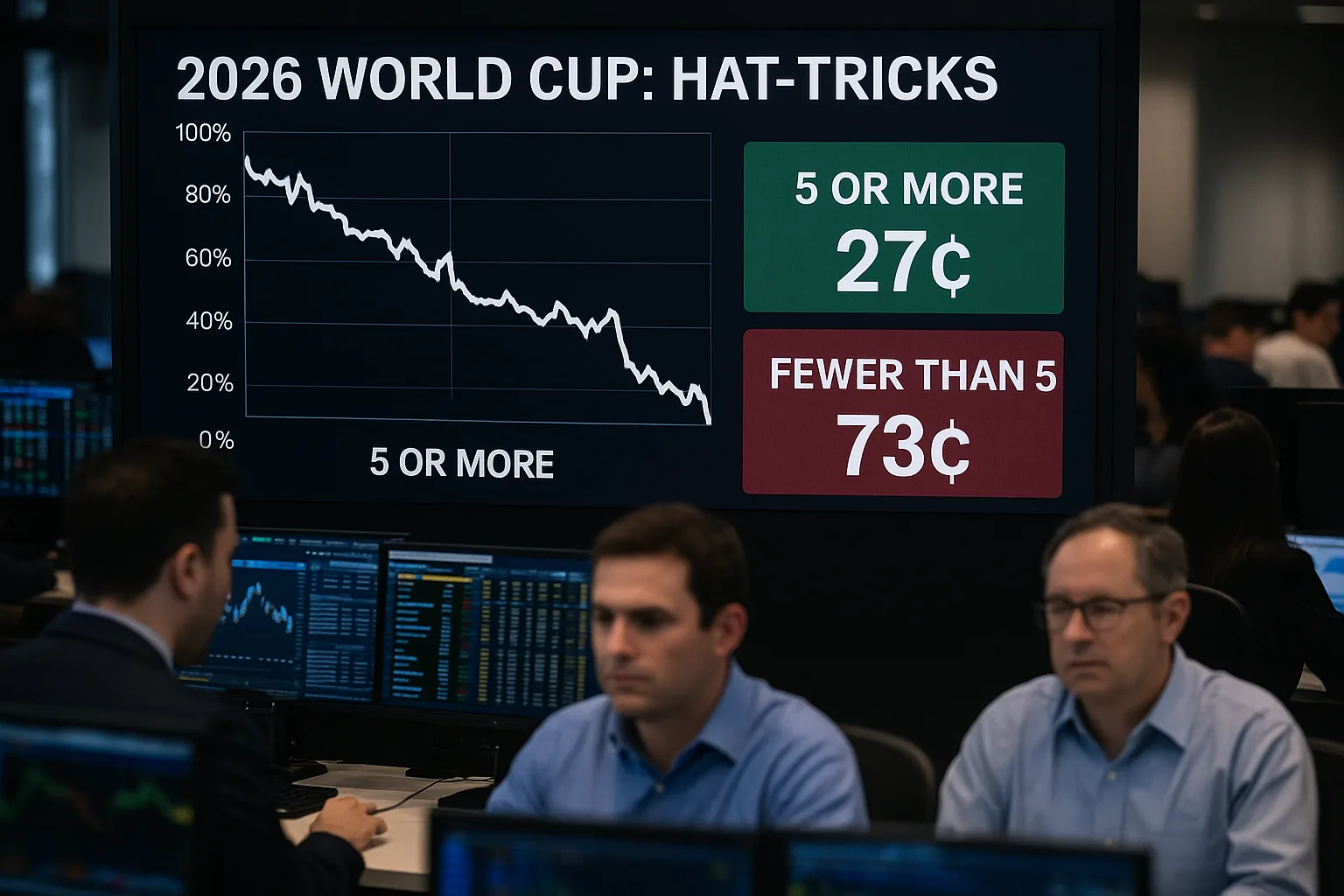
As the 2026 FIFA World Cup group stage progresses, traders in a regulated predictions market are scaling back expectations for a high total of hat-tricks in the tournament. The probability for "5 or more hattricks" has seen a sharp decline, falling 46 percentage points to 17% in the session of Monday, June 24, 2026. The repricing follows the conclusion of another slate of games, with the tournament now having confirmed two hat-tricks and the tighter-margin knockout rounds approaching.
The market adjustment reflects a broader cooling of expectations across contracts for higher totals. This suggests that while two hat-tricks have already been scored—one by Argentina's Lionel Messi on June 16 and another by Canada's Jonathan David on June 18—traders are pricing in a lower frequency of such events for the remainder of the World Cup. The "2+ hattricks" contract is priced at 98%, reflecting the near-certainty of the current tally, while odds for three or four hat-tricks also saw modest declines.
Distribution Analysis
The market shows a clear downward shift in expectations for outcomes beyond three total hat-tricks. The most significant move occurred in the "5+ hattricks" contract, though on relatively low volume, while other higher-end contracts also edged lower.
| Outcome | Current Prob | Change | Volume |
|---|---|---|---|
| 2+ hattricks | 98% | ~0.0pp | 1,358 |
| 3+ hattricks | 64% | -1.0pp | 210 |
| 4+ hattricks | 55% | -4.0pp | 443 |
| 5+ hattricks | 17% | -46.0pp | 31 |
Net: 3 of 4 eligible contracts declined on 684 total trades, shifting the implied consensus toward a lower final tally of total hat-tricks.
What's Driving the Shift
The repricing appears to be driven by the tournament's natural progression and historical patterns of goal-scoring.
Shrinking Calendar: With a significant portion of the group stage now complete, the number of remaining matches is shrinking. The group stage, which often features mismatches between top-seeded teams and lower-ranked opponents, historically provides the most fertile ground for high-scoring games and hat-tricks. As the tournament advances, the window of opportunity for such events narrows.
Knockout Round Dynamics: The market shift coincides with several teams clinching spots in the Round of 32. Knockout stage matches are typically more defensive and feature more evenly matched opponents, leading to tighter scorelines. The historical record of World Cup hat-tricks shows that while they can occur in knockout games, the frequency is lower than in lopsided group-stage encounters.
Early Flurry Priced In: The tournament's first two hat-tricks occurred early in the group stage. Traders have now fully priced in those events, with the "2+ hattricks" contract trading near its maximum value. The current market activity is focused solely on forecasting the number of additional hat-tricks, and the consensus is that the early pace is unlikely to be sustained.
Market Context
The current market pricing suggests an expected final tally in the range of 3-4 hat-tricks. This would be a typical result for a modern World Cup. The 2022 and 2018 tournaments each saw two hat-tricks, while the 2014 edition had two as well.
The market has moved decisively away from pricing a scenario similar to the all-time record of eight hat-tricks set at the 1954 World Cup in Switzerland. At the same time, it avoids the opposite extreme of the 2006 World Cup in Germany, which was the only tournament in history with no hat-tricks. The sharp 46-point drop in the "5+" contract occurred on light volume, suggesting the move may have been exacerbated by a thin market, but the overall downward trend across related contracts indicates a consistent directional shift.
What to Watch
Traders will be closely watching the final matches of the group stage for any high-scoring affairs that could produce a third hat-trick and shift probabilities again. The start of the Round of 32 will be a key inflection point, as a hat-trick in the knockout stage would signal the potential for a higher final count than the market currently implies. The market is scheduled to close on July 27, 2026, with the final tournament statistics from FIFA and ESPN serving as the settlement source.
