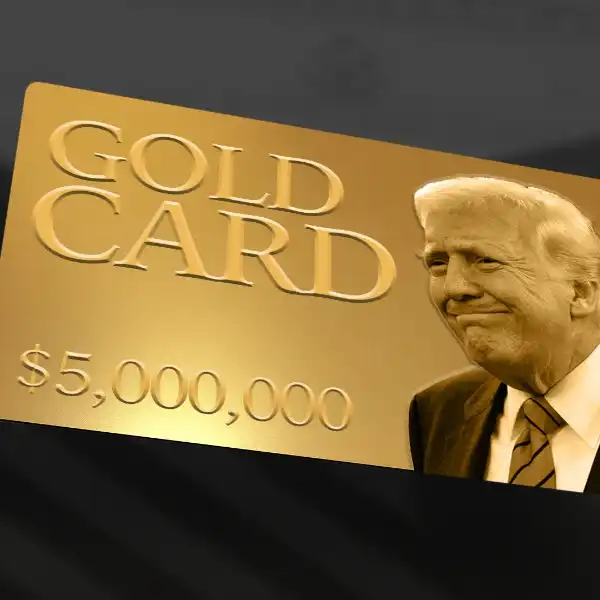
Short Answer

Both the model and the Kalshi market overwhelmingly agree that 0 Gold Cards will be issued before May, with only minor residual uncertainty.

1. Executive Verdict

  • Commerce Secretary Lutnick confirmed one Gold Card visa issued by April 23.
  • Only one Gold Card visa issued by April 23 makes further issuances improbable.
  • The Gold Card program faces high financial requirements and complexity.
  • External legal challenges and political pushback generally impede issuances.
  • Market price dropped 14 points on April 23 following official confirmation.

Who Wins and Why

Outcome Market Model Why
1 to 5 15.0% 21.2% Commerce Secretary Lutnick stated only one Gold Card visa had been granted as of April 23, 2026.
0 76.0% 76.8% Commerce Secretary Howard Lutnick confirmed one Gold Card visa was already issued by April 23, 2026.
Above 1,000 1.0% 0.3% Commerce Secretary Lutnick confirmed only one Gold Card visa had been issued by April 23, 2026.
6 to 99 3.0% 1.4% Commerce Secretary Lutnick confirmed only one Gold Card visa had been issued by April 23, 2026.
100 to 499 0.3% 0.1% Commerce Secretary Lutnick confirmed only one Gold Card visa had been issued by April 23, 2026.

2. Market Behavior & Price Dynamics

Historical Price (Probability)

Outcome probability
Date
This market has demonstrated a general downward trend since its inception. It opened with a high probability of 90.4%, peaked at 98.5%, but has since declined to its current price of 82.0%. The most significant price movement was a sharp 14.0 percentage point drop on April 23, 2026, when the perceived probability fell from 95.0% to 81.0%. The cause for this sudden re-evaluation is not apparent from the provided context, as no specific news or developments were noted. This drop occurred on a notable increase in trading volume, suggesting that the move was backed by significant market conviction rather than being a low-liquidity anomaly.
The chart indicates a shift in market sentiment over time. While traders initially assigned a near-certain probability to the outcome, confidence has waned, culminating in the recent sharp decline. The price history suggests a resistance level near the high of 98.5%, which the market was unable to sustain. The recent price action has established a new area of interest in the low 80s, which could become a new support or consolidation range. The overall high volume of over 118,000 contracts traded throughout the market's life indicates sustained interest, but the recent price action points toward growing doubt about a YES resolution.

3. Significant Price Movements

Notable price changes detected in the chart, along with research into what caused each movement.

📉 April 23, 2026: 14.0pp drop

Price decreased from 95.0% to 81.0%

Outcome: 0

What happened: No supporting research available for this anomaly.

4. Market Data

View on Kalshi →

Contract Snapshot

This market resolves to Yes if exactly zero "gold cards" are issued by the federal government before May 1, 2026. A "gold card" signifies legal U.S. residency granted via a new pathway requiring an investment or payment higher than the current EB-5 visa minimum. If one or more such cards are issued, the market resolves to No, with outcomes determined by specified news and government sources, and the market closes by May 1, 2026, or earlier if the event occurs.

Available Contracts

Market options and current pricing

Outcome bucket Yes (price) No (price) Last trade probability
0 $0.80 $0.23 76%
1 to 5 $0.15 $0.86 15%
6 to 99 $0.03 $0.98 3%
Above 1,000 $0.01 $1.00 1%
100 to 499 $0.01 $1.00 0%
500 to 1,000 $0.01 $1.00 0%

Market Discussion

The market currently favors zero Gold Cards being issued by Trump before May 2026, with a 76% probability. However, traders are actively discussing reports, particularly from the Associated Press, that at least one "gold card" has already been issued, leading many to believe the "0 cards" outcome is unlikely. This suggests a potential mispricing in the market, with some predicting a "lock" for those betting on 1-5 cards as official confirmation is awaited.

5. What is the 'Gold Card' immigration program and its financial requirements?

Program FunctionFast-track route to a green card or visa [^], [^]
Proposed Donation$1 million for a fast-track green card [^]
Proposed Waitlist Fee$5 million for waitlist access [^]
The 'Gold Card' is a proposed immigration policy and a fundraising mechanism. It is defined primarily as a proposed immigration policy program, detailed in documents like the "Executive Order: The Gold Card" [^] and other initiatives from The White House [^], [^]. This program aims to establish a fast-track pathway to a green card or visa [^], [^] for individuals identified as possessing "extraordinary ability," which is often understood to mean significant wealth or investment [^], [^]. Its core objective is to streamline the immigration process for high-net-worth individuals [^], [^].
The 'Gold Card' also serves as a fundraising item due to significant financial requirements. Applicants are expected to make a substantial monetary contribution or investment to qualify for the program. Proposed price points vary, with some sources indicating a $1 million donation for a fast-track green card [^]. Other reports mention a $5 million fee to be placed on a waitlist for the program [^]. Consequently, the universe of potential recipients is limited to individuals who can meet these considerable financial thresholds [^], [^], [^].

6. What Was the Initial Sales Volume of Trump's NFTs?

Initial Sales VolumeApproximately $4.4 million - $4.455 million [^]
Number of NFTs in Collection45,000 [^]
Time to Sell OutLess than a day [^]
Donald Trump's first NFT collection sold out rapidly. The "Trump Digital Trading Cards," Donald Trump's initial Series 1 NFT collection, launched in December 2022. This collection comprised 45,000 unique digital collectibles, each initially priced at $99 [^]. The entire series experienced a swift sell-out, reportedly completing in less than a day [^] or within hours of its launch [^].
Initial NFT sales volume reached over $4.4 million. This rapid sale generated a significant total sales volume, estimated between $4.4 million [^] and $4.455 million [^] during its initial launch period. While one source indicated sales surpassed $5 million [^], the lower range aligns more consistently with the reported quantity and price. This substantial sales volume was achieved within the first 30 days of the collection's issuance [^].
Physical "Trump Cards" did not involve direct sales. It is important to distinguish the Series 1 NFT collection from "Trump Cards" circulated between 2021-2023. These physical cards served as incentives for political donations rather than having a direct sales volume comparable to the digital collectibles [^]. Therefore, quantitative sales data primarily pertains to the NFT collection.

7. Why Is Trump Campaign's Q1 2026 Financial Data Unavailable?

Q1 2026 FEC FilingsNot yet available [^]
Q1 2026 Cash-on-HandNot possible to report [^]
Q1 2026 Burn RateNot possible to report [^]
Financial data for the first quarter of 2026 is currently unavailable. Filings that would detail the Trump campaign's financial position, including its cash-on-hand and burn rate for this period, have not been released because the first quarter of 2026 has not yet occurred [^]. The Federal Election Commission (FEC) provides historical financial data through reports such as Forms 3P and 3X for specific past reporting periods [^]. Therefore, it is not possible to ascertain the campaign's financial standing for this future quarter or to assess if a cash crunch might incentivize a high-volume fundraising push [^].
A direct financial comparison to the 2020 cycle is impossible at this time. Due to the lack of available first quarter 2026 financial data, a direct comparison of the Trump campaign's financial position to the same period in the 2020 election cycle cannot be made. While general information regarding the DONALD J. TRUMP FOR PRESIDENT, INC. committee and FEC data trends is publicly accessible [^], specific financial details for a future quarter are not part of current public records.

8. Were There Internal Disputes Over Trump's 'Gold Card' Branding?

Internal Campaign DisagreementsNone documented in available research [^]
RNC Legal ChallengesNone mentioned regarding branding or dilution [^]
External Legal ChallengesMultiple lawsuits filed by various groups [^]
No internal disagreements or RNC legal challenges were documented regarding the 'Gold Card' initiative. Web research from early-to-mid April 2026 does not indicate any internal disputes within the Trump campaign leadership concerning the 'Gold Card' initiative's branding, legality, or potential for brand dilution [^]. Furthermore, the available information does not mention any legal challenges initiated by entities such as the RNC concerning the branding or brand dilution of the program [^].
However, the 'Gold Card' proposal has encountered substantial external scrutiny and legal challenges. Multiple lawsuits were filed by various groups, alleging a lack of transparency and contending that the program constituted an unlawful "pay-to-play" visa scheme [^]. The watchdog group Citizens for Responsibility and Ethics in Washington (CREW) also advocated for Congress to prevent the Commerce Department from using 'Gold Card' funds to bypass spending controls [^]. Additionally, the 'Gold Card' proposal faced pushback during House Judiciary budget talks [^].

9. How Many 'Gold Card' Visas Were Issued By April 2026?

Visas Granted/ApprovedOne 'Gold Card' visa (April 23, 2026 [^])
Investment RequirementStarting at $1 million [^]
Announcement DateApril 23, 2026 [^]
A significant update on the Gold Card program was issued. On or immediately preceding April 23, 2026, statements attributed to Commerce Secretary Howard Lutnick or a White House official revealed that only one "Gold Card" visa had been granted or approved under the program [^]. This disclosure by high-ranking government officials provided a precise and current update on the program's initial rollout and its uptake.
This singular approval indicated a very limited issuance volume. The confirmation of a single issued visa significantly altered the expected issuance volume for the "Gold Card" program as of April 23, 2026, and preceding May 2026. This visa program requires a substantial investment from applicants, beginning at $1 million [^]. The low number of approvals underscored the program's slow initial progression despite its high entry barrier.

10. What Could Change the Odds

Key Catalysts

Catalyst analysis unavailable.

Key Dates & Catalysts

  • Expiration: May 01, 2026
  • Closes: May 01, 2026

11. Decision-Flipping Events

  • Trigger: Catalyst analysis unavailable.

13. Historical Resolutions

No historical resolution data available for this series.