
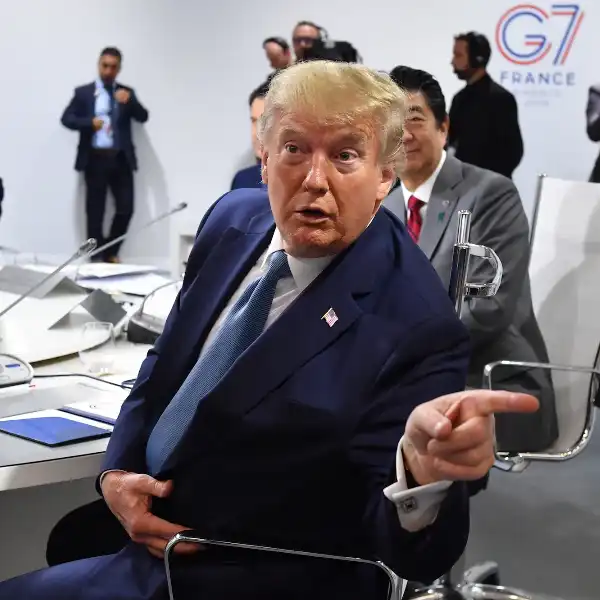
Which G7 leader will leave next?
Short Answer
Both the model and the market expect Keir Starmer to be the G7 leader who leaves next, with no compelling evidence of mispricing.
1. Executive Verdict
- No evidence shows LDP factions demanded Kishida's resignation pre-July 4th.
- Bardella demands an absolute majority for cohabitation with Macron.
- Credit Default Swaps cannot predict government collapse from party defections.
- Rishi Sunak faces a substantially higher risk of early removal.
- Canada's Liberal-NDP confidence-and-supply agreement concluded September 4, 2024.
Who Wins and Why
| Outcome | Market | Model | Why |
|---|---|---|---|
| Keir Starmer | 53.0% | 44.4% | Market higher by 8.6pp |
| Sanae Takaichi | 1.0% | 1.1% | Model higher by 0.1pp |
| Donald Trump | 6.0% | 6.4% | Model higher by 0.4pp |
| Emmanuel Macron | 44.0% | 37.6% | Market higher by 6.4pp |
| Mark Carney | 1.0% | 1.1% | Model higher by 0.1pp |
2. Market Behavior & Price Dynamics
Historical Price (Probability)
Outcome probability
Date
This market has demonstrated a sideways trend with very low volatility since its inception. The price has been confined to a narrow range between 1.0% and 5.0%. Starting at 2.0%, the contract's probability has since settled at 1.0%, which appears to be acting as a support level for the market. The peak price of 5.0% represents the highest probability the market has assigned to this outcome, serving as a resistance point that was not sustained. Given the lack of specific news or events in the provided context, these minor fluctuations within the range cannot be attributed to any particular catalyst and likely reflect speculative trading rather than reactions to new information.
The trading volume provides further insight into market sentiment. With a total of only 270 contracts traded over the market's history, participation is extremely low. The pattern of limited initial volume followed by periods of zero activity, as shown in the sample data, suggests a lack of strong conviction or interest from traders. This low liquidity indicates that the price could be moved by relatively small trades, but the persistent sideways movement shows a general consensus has been reached, at least for now.
Overall, the price action suggests that market participants believe this outcome has a very low and stable probability. The current price at the 1.0% floor, combined with the low volume and lack of a clear upward trend, indicates a strong market sentiment that this specific G7 leader is not perceived as the most likely to leave office next. The market appears to be in a holding pattern, awaiting new information that might shift this low-probability assessment.
3. Significant Price Movements
Notable price changes detected in the chart, along with research into what caused each movement.
📈 April 13, 2026: 9.0pp spike
Price increased from 35.0% to 44.0%
Outcome: Emmanuel Macron
What happened: No supporting research available for this anomaly.
4. Market Data
Contract Snapshot
This market resolves to Yes if Keir Starmer, the UK Prime Minister at issuance, is the first G7 leader to leave office; otherwise, it resolves to No. The market opened on October 23, 2025, and closes early if any G7 leader leaves office, or by January 1, 2045. In the event of a leader's death, all markets in the set settle at their last traded prices before death, with the Exchange determining fair value if prices are inconsistent.
Available Contracts
Market options and current pricing
| Outcome bucket | Yes (price) | No (price) | Last trade probability |
|---|---|---|---|
| Keir Starmer | $0.52 | $0.49 | 53% |
| Emmanuel Macron | $0.45 | $0.56 | 44% |
| Giorgia Meloni | $0.08 | $0.97 | 8% |
| Donald Trump | $0.06 | $0.99 | 6% |
| Friedrich Merz | $0.01 | $1.00 | 1% |
| Mark Carney | $0.01 | $1.00 | 1% |
| Sanae Takaichi | $0.05 | $0.99 | 1% |
Market Discussion
Limited public discussion available for this market.
5. Did LDP Factions Demand Kishida's Resignation Pre-July 4th?
| Pressure on Kishida | Mounting pressure to forgo seeking re-election (pre-July 4th) [^] |
|---|---|
| LDP Leadership Stance | No open calls for Kishida's resignation from LDP leadership (mid-June 2024) [^] |
| Factional Disagreements | Rift over political reforms and fund regulation between Kishida, Motegi, and Aso [^] |
No direct evidence shows LDP factions demanded Kishida's resignation before July 4th. While Prime Minister Fumio Kishida faced considerable pressure and a growing divide within the Liberal Democratic Party (LDP) prior to the UK's July 4th election, available research does not detail specific private discussions where the LDP's Aso and Motegi factions explicitly demanded his resignation by that date to preempt further damage from the ongoing fundraising scandal. Reports before July 4th did indicate mounting pressure on Kishida within the LDP to forgo re-election, with discontent spreading even among his supporters [^]. Despite this general discontent, including calls from local LDP chapters for Kishida to step down, there were "no open calls from within the LDP leadership for Kishida to resign" as of mid-June 2024 [^].
Disagreements primarily centered on political reforms and fund regulation, rather than a resignation demand. Instead, a rift emerged within the LDP leadership, with LDP Secretary-General Toshimitsu Motegi and Vice President Taro Aso reportedly dissatisfied with compromises on political reforms and fund regulation [^]. These disagreements between Kishida, Motegi, and Aso over revising the political funds control law were seen as potentially undermining both the party and the prime minister’s leadership [^]. Therefore, while dissatisfaction among key allies and general pressure for change were present, the sources do not confirm private discussions by the Aso and Motegi factions explicitly demanding Kishida's resignation before the UK's July 4th election as a pre-emptive measure for the fundraising scandal.
6. What are Jordan Bardella's demands for cohabitation with Macron?
| Absolute Majority Condition | Required to govern effectively and for Bardella to become Prime Minister [^] |
|---|---|
| Key Policy Control | Demands control over finances, security, foreign, and defense policy [^] |
| Ukraine Stance | Refuses to send long-range missiles or French troops to Ukraine [^] |
Jordan Bardella has established an absolute majority as a non-negotiable condition for governance. The leader of the National Rally has explicitly stated he will decline the role of Prime Minister or the formation of a government without securing an absolute majority in the National Assembly following the elections [^]. He contends that a relative majority would impede effective action, declaring, "To act, we need an absolute majority. An absolute majority will allow us to govern. If tomorrow the French give us a relative majority, we will not be able to act" [^]. This demand presents a direct challenge to forming a stable government in a hung parliament scenario, potentially leading to political paralysis if an absolute majority is not achieved.
Beyond numerical strength, Bardella insists on controlling key government portfolios. He seeks authority over critical domains such as finances, security, and notably, foreign and defense policy [^]. Bardella has publicly affirmed that he would not function as a mere implementer of the President's agenda, stating, "If the president of the republic considers that he is the one who sets the course and I am the one who executes it, then the French will not be able to count on me" [^]. Regarding Ukraine, while acknowledging that France would not "directly call into question the commitments made by France on the international level" concerning overall support, Bardella stated he would refuse to deploy long-range missiles or French troops. His aim is to prevent an escalation of the conflict, as he maintains that Russia poses no "existential threat" to France [^]. Such fundamental disagreements on critical foreign policy matters, especially combined with Bardella's demand for control over foreign policy, could render cohabitation untenable and potentially trigger a resignation crisis [^].
7. Can CDS Data Predict Government Collapse from Party Defections?
| Italy 5-year CDS | 62.72 points (May 17, 2024) [^] |
|---|---|
| Germany 5-year CDS | 14.12 points (May 17, 2024) [^] |
| Italy Bond Spread over Germany | Below 100 basis points (early 2024) [^] |
Credit Default Swaps do not quantify government collapse probability from defections. It is not possible to derive a precise probability of a "government collapse scenario" before October 2024, specifically linked to party defections, directly from Credit Default Swaps (CDS) data [^]. CDS primarily reflect the market's perception of a sovereign's risk of defaulting on its debt, rather than the probability of specific political events like coalition breakdowns. However, the current CDS levels indicate the relative perceived financial stability of both governments. As of May 17, 2024, Italy's 5-year CDS stood at 62.72 points, while Germany's 5-year CDS were significantly lower at 14.12 points on the same date [^].
Market indicators show improved sovereign risk perception for both nations. Recent trends show Italy's default risk is at its lowest since 2011, and its bond spread over Germany dropped below 100 basis points in early 2024, reflecting improved market sentiment towards Italian debt [^]. Similarly, Germany's 10-year swap spread reached a 20-year low in late 2024, signaling robust market confidence in its sovereign stability [^]. Regarding specific party defection risks, available information indicates Italy's Prime Minister Meloni's coalition faces "risks and challenges" and Matteo Salvini's Lega party leader is weakened [^]. However, the sources do not provide quantifiable probabilities of defection or a direct link to CDS movements. Overall, while CDS offer an indication of perceived sovereign credit risk, they do not directly assess specific coalition stability issues, though current financial market indicators generally point to reduced perceived sovereign risk for both nations in the immediate term [^].
8. Who Has a Higher Risk of Early Removal: Sunak or Biden?
| Rishi Sunak No-Confidence Risk | 27% probability before next general election [^] |
|---|---|
| Joe Biden 25th Amendment Risk | 4% probability before 2024 election [^] |
| Sunak vs. Biden Risk Comparison | Sunak's risk is >6x higher than Biden's [^] |
Based on current prediction market data, UK Prime Minister Rishi Sunak faces a substantially higher quantifiable risk of early removal from office before his scheduled July 4 election departure. Prediction markets currently indicate a 27% probability that he will face a Conservative Vote of No Confidence before the next general election [^]. Related betting odds further suggest he is odds-on to be replaced as Tory leader this year [^].
Conversely, US prediction market data suggests President Joe Biden faces a considerably lower quantifiable risk of premature departure before his scheduled January 20 exit. This is evidenced by a 4% probability of him being removed from office via the 25th Amendment before the 2024 election [^]. Therefore, considering these specific mechanisms—a Vote of No Confidence for Sunak versus the 25th Amendment for Biden—Rishi Sunak's probability of facing a no-confidence vote (27%) is more than six times higher than the probability of Biden being removed via the 25th Amendment (4%) [^].
9. When Did Canada's Liberal-NDP Agreement Conclude?
| Agreement End Date | September 4, 2024 [^] |
|---|---|
| Involved Parties | Liberal Party and New Democratic Party (NDP) [^] |
| Agreement Status | No longer active; NDP withdrew support [^] |
The Liberal-NDP confidence-and-supply agreement officially concluded September 4, 2024. The confidence-and-supply agreement between Canada's Liberal Party and the New Democratic Party (NDP) officially concluded on September 4, 2024 [^]. This termination marked the NDP's withdrawal of support, effectively ending the arrangement that had previously bolstered Justin Trudeau's minority government [^].
No specific legislative votes serve as triggers after the agreement's end. As a direct result of the agreement's conclusion in September 2024, there are no specific upcoming legislative votes that NDP leader Jagmeet Singh could designate as triggers for withdrawing support or collapsing the government under the framework of that particular agreement. The provided research confirms the dissolution of the agreement but does not identify any specific legislation, such as budget bills or pharmacare, as the direct cause for its conclusion [^].
10. What Could Change the Odds
Key Catalysts
Catalyst analysis unavailable.
Key Dates & Catalysts
- Expiration: January 01, 2045
- Closes: January 01, 2045
11. Decision-Flipping Events
- Trigger: Catalyst analysis unavailable.
13. Historical Resolutions
No historical resolution data available for this series.
