Short Answer

Both the model and the market expect Mamdani will freeze the rent in 2026, with no compelling evidence of mispricing.

1. Executive Verdict

  • Landlord operating and maintenance costs may influence the RGB decision.
  • Historical patterns do not support simultaneous freezes for both lease terms.
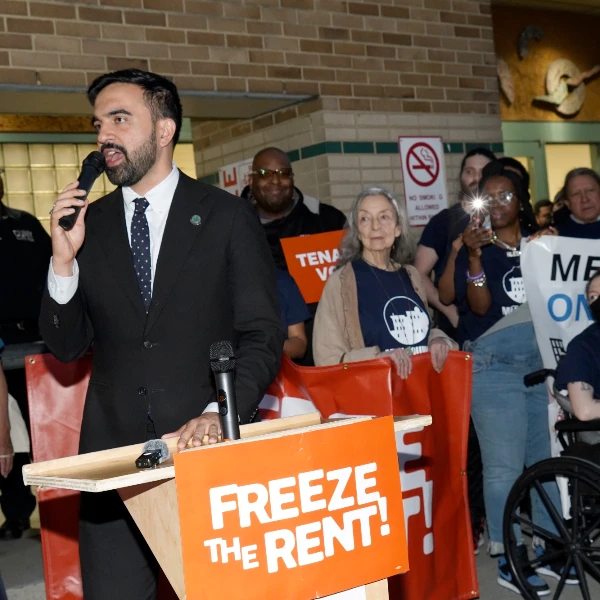
  • Mayor Adams opposed a rent freeze; Mamdani advocated for tenant relief.
  • RGB's 2026 reports indicate rising landlord operating costs.
  • The RGB's preliminary May 2026 vote included a 0% rent option.

Who Wins and Why

Outcome Market Model Why
In 2026 77.2% 67.7% Political pressures suggest Mamdani may freeze rents in 2026.

Current Context

The 2026 rent freeze remains conditional, pending a final vote in June. As of May 8, 2026, a rent freeze for New York City rent-stabilized apartments is still possible but not guaranteed. The decisive step for the 2026 rent adjustments will be the NYC Rent Guidelines Board’s final vote on June 25, 2026 [^][^]. A preliminary vote on May 7, 2026, considered 0% within the proposed ranges, specifically 0%2% for one-year leases and 0%4% for two-year leases [^][^][^].
Prediction markets specifically define a rent freeze for settlement purposes. Markets with a resolution date of December 31, 2026, narrowly define a "YES" outcome as 0.0% rent adjustments effective for both one-year and two-year renewal leases for rent-stabilized apartments citywide by 11:59 PM ET on that date, otherwise settling as "NO" [^]. At least one market commentary reported "YES" priced around 32 cents, indicating an implied probability of approximately 31.5% [^]. The "NO" outcome was priced around 69 cents, suggesting an implied probability of about 68.5%, which reflects skepticism that a full rent freeze will occur within the 2026 deadline [^].

2. Market Behavior & Price Dynamics

Historical Price (Probability)

Outcome probability
Date
This prediction market shows a distinct downward trend, with the probability of a rent freeze in 2026 declining from a high of 87.0% to its current price of 77.2%. The most significant price drop occurred between late April and early May. The market, which started with high confidence at 86.0% on April 24, fell to 77.2% by May 8. This decrease in perceived probability appears directly linked to the NYC Rent Guidelines Board's preliminary vote on May 7. While the vote kept a 0% freeze on the table, it also introduced potential rent increases of up to 2% for one-year leases and 4% for two-year leases. This introduction of uncertainty, confirming that a freeze was not guaranteed, seems to have caused traders to reassess the likelihood of a freeze, leading to the price decline.
The market has established a clear trading range, with resistance near the starting price of 86-87% and a support level around 75.0%. Trading volume, initially low, increased significantly around the time of the price drop in early May, suggesting that the move lower was accompanied by strong market conviction. The current price of 77.2% is hovering just above the support level. Overall, the price action indicates a shift in market sentiment from strong certainty to cautious optimism. While the market still favors a rent freeze as the most probable outcome, the nearly 10-point drop reflects a growing acknowledgment among traders that a small rent increase is a distinct possibility pending the final vote in June.

3. Market Data

View on Kalshi →

Contract Snapshot

The market resolves to YES if the NYC Rent Guidelines Board (RGB) sets a 0% rent increase or any decrease for one-year, two-year, or both lease types for rent-stabilized apartments with leases commencing between October 1, 2026, and September 30, 2027. It resolves to NO if the RGB votes only positive percentages for both lease types, if they cannot meet or vote due to lack of quorum, or if the rent stabilization system is abolished or suspended; indexation to inflation is considered a rent increase and would not qualify as a freeze. The market opens November 5, 2025, and closes early upon the RGB's final official vote (not preliminary), or by December 31, 2026, with payouts projected 30 minutes after closing, verified by the NYC Rent Guidelines Board.

Available Contracts

Market options and current pricing

Outcome bucket Yes (price) No (price) Last trade probability
In 2026 $0.77 $0.23 77%

Market Discussion

Traders are discussing the likelihood of a 2026 rent freeze, with the "Yes" side citing a recent preliminary NYC Rent Guidelines Board vote that suggested a 0%-2% increase for one-year leases, meeting the freeze criteria. Arguments for "No" highlight political challenges for Mamdani, including a scandal involving an appointee and perceived fiscal defeats that suggest he may not deliver on campaign promises for a freeze. Despite these "No" arguments, the market price heavily favors "Yes" at 77.3%, indicating traders are primarily influenced by the preliminary RGB vote.

4. What key economic indicators, presented before the June 25 final vote, are most likely to influence the Rent Guidelines Board's decision on a full 2026 rent freeze?

Rent-stabilized apartment revenue increaseMore than 6% last year [^]
Landlord net operating income increase30% over the past three years [^]
Median asking rent NYC early 2026$3,616 (6.2% increase from previous year) [^]
The Rent Guidelines Board (RGB) decision hinges on the real estate industry's economic condition, including landlords' operating and maintenance costs, and the cost of living for New York City residents [^] [^] [^] [^] . Operating costs scrutinized include real estate taxes, sewer and water rates, insurance, governmental fees, fuel, and labor [^][^][^][^]. Small property owners voice concerns that a rent freeze would ignore these increasing financial burdens [^][^][^][^]. However, buildings with rent-stabilized apartments experienced over 6% revenue growth last year [^], and landlords' net operating income increased by 30% over the past three years [^]. New initiatives, such as a city-backed insurance program, could also reduce landlords' premiums by 20-30% [^].
Tenant affordability, rising rents, and market dynamics are critical factors. The board thoroughly reviews current and projected cost of living data for New York City residents, alongside broader information on tenant affordability and financial pressures [^][^]. Over half of the city's renters are considered rent-burdened, allocating 30% or more of their income to rent [^]. The median asking rent in NYC reached $3,616 in early 2026, marking a 6.2% increase from the previous year [^]. Tenant advocates argue that their economic data provides justification for a rent freeze [^]. Furthermore, the RGB analyzes the overall availability of housing accommodations and current vacancy rates to understand market dynamics [^].

5. What historical precedents and voting patterns support the market's skepticism that the Rent Guidelines Board will freeze rents for *both* one- and two-year leases in 2026?

One-year lease freezes2015 and 2016 (not consistent for both terms) [^][^]
Preliminary 2026 vote range (one-year)0–2% [^]
Preliminary 2026 vote range (two-year)0–4% [^]
Historical patterns do not support a simultaneous freeze for both lease terms. While the Rent Guidelines Board (RGB) has implemented rent freezes for one-year leases in the past, specifically in 2015 and 2016, there is no consistent precedent for freezing both one- and two-year leases concurrently [^][^]. During non-freeze periods, the RGB typically establishes positive guideline increases for both lease terms. For example, the 2024/2025 guidance tables published by the RGB show distinct positive values for both one-year and two-year lease durations, rather than a uniform 0% [^][^].
Preliminary 2026 votes indicate potential for positive rent adjustments. Further reinforcing skepticism regarding a complete freeze, the RGB's preliminary vote in May 2026 for leases effective between October 1, 2026, and September 30, 2027, established non-binding ranges that allow for increases: 0–2% for one-year leases and 0–4% for two-year leases [^][^]. The Board's established decision-making process, which includes initial preliminary ranges followed by final hearings and votes, is structured such that the ultimate decision can diverge from initial proposals if economic conditions or public input support non-zero rent adjustments [^][^][^].

6. How do the public positions of Mayor Eric Adams and Zohran Mamdani on the 2026 rent guidelines differ regarding the balance between tenant relief and landlord costs?

Mamdani's RGB AppointmentsMajority of tenant-friendly members appointed in February 2026 [^][^][^][^]
Adams-era Rent Increase3% for one-year leases and 4.5% for two-year leases in 2025 [^]
Preliminary Rent Freeze VoteIncluded a 0% increase option for one-year leases [^][^][^][^][^][^]
Mayor Adams opposed a rent freeze, while Mamdani advocated for tenant relief. Mayor Eric Adams consistently opposed a rent freeze, viewing it as detrimental to property maintenance and tenant safety. He emphasized the Rent Guidelines Board's (RGB) role in balancing tenant protection with ensuring landlords could maintain buildings amid rising costs, aligning with landlord groups [^][^][^][^][^][^][^][^][^][^][^][^]. Under his leadership, the RGB approved rent increases multiple times, including 3% for one-year leases and 4.5% for two-year leases in 2025 [^]. In contrast, Mayor Zohran Mamdani campaigned on and has taken steps toward implementing a rent freeze to provide "real relief" for tenants and address the "affordability crisis" [^][^][^][^][^][^][^][^][^].
Mamdani's appointments and RGB vote signal a probable rent freeze. Upon taking office, Mamdani appointed a majority of tenant-friendly members to the RGB in February 2026, thereby securing the votes needed for a potential rent freeze [^][^][^][^]. A preliminary vote by the RGB, under Mamdani's influence, included a 0% increase option for one-year leases, signaling a strong possibility for a rent freeze [^][^][^][^][^][^]. Landlord organizations argue that a rent freeze would disregard increasing financial burdens, citing that the Price Index of Operating Costs increased by 5.3% this year, while the net operating income for landlords rose by 6.2% between 2023 and 2024 [^][^][^][^][^].
A 2026 rent freeze for stabilized apartments is highly probable. Based on Mamdani's campaign promises, his strategic appointments to the RGB, and the preliminary vote, it is highly probable that Mamdani will achieve a rent freeze for rent-stabilized apartments in 2026 [^][^][^][^][^][^][^][^][^][^]. The final decision by the RGB is scheduled for June 25, 2026 [^][^][^][^][^][^].

7. What is the official release schedule for the Rent Guidelines Board's 2026 research reports, and what do they indicate about landlord operating costs?

Rent-stabilized building cost increase5.3% [^]
Net Operating Income (NOI) increase6.2% [^][^]
Landlord operating cost increase4.2% [^][^]
The Rent Guidelines Board (RGB) released its 2026 research reports, indicating a rise in landlord operating costs. The 2026 Income & Expense Study was published on March 26, 2026, followed by the 2026 Price Index of Operating Costs (PIOC) on April 9, 2026 [^][^]. Collectively, these reports revealed that while landlord operating costs were increasing, their rate of growth varied when compared to net operating income.
The PIOC detailed specific increases in operating costs for landlords. Costs for buildings containing rent-stabilized apartments notably rose by 5.3%, with the "Core" PIOC experiencing a 4.8% increase [^]. Furthermore, the report projected a continued upward trend, estimating a 4.1% rise in the PIOC for the subsequent year [^].
Net operating income grew faster than overall landlord operating costs during this period. The 2026 Income & Expense Study showed a 6.2% increase in net operating income (NOI), while overall operating costs for landlords grew at a slower rate of 4.2% [^][^]. This indicates that landlords' operating expenses were indeed rising, but their rate of increase was less than the growth in net operating income for the same timeframe [^][^].

8. How do the proposed 2026 rent adjustment ranges (0%-4%) compare to the final approved percentages in the last five Rent Guidelines Board votes?

Proposed 2026 one-year lease adjustment0-2% (proposed) [^]
Proposed 2026 two-year lease adjustment0-4% (proposed) [^]
Chance of 0% approval before 2027Approximately 33% [^][^]
The 2026 proposed rent adjustment ranges include a notable zero-percent option. These proposed ranges are 0-2% for one-year leases and 0-4% for two-year leases, with the final vote scheduled for June 25, 2026 [^]. The potential for a zero-percent increase distinguishes these proposals from the final approved percentages in the last five Rent Guidelines Board votes, which did not include a zero-percent option for either lease term [^].
One-year lease proposals for 2026 are generally lower than recent approvals. The 0-2% proposed 2026 range for one-year leases [^] is comparatively lower than or overlaps with past final approved percentages. For example, previous increases were 3% in 2025-26 [^][^], 2.75% in 2024-25 [^], 3% in 2023-24 [^], 3.25% in 2022-23 [^], and a phased total of 1.5% in 2021-22 [^].
Two-year lease proposals are also generally lower or overlapping with past rates. The 0-4% proposed 2026 range for two-year leases [^] likewise falls below or aligns with previous final approved percentages. Historically, approvals included 4.5% in 2025-26 [^][^], 5.25% in 2024-25 [^], 2.75% in the first year and 3.2% in the second year for 2023-24 [^], 5% in 2022-23 [^], and 2.5% in 2021-22 [^]. Prediction markets currently estimate approximately a 33% chance that a 0% approval will occur before 2027 [^][^].

9. What Could Change the Odds

Key Catalysts

The NYC Rent Guidelines Board (RGB) conducted a preliminary vote on May 7–8, 2026, under Mayor Zohran Mamdani, setting possible rent increases at 0%–2% for one-year leases and 0%–4% for two-year leases [^] [^] [^] . However, prediction markets define a "freeze" as requiring 0.0% rent adjustments for both one-year and two-year renewal leases for rent-stabilized apartments citywide by December 31, 2026 [^][^][^]. This definition specifies that announced intentions do not count and implementation timing matters [^][^][^].
The preliminary vote explicitly did not set final rents, as the final vote must occur by June 25 [^] [^] [^] . The Rent Guidelines Board's "Public Meeting (Final Vote)" is scheduled for Thursday, June 25, 2026 at 7:00 PM, with doors opening at 6:00 PM [^]. Following the preliminary vote, the Board holds public hearings across the five boroughs before making its final decision on June 25, aligning the catalyst window with late June rather than early May [^].

Key Dates & Catalysts

  • Expiration: January 01, 2027
  • Closes: January 01, 2027

10. Decision-Flipping Events

  • Trigger: The NYC Rent Guidelines Board (RGB) conducted a preliminary vote on May 7–8, 2026, under Mayor Zohran Mamdani, setting possible rent increases at 0%2% for one-year leases and 0%4% for two-year leases [^] [^] [^] .
  • Trigger: However, prediction markets define a "freeze" as requiring 0.0% rent adjustments for both one-year and two-year renewal leases for rent-stabilized apartments citywide by December 31, 2026 [^] [^] [^] .
  • Trigger: This definition specifies that announced intentions do not count and implementation timing matters [^] [^] [^] .
  • Trigger: The preliminary vote explicitly did not set final rents, as the final vote must occur by June 25 [^] [^] [^] .

12. Historical Resolutions

No historical resolution data available for this series.