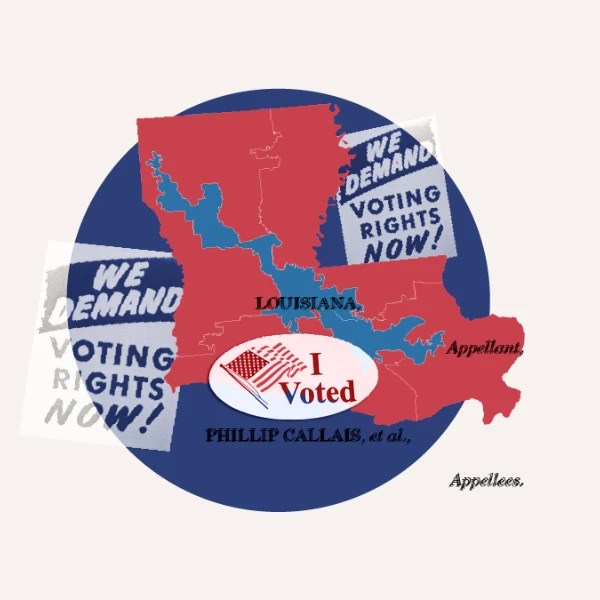
Short Answer

The model assigns meaningfully lower odds than the market for 3 justices voting for reversal (46.6% vs 58.0%), driven by its higher assessment of a five-justice reversal (17.2% model vs 5.0% market).

1. Executive Verdict

  • Three liberal justices will vote to reverse, upholding VRA Section 2.
  • Thomas, Alito, Gorsuch likely vote against reversal in this case.
  • Roberts and Kavanaugh previously joined liberals in VRA Section 2 cases.
  • Louisiana v. Callais concerns Voting Rights Act Section 2 only.
  • An outcome of 0-2 votes for reversal is virtually impossible.

Who Wins and Why

Outcome Market Model Why
6 8.0% 10.4% Six votes for reversal would require an additional conservative justice joining the pro-VRA bloc.
3 58.0% 46.6% Three votes for reversal would only include the liberal justices, without support from Roberts or Kavanaugh.
5 5.0% 17.2% Five votes for reversal are expected from the liberal bloc, Chief Justice Roberts, and Justice Kavanaugh.
4 18.0% 20.7% Four votes for reversal imply a split between Chief Justice Roberts and Justice Kavanaugh on VRA enforcement.
9 7.3% 1.0% All nine justices voting for reversal contradicts known anti-reversal stances on VRA Section 2.

2. Market Behavior & Price Dynamics

Historical Price (Probability)

Outcome probability
Date
This market is pricing the probability of the number of Supreme Court justices who will vote for reversal in the case of Louisiana v. Callais. The price action has been confined to a very narrow sideways channel, trading between a 4.0% and 6.0% probability. The market opened at 4.0% and remained there for a period before experiencing a single, distinct upward movement to its current price of 6.0%. This jump represents the only significant price activity in the chart's history. Given the lack of specific news or developments provided, the direct cause for this modest increase in perceived probability is not apparent from the available context.
The trading volume provides some insight into market conviction. The price jump from 4.0% to 6.0% was accompanied by a significant surge in volume, with 305 contracts traded on that day, which constitutes the majority of the total 471 contracts traded in the market's lifetime. This suggests the move was backed by a notable level of conviction from traders. The 4.0% level has acted as a clear support floor since the market's inception, while the current price of 6.0% represents the peak and current resistance.
Overall, market sentiment suggests that a reversal is considered a very low-probability event. While the price has increased from its opening low, the absolute probability remains in the single digits. The chart indicates a slight uptick in the market's belief that a reversal could happen, but the overwhelming consensus is that it is highly unlikely.

3. Significant Price Movements

Notable price changes detected in the chart, along with research into what caused each movement.

Outcome: 4

📈 April 28, 2026: 11.0pp spike

Price increased from 7.0% to 18.0%

What happened: No supporting research available for this anomaly.

📉 April 26, 2026: 13.0pp drop

Price decreased from 20.0% to 7.0%

What happened: No supporting research available for this anomaly.

Outcome: 3

📈 April 23, 2026: 12.0pp spike

Price increased from 43.0% to 55.0%

What happened: No supporting research available for this anomaly.

📉 April 22, 2026: 13.0pp drop

Price decreased from 56.0% to 43.0%

What happened: No supporting research available for this anomaly.

4. Market Data

View on Kalshi →

Contract Snapshot

For each specific contract, a 'Yes' resolution is triggered if the exact number of justices specified vote in favor of the petitioner in Louisiana v. Callais, and 'No' otherwise; a dismissal or conclusion without a final merits judgment results in 0 votes for the petitioner. A justice's vote counts only if their position in the Supreme Court's final action supports granting some or all relief requested by the petitioner, who is defined as the appellant-side seeking reversal of the district court judgment. The market opened on December 4, 2025, and closes either upon the outcome or by August 1, 2026, with payouts projected 30 minutes after closing.

Available Contracts

Market options and current pricing

Outcome bucket Yes (price) No (price) Last trade probability
3 $0.58 $0.43 58%
4 $0.20 $0.84 18%
6 $0.08 $0.93 8%
9 $0.08 $1.00 7%
0 $0.12 $1.00 6%
7 $0.07 $1.00 6%
5 $0.10 $0.95 5%
1 $0.06 $1.00 1%
2 $0.05 $1.00 1%
8 $0.06 $1.00 1%

Market Discussion

The market discussion primarily clarifies that the "petitioner" refers to the appellant-side seeking reversal of the district court's judgment striking down Senate Bill 8, which means Louisiana. Traders debated the potential outcome based on ideological alignment, with one suggesting "the left will win" (implying fewer votes for reversal) and another disputing this. Despite the limited explicit arguments for specific numbers, the market shows a strong consensus, with 58% probability for exactly 3 justices voting for reversal, and 18% for 4 justices.

5. Do Rahimi's Second Amendment Tests Apply to Louisiana v. Callais?

Louisiana v. Callais FocusVoting rights and congressional redistricting [^]
United States v. Rahimi FocusSecond Amendment and firearm possession [^]
Applicability of Rahimi FrameworkNot applicable to Louisiana v. Callais [^]
Louisiana v. Callais addresses voting rights and redistricting challenges. This Supreme Court case, identified by docket numbers 24-109 and 24-110, focuses on Louisiana's congressional district map and the creation of majority-Black districts. The legal arguments involved are rooted in the Voting Rights Act and the Fourteenth and Fifteenth Amendments, specifically addressing issues like electoral districting and racial vote dilution [^].
United States v. Rahimi involves a different Second Amendment legal framework. Conversely, United States v. Rahimi (docket number 22-915) was a Second Amendment case that examined the constitutionality of a federal law prohibiting individuals under domestic violence restraining orders from possessing firearms [^]. The concurring opinions of Justices Gorsuch, Kavanaugh, and Barrett in Rahimi outlined how the Bruen framework applies to identify historical analogues for modern firearm regulations. Given the distinct nature of these cases, the legal arguments and specific tests, such as the "analogue regulation" framework from the Bruen standard discussed in the Rahimi concurring opinions, do not apply to the factual record or the legal questions presented in Louisiana v. Callais. The Callais case is fundamentally a voting rights matter, rendering Rahimi's Second Amendment tests irrelevant to its proceedings [^].

6. Did Justices Roberts, Kavanaugh Question Fifth Circuit's Firearm Ruling Scope?

Chief Justice Roberts' QuestionOn whether Fifth Circuit opinion invalidates all firearm restrictions [1, p [^]. 5] [^]
Justice Kavanaugh's InquirySought examples of non-violent felons who could still be prohibited from firearms [1, p [^]. 24] [^]
Judicial Intent Regarding RulingPreference for narrow reversal upholding specific law [^]
During oral arguments in Louisiana v [^] . Callais, Justices Roberts and Kavanaugh expressed concern about the ruling's broad scope [^]. Chief Justice Roberts specifically questioned whether the Fifth Circuit's decision could "stand for the proposition that all restrictions on who can possess a firearm are unconstitutional?" [1, p [^]. 5] [^]. He further challenged the implications for general felon disarmament laws, asking if the ruling "essentially invalidates all felon dispossession laws in the Fifth Circuit?" for "felons in general" [1, pp [^]. 16-17] [^]. Justice Kavanaugh similarly focused on the scope and limiting principles of the Fifth Circuit's decision [^]. He pressed respondents for examples of "what kind of felon who's committed a non-violent felony would still be able to be prohibited from having a firearm" [1, p [^]. 24] [^]. Kavanaugh also inquired about the opinion's application, asking, "Is it all non-violent felonies, just some [^]? How would we figure out which ones it applies to?" [1, p [^]. 25], emphasizing a search for the "limiting principle of the Fifth Circuit's test" [1, p [^]. 34] [^]. The justices' questioning signals a clear preference for a narrow reversal [^]. Their collective focus on the potential "overbreadth" of the Fifth Circuit's ruling indicates an intent to uphold the specific law in question rather than issue a broader opinion that significantly re-clarifies or expands the Bruen "history and tradition" test for future cases [^]. This suggests a desire to curtail the Fifth Circuit's expansive application, aiming to limit the impact to preserve existing firearm regulations without setting a sweeping new precedent [^].

7. How Could Justice Thomas's Rahimi Dissent Influence Callais?

Rahimi Case FocusSecond Amendment's scope, critiqued by Justice Thomas as an "interest-balancing test disguised as 'history'" [^]
Callais Case FocusInterpretation and application of Section 2 of the Voting Rights Act (VRA) for racial vote dilution [^]
Potential ArgumentDistinguish Rahimi (constitutional right) from Callais (statutory interpretation) to align with Justice Thomas's anti-"interest-balancing" stance [^]
Justice Thomas's Rahimi dissent provides a strict interpretative framework. In United States v. Rahimi, Justice Thomas criticized the majority's "historical tradition" test for Second Amendment cases, labeling it an "interest-balancing test disguised as 'history'" and advocating for strict, textually and historically grounded interpretations of individual constitutional rights [^]. His dissent reflects skepticism towards judicial methods that, in his view, invent constitutional exceptions or weigh competing societal interests over original meaning.
Counsel in Callais can highlight its distinction from Rahimi . Louisiana v. Callais primarily concerns the interpretation and application of Section 2 of the Voting Rights Act (VRA), a federal statute, rather than directly defining an individual constitutional right [^]. The central issue in Callais is whether Louisiana's congressional redistricting map, which now includes a second majority-Black district, complies with the VRA's prohibition against racial vote dilution [^]. For justices prioritizing textualism and judicial restraint, such as Justice Thomas, upholding the lower court's decision in Callais (i.e., voting against reversal) could be presented as a more faithful application of Congress's repeatedly reauthorized intent to prevent vote dilution [^].
Upholding the lower court aligns with Justice Thomas's judicial restraint principles. Extending Justice Thomas's critique of "interest-balancing" from Rahimi, counsel might argue that reversing the lower court in Callais would similarly entail an expansive and less-grounded judicial intervention [^]. Such a reversal would likely require either a narrow reading of VRA Section 2 that arguably overlooks its text and legislative history, or the imposition of novel constitutional limits on Congress's power under the VRA without the clear historical and textual justification Justice Thomas demands for constitutional interpretation [^]. Conversely, counsel could contend that voting against reversal would exemplify judicial restraint, respect Congress's legislative authority regarding the VRA, and avoid creating new constitutional tests or exceptions not strictly tied to original meaning, thereby aligning with the methodological principles articulated in Justice Thomas's Rahimi dissent.

8. What Legal Issues Does Louisiana v. Callais Address?

Case NameLouisiana v [^]. Callais (Docket No [^]. 24-109) [^]
Core Legal IssueSection 2 of the Voting Rights Act, congressional redistricting [^]
Certiorari GrantedJanuary 22, 2024 [^]
Louisiana v. Callais focuses solely on Voting Rights Act redistricting claims. This U.S. Supreme Court case, Docket No. 24-109, centers on Section 2 of the Voting Rights Act and specifically concerns the legality of Louisiana's congressional redistricting map [^]. The Supreme Court granted certiorari for the case on January 22, 2024 [^]. Legal organizations and news outlets, including the Cornell Law School's Legal Information Institute and SCOTUSblog, consistently identify the central issue as whether Louisiana's congressional map violates the VRA [^].
The case explicitly excludes restraining orders, due process, or Second Amendment issues. It is critical to note that Louisiana v. Callais does not involve matters related to restraining orders, procedural due process regarding their issuance, or Second Amendment claims [^]. Consequently, any legal arguments based on procedural due process concerning restraining orders, separate from Second Amendment claims, fall outside the factual scope of Louisiana v. Callais, which is exclusively a voting rights and redistricting matter [^].

9. How Does Roberts Influence Supreme Court Ruling Scope via Assignments?

Roberts' Opinion AssignmentSelf-assigns in ideologically charged cases to control scope [^]
Justice Barrett's ApproachFavors a "narrower approach" in rulings [^]
Impact on Conservative MajorityCan alienate doctrinaire justices seeking broader rulings [^]
Chief Justice Roberts strategically assigns opinions to control scope and uphold institutional standing. In ideologically charged cases like Louisiana v. Callais, where the initial conference vote favors reversal, historical precedent indicates that Chief Justice John Roberts leverages his power to assign the majority opinion to influence the ruling's scope and safeguard the Court's institutional standing [^]. Roberts frequently self-assigns significant majority opinions, allowing him to meticulously craft narrow decisions that avoid sweeping changes and foster consensus, even if tenuous [^]. This method is often utilized to navigate contentious legal landscapes without excessively polarizing the Court or the public, thereby preserving the Court's perceived legitimacy [^].
Justice Barrett is a strong candidate for narrow assignments if Roberts foregoes self-assignment. Given Justice Amy Coney Barrett's judicial philosophy, she presents a strong option for such an assignment if Roberts chooses not to author the opinion himself. While a member of the Court's conservative majority, Justice Barrett is characterized by her preference for a "narrower approach" in her rulings [^]. This aligns directly with Roberts' objective of achieving a conservative outcome that is carefully limited in its reach, rather than issuing a broad, expansive decision that could generate significant dissent or backlash [^].
Narrow opinion assignments risk alienating more doctrinaire conservative justices, impacting the final vote. This assignment strategy, whether Roberts assigns to himself or to a moderate conservative like Barrett, carries the risk of affecting the final vote count by potentially alienating more doctrinaire conservative justices. Although dominant, the Court's conservative majority has shown divisions, particularly regarding the scope and speed of conservative legal victories [^]. Assigning a narrow opinion might frustrate justices who favor a more expansive or originalist interpretation, potentially leading them to concur only in the judgment, write separate concurrences to express broader views, or even dissent on the grounds that the ruling did not go far enough. This internal friction within the conservative bloc could result in a less unified majority than the initial conference vote might suggest [^].

10. What Could Change the Odds

Key Catalysts

Catalyst analysis unavailable.

Key Dates & Catalysts

  • Expiration: August 01, 2026
  • Closes: August 01, 2026

11. Decision-Flipping Events

  • Trigger: Catalyst analysis unavailable.

13. Historical Resolutions

No historical resolution data available for this series.