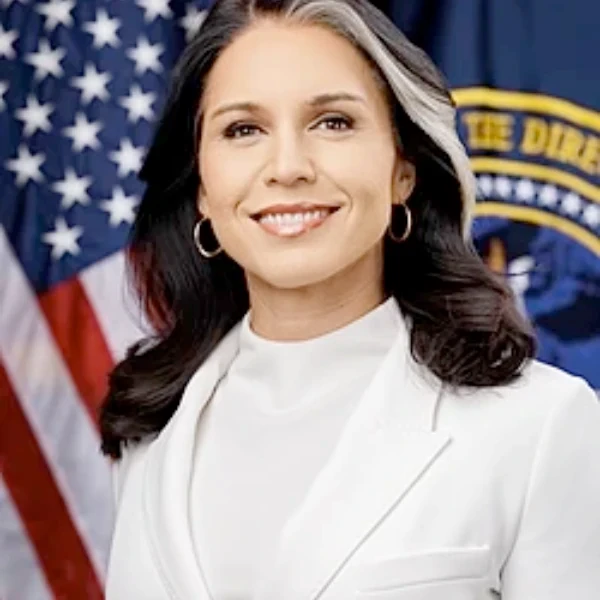
Short Answer

Both the model and the market expect Tulsi Gabbard to announce her departure as Director of National Intelligence before August 1, 2026, with no compelling evidence of mispricing.

1. Executive Verdict

  • Trump reportedly sought Tulsi Gabbard's resignation in March 2026.
  • Advisors were polled on potential replacements for Gabbard.
  • Policy disagreement regarding a March 2026 Iran strike arose.
  • This conflict strongly indicates her departure before January 2027.
  • Recent market activity reflects heightened expectations for her departure.

Who Wins and Why

Outcome Market Model Why
Before May 1, 2026 3.2% 4.8% Model higher by 1.6pp
Before Jun 1, 2026 23.0% 25.8% Model higher by 2.8pp
Before Jul 1, 2026 36.0% 38.5% Model higher by 2.5pp
Before Aug 1, 2026 54.0% 55.4% Model higher by 1.4pp

2. Market Behavior & Price Dynamics

Historical Price (Probability)

Outcome probability
Date
This market's price action indicates a distinct and sustained downward trend. The contract opened with a 10.0% probability, but quickly experienced a significant drop, falling to the low single digits where it has remained. The price has been relatively stable in a narrow range between its all-time low of 1.0% and its current price of 3.2%. The initial high of 15.0% has not been challenged since the market's early days, suggesting a consistent lack of belief in the event occurring.
Without any accompanying news or context, the specific catalyst for the sharp initial decline from 10.0% cannot be identified from the price chart alone. The total volume of 3,593 contracts, distributed across 269 data points, suggests periods of low liquidity. This means that a small number of trades could be responsible for price shifts, and the low volume may indicate a lack of strong market conviction. A clear support level appears to have formed in the 1.0% to 2.0% range, as the price has repeatedly found a floor there. The chart's overall pattern reflects a strong and unwavering market sentiment that Tulsi Gabbard is highly unlikely to announce her departure before the resolution date.

3. Significant Price Movements

Notable price changes detected in the chart, along with research into what caused each movement.

Outcome: Before Jul 1, 2026

📈 April 22, 2026: 8.0pp spike

Price increased from 30.0% to 38.0%

What happened: No supporting research available for this anomaly.

Outcome: Before Aug 1, 2026

📈 April 21, 2026: 10.0pp spike

Price increased from 41.0% to 51.0%

What happened: No supporting research available for this anomaly.

4. Market Data

View on Kalshi →

Contract Snapshot

The market resolves to "Yes" if Tulsi Gabbard announces her departure or leaves the Director of National Intelligence role before August 1, 2026, based on public announcements from specified news organizations or official records. Otherwise, it resolves to "No," which can also occur if the role ceases to exist without a plausible successor. Temporary leaves, suspensions, or recusals do not qualify, but death may resolve contracts at the last fair price, and the market closes by July 31, 2026, at 11:59 PM EDT if the event has not occurred.

Available Contracts

Market options and current pricing

Outcome bucket Yes (price) No (price) Last trade probability
Before May 1, 2026 $0.05 $0.97 3%
Before Jun 1, 2026 $0.27 $0.77 23%
Before Jul 1, 2026 $0.39 $0.64 36%
Before Aug 1, 2026 $0.54 $0.51 54%

Market Discussion

Limited public discussion available for this market.

5. What is the nature of Donald Trump and Tulsi Gabbard's relationship?

Initial ImpressionTrump reportedly impressed and praised Gabbard's work on alleged election fraud [^]
Policy DivergenceTrump publicly disagreed with Gabbard on the Iran nuclear issue and dismissed intel briefings [^]
Job Security InterventionRoger Stone persuaded Trump not to fire Tulsi Gabbard despite tensions [^]
Donald Trump and Tulsi Gabbard initially showed alignment in their professional relationship. During her tenure as Director of National Intelligence, Gabbard reportedly impressed Trump with actions seen as supporting his interests, such as connecting him with FBI agents involved in the Fulton County elections office search [^]. Trump publicly acknowledged Gabbard, stating she was "working very hard to dig up alleged 2020 election fraud," which at the time indicated a shared focus and degree of loyalty [^].
However, friction and policy differences emerged between Trump and Gabbard. Established Trump-world journalists and news outlets reported growing tensions. Maggie Haberman noted being "struck by" Trump's public dismissal of intelligence briefings, specifically his statement, "I don't care what intel says," during a disagreement with Gabbard regarding the Iran nuclear issue [^]. This public dissent, where Trump revealed how Gabbard "differs from him on Iran," underscored a significant policy divergence [^]. The Guardian reported that Trump polled advisors about replacing Gabbard as intelligence chief, and The Daily Beast described "secret snubs" and "humiliations" Gabbard faced, indicating a lack of unwavering loyalty from Trump [^].
Gabbard retained her position despite reported tensions and disagreements. She was not fired, reportedly due to interventions by figures such as Roger Stone, who "persuaded Trump not to fire Tulsi Gabbard" [^]. While specific statistics on the frequency of one-on-one meetings are not available, the described incidents suggest a direct working relationship, albeit one frequently marked by public and private disagreements. Reporting from journalists like Haberman and Jonathan Swan, known for their insights into Trump's inner circle, highlights the volatile nature of their professional and personal dynamic [^].

6. What Changes Has Tulsi Gabbard Implemented as DNI?

ODNI Staff ReductionApproximately 40% [^]
Top Officials FiredTwo at US National Intelligence Council [^]
Internal DissentAnonymous leaks, CIA objections to declassification [^]
Tulsi Gabbard's leadership as Director of National Intelligence [^] has prompted significant structural and personnel changes within the career intelligence community. Her tenure included a decision to reduce the Director of National Intelligence staff by approximately 40% [^], a move that could lead to widespread internal disruption within the agency.
Senior-level departures and firings suggest a challenging internal environment under Gabbard's leadership. She notably fired two top officials at the US National Intelligence Council [^]. Further instability is indicated by the resignation of Joe Kent [^] and the departure of another key ally, which was reported as a blow to strategic analysis at the ODNI [^], alongside mentions of "firing rumors" [^].
Anonymous leaks reveal internal dissent regarding Gabbard's DNI direction to national security reporters. For instance, sources informed NBC News that Gabbard declassified documents despite objections from the CIA [^], signaling clear disagreements within the intelligence apparatus. Such disclosures, including an opinion piece in The Washington Post suggesting the DNI "shouldn't exist" under her [^], reflect considerable internal concerns about her leadership and strategic approach.

7. Is Tulsi Gabbard Preparing for a 2028 Presidential Run?

PAC ConnectionsConnected to "For Love of Country" and "Defend Freedom" PACs with financial activity [^]
Past Campaign Committees"TEAM TULSI" [^] and "OUR FREEDOM, OUR FUTURE" [^] listed with FEC
2028 Presidential RunHas not ruled out a 2028 presidential bid [^]
Tulsi Gabbard maintains an active political infrastructure through several associated PACs. Following her 2020 presidential campaign, her "Tulsi Now" PAC was reformed into "For Love of Country," which consistently raises and spends money, often benefiting consultants and staff from her previous campaigns [^]. Other Political Action Committees, such as "Defend Freedom," are also linked to her, indicating an ongoing political presence with financial activity [^]. While not explicitly exploratory committees for a future run, their consistent operation suggests potential for future mobilization. Federal Election Commission (FEC) records provide historical context for her fundraising efforts, showing past campaign committees like "TEAM TULSI" [^] and "OUR FREEDOM, OUR FUTURE" [^]. Gabbard herself has fueled speculation by stating she will not rule out a 2028 presidential bid [^].
Gabbard's recent media appearances primarily align with her DNI responsibilities. Most evidence suggests her public profile reflects her role as Director of National Intelligence (DNI). Her official duties involve testifying before Congress on topics such as the annual threat assessment of the U.S. Intelligence Community [^] and discussing critical matters like cyber threats and Iran [^]. While she has participated in interviews covering "The Biggest Threats To America" [^], these subjects closely correspond with her DNI portfolio. Therefore, these appearances do not strongly indicate a significant increase in media engagement specifically aimed at building a campaign narrative beyond her current official responsibilities.

8. How Has Tulsi Gabbard's Relationship With Intelligence Committees Evolved?

SSCI Initial SupportNomination advanced, Chairman Tom Cotton expressed confidence [^]
SSCI Vice Chairman CriticismMark Warner accused Gabbard of 'abuse and politicization' [^] and planning 'slash intelligence staff' [^]
HPSCI Oversight StanceChairman Crawford emphasized 'rigorous oversight' but no specific public criticisms [^]
Tulsi Gabbard initially received congressional support, regularly testifying before intelligence committees. Her relationship with congressional intelligence committees began with initial support from the Senate Select Committee on Intelligence (SSCI). During her confirmation for the Director of National Intelligence (DNI) role, SSCI Chairman Tom Cotton affirmed her "necessary experience and gravitas," which led the committee to advance her nomination, a step he deemed "crucial" for leadership [^]. Gabbard has also routinely testified before both the House Permanent Select Committee on Intelligence (HPSCI) and the SSCI regarding Annual Threat Assessments [^].
However, Gabbard's relationship with the SSCI notably deteriorated due to public criticism. Vice Chairman Mark Warner publicly condemned Gabbard in August 2025 for "abuse and politicization of the security clearance process" [^] and criticized her "plan to slash intelligence staff" [^]. By September 2025, CNN reported Warner's intention to deliver a floor speech to "call out" Gabbard for "going to war with the intelligence community," signaling a significant decline in relations [^]. Additionally, there has been "scrutiny in Congress" concerning Gabbard's intelligence on the Iran nuclear threat [^].
In contrast, the HPSCI maintained professional oversight without launching formal investigations. Under Chairman Mike Crawford, the committee has focused on its oversight responsibilities, with Crawford emphasizing its commitment to "rigorous oversight of the Intelligence Community’s budget and activities" and readiness to work with Director Gabbard to ensure accountability [^]. While this indicates a watchful, professional approach, available information does not detail specific public criticisms of Gabbard's leadership or testimony from Chairman Crawford, nor any formal investigations initiated by the Chairs or Ranking Members of either committee.

9. What Caused Trump's Conflict with Tulsi Gabbard Over Iran?

Iran Strike EventMarch 2026 amid nuclear talks [^]
Gabbard's StanceAvoided answering whether Iran posed an 'imminent threat' [^]
Trump's ActionSought DNI Tulsi Gabbard's resignation by April 2, 2026 [^]
A major foreign policy event involving military intervention by the Trump administration, specifically a strike against Iran in March 2026, appears to have created an irreconcilable policy difference with Tulsi Gabbard's stated 'red lines' on military interventionism [^] . This action, taken "amid nuclear talks," highlighted a divergence between President Trump and his Director of National Intelligence on the Iran nuclear issue [^].
Gabbard's Senate testimony following the strike further solidified policy disagreements. During her testimony, Gabbard "avoided answering whether Iran posed an 'imminent threat'," a stance consistent with her long-held opposition to military interventionism without clear justification [^]. The immediate fallout was swift; by April 2, 2026, reports indicated that President Trump "reportedly wants Director of National Intelligence [Tulsi Gabbard] to resign" [^]. Furthermore, Trump was also said to have "polled advisers about replacing Tulsi Gabbard as intelligence chief," signaling the severity of the policy disagreements and the administration's intent to change leadership in the DNI position [^].

10. What Could Change the Odds

Key Catalysts

Catalyst analysis unavailable.

Key Dates & Catalysts

  • Expiration: May 08, 2026
  • Closes: August 01, 2026

11. Decision-Flipping Events

  • Trigger: Catalyst analysis unavailable.

13. Historical Resolutions

No historical resolution data available for this series.