Short Answer

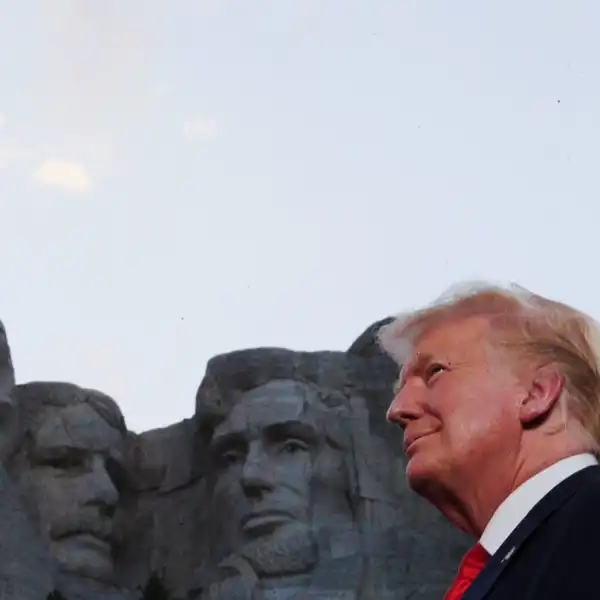
Both the model and the market expect Trump to add himself to Mt. Rushmore before 2029, with no compelling evidence of mispricing.

1. Executive Verdict

  • Altering Mount Rushmore strictly requires specific congressional approval.
  • South Dakota's Governor firmly opposes adding new faces to the memorial.
  • No structurally viable location exists for a fifth carving on Mount Rushmore.
  • Presidents cannot bypass Congress for memorial changes using private funds.
  • North Dakota Governor Burgum publicly advocates for adding Trump to Mount Rushmore.

Who Wins and Why

Outcome Market Model Why
Before 2029 13.0% 6.1% Adding a new face to Mount Rushmore faces insurmountable legal, environmental, and logistical challenges.

2. Market Behavior & Price Dynamics

Historical Price (Probability)

Outcome probability
Date
Based on the chart data, this market has exhibited a sideways trading pattern with low volatility. The price has remained within a narrow six-point range, fluctuating between a support level of 12% and a resistance level of 18%. The market opened at a 15% probability and is currently trading at 13%, indicating a slight negative drift but no definitive trend. An early price movement saw the probability rise to a high of 18% before falling to its current level. Given that no specific news or external events have been provided, these minor price fluctuations cannot be attributed to a clear catalyst and are likely a result of trading activity within a low-liquidity environment.
The total volume of 543 contracts traded is very low, suggesting limited participation and conviction from traders. The sample data shows that even a small trade volume of 5.62 contracts corresponded with a significant price swing, which is characteristic of an illiquid market where small orders can have an outsized impact. This low volume, combined with the stable, sideways price action, implies that market sentiment has been consistent. The persistent low probability indicates that traders collectively assess the event—Trump adding himself to Mt. Rushmore before the end of his term—as highly improbable. The market has not reacted strongly to any potential catalysts, instead maintaining a stable consensus on the unlikelihood of this outcome.

3. Market Data

View on Kalshi →

Contract Snapshot

This market resolves to "Yes" if an executive action is taken or a bill becomes law directing President Trump’s likeness to be sculpted into Mt. Rushmore before January 21, 2029. If this condition is not met by the deadline, the market resolves to "No." Resolution is determined based on information from sources including the White House, Executive Branch, and a list of major news outlets such as The New York Times and The Washington Post.

Available Contracts

Market options and current pricing

Outcome bucket Yes (price) No (price) Last trade probability
Before 2029 $0.13 $0.88 13%

Market Discussion

Overall market sentiment strongly favors "No," with a significant majority of traders believing Trump will not add himself to Mt. Rushmore. The key argument for "No" centers on the scientific claim that the mountain's geological structure cannot support the creation of an additional facial image. Discussions lacked substantive arguments for "Yes," focusing instead on trading strategies or lighthearted observations, though one user noted the market's long expiry could allow for future possibilities beyond Trump's immediate term.

4. Does Altering Mount Rushmore Require Congressional Approval?

Required Alteration MechanismNew act of Congress (rather than Executive Order) [^]
Antiquities Act ApplicabilityNot appropriate for altering specific design of existing memorials [^]
Current Legislative EffortH.R. 386, "Mount Rushmore Protection Act," aims to prohibit alterations without approval [^]
Altering the Mount Rushmore National Memorial requires specific congressional action. Significant modifications to the memorial necessitate a new act of Congress, rather than an Executive Order based on the Antiquities Act. The memorial's establishment and management are rooted in congressional legislation, including the Norbeck-Williamson Act of 1929 [^] and the Mount Rushmore Memorial Act of 1938 [^]. This legislative framework confirms Congress's primary authority over the memorial. Legislative efforts, such as H.R. 386 (the "Mount Rushmore Protection Act"), further underscore this requirement by proposing to prohibit federal funds for altering the memorial [^].
An Executive Order via the Antiquities Act cannot alter the memorial. Such an order is not the appropriate legal means for changing Mount Rushmore's design. Enacted in 1906, the Antiquities Act grants the President power to designate or expand national monuments, primarily for their protection [^]. It is not intended to unilaterally change the specific design or features of a pre-existing national memorial that was created and defined by explicit acts of Congress [^]. Although the National Parks Omnibus Management Act of 1998 broadly oversees units within the National Park System, including Mount Rushmore [^], it does not empower the President to fundamentally redesign or add features to a congressionally established memorial through an Executive Order. Thus, any substantial changes to Mount Rushmore's carvings or design would mandate new legislation.

5. What is South Dakota's Stance on Adding to Mount Rushmore?

Governor's Current StanceOpposes adding faces to Mount Rushmore (July 2022) [^]
Federal Legislative ActionBill introduced to prohibit federal funds for additions (2020, 2023) [^]
Trump's Past InterestExpressed 'dream' of being added to monument (2018) [^]
Governor Kristi Noem strongly opposes adding new faces to Mount Rushmore. She has firmly stated her opposition to adding any new individuals to the monument. In July 2022, Governor Noem definitively declared, "No, Trump’s face won’t be etched onto Mount Rushmore," further clarifying that the monument is dedicated to four presidents who held a vision for America, and there is no intent to add more faces [^]. This definitive position contrasts with an earlier statement in 2018, when, as a U.S. Representative, Noem mentioned that then-President Trump had expressed a "dream" of being included on the monument [^]. Governor Noem has also consistently advocated for the existing monument, opposing any efforts to remove it [^].
South Dakota's state legislature has not acted on Mount Rushmore additions. The provided research does not indicate that any specific state-level resolutions or bills have been introduced by the South Dakota state legislature since 2016 that would either facilitate or block a potential federal project to add to Mount Rushmore. However, South Dakota's federal representative, Dusty Johnson, has taken action at the federal level. He introduced the "Mount Rushmore Protection Act" in the U.S. House of Representatives during both the 116th Congress (H.R. 7358 in 2020) and the 118th Congress (H.R. 386 in 2023) [^]. This legislation's objective is to prohibit the use of federal funds for adding any individuals to Mount Rushmore, aligning with the sentiment to preserve the monument in its existing form [^].

6. Is a Fifth Carving on Mount Rushmore Geologically Possible?

Fifth Carving FeasibilityNo structurally viable location (National Park Service, experts) [^]
Hypothetical Project TimelineAt least 15 years from approval (National Park Service) [^]
Original Carving Duration14 years (1927-1941) [^]
According to geological stability and engineering assessments, no structurally viable location exists for a fifth carving on Mount Rushmore. The National Park Service (NPS) and other experts confirm that the original sculptor, Gutzon Borglum, determined that the suitable rock mass for carving was exhausted after the four faces of George Washington, Thomas Jefferson, Theodore Roosevelt, and Abraham Lincoln were completed [^]. This limitation is evident in the specific positioning of Abraham Lincoln's face to avoid the "President's Fissure," a significant structural weakness that makes that section of the mountain unsuitable for further major carving [^]. NPS officials and geological experts consistently affirm that "there is no room" and "the rock formation is not suitable" for an additional carving, also noting that any alteration would contradict the original sculptor's intent [^].
A hypothetical fifth carving would require at least 15 years from approval to completion. This estimate, provided by the National Park Service, accounts for the site's complex geology, federal regulations, and the extensive environmental reviews necessary for any major new construction within a national memorial [^]. For historical context, the original carving of the four presidential faces took 14 years from 1927 to 1941, although the active carving work within that period spanned approximately 6.5 years [^]. Despite potential efficiencies offered by modern tools, the immense scale and inherent challenges of carving a granite mountain face, alongside contemporary regulatory processes and preservation considerations, contribute to this lengthy timeline estimate [^].

7. Can private funding bypass Congress for National Memorial alterations?

Mount Rushmore Federal FundingNearly $1 million (1929-1941) [^]
CWA RequirementCongressional approval for alterations on federal lands [^]
Private Funding RoleSupports memorials in partnership with federal agencies [^]
Presidents cannot bypass Congress for memorial changes using private funds. A U.S. President's ability to accept private funding through a designated foundation to alter or add to a National Memorial, thereby bypassing congressional appropriations for authorization, is generally not supported by existing legal frameworks [^]. While private funding can contribute significantly to federal projects, it typically cannot bypass the legislative requirement for congressional approval for the establishment or significant alteration of commemorative works on federal land [^]. Organizations like the Trust for the National Mall raise private donations for national memorial improvements, but these initiatives still require adherence to federal guidelines and approvals from entities such as the National Capital Planning Commission and the Commission of Fine Arts, under the principles of the Commemorative Works Act (CWA) [^]. Therefore, private funds may reduce the need for congressional appropriations but generally cannot circumvent the congressional authorization process for the project itself.
Mount Rushmore's original funding blended state, federal, and private contributions. Conceived by Doane Robinson and sculpted by Gutzon Borglum, the project initially received state funding [^]. A 1929 bill then established the Mount Rushmore National Memorial Commission, empowering it to accept private subscriptions and federal appropriations [^]. Federal contributions to Mount Rushmore amounted to nearly $1 million between 1927 and 1941, complementing other funds received [^].
Replicating Mount Rushmore's model today faces legal and physical challenges. While the original project benefited from a unique blend of funding sources, replicating this model for altering an existing National Memorial would now encounter significant legal hurdles. The Commemorative Works Act (CWA), though primarily for new memorials, extends its principles to significant modifications of existing federal memorials, mandating detailed review and congressional authorization [^]. Even with private funding, securing congressional authorization for such an alteration would be a mandatory prerequisite, making a direct bypass of Congress unlikely [^]. Furthermore, the National Park Service considers adding another figure to Mount Rushmore legally and physically impossible, citing the stability of the granite and the integrity of the original design [^].

8. What is Doug Burgum's stance on Trump's Mount Rushmore inclusion?

Current RoleGovernor of North Dakota [^]
Mount Rushmore ViewBelieves there is "room for" Trump's face [^]
Potential Future RoleSuggested for U.S. Department of the Interior Secretary [^]
North Dakota Governor Doug Burgum publicly advocates for adding Donald Trump to Mount Rushmore. He explicitly stated that "they certainly have room for" Trump's face on the iconic monument [^]. This stance positions him among those who champion Trump's inclusion on the memorial [^]. As a sitting governor and former presidential candidate, Burgum maintains a prominent political standing [^].
Burgum is a likely candidate for a significant Department of the Interior position. Research suggests his potential appointment, with one source identifying him as "Secretary Doug Burgum | U.S. Department of the Interior" [^]. His public support for Trump's inclusion on Mount Rushmore, combined with his political experience, makes him a strong prospect for a key role such as Secretary of the Interior within a potential future administration [^].

9. What Could Change the Odds

Key Catalysts

Catalyst analysis unavailable.

Key Dates & Catalysts

  • Expiration: January 21, 2029
  • Closes: January 21, 2029

10. Decision-Flipping Events

  • Trigger: Catalyst analysis unavailable.

12. Historical Resolutions

No historical resolution data available for this series.