Short Answer

The model assigns meaningfully lower odds than the market for the White House State Ballroom being completed Before 2030 (42.3% model vs 61.0% market). This is due to high-quality GSA data indicating construction timelines extend into the 2030s.

1. Executive Verdict

  • GSA data indicates RFP issuance not before February 2028.
  • Construction lasting 2-5 years pushes completion well into the 2030s.
  • Earlier political announcements of completion were likely unrealistic.
  • White House projects require rigorous security clearances and multi-stage processes.
  • Major renovations necessitate specific Congressional funding appropriations.

Who Wins and Why

Outcome Market Model Why
Before 2027 2.0% 1.2% Market higher by 0.8pp
Before 2028 11.0% 6.4% Market higher by 4.6pp
Before 2029 40.0% 24.7% Market higher by 15.3pp
Before 2030 61.0% 42.3% Market higher by 18.7pp

2. Market Behavior & Price Dynamics

Historical Price (Probability)

Outcome probability
Date
This prediction market, "When will Trump's ballroom be completed?", has experienced a significant downward trend since its inception. The market opened with a 9.0% probability, saw a brief spike to an all-time high of 14.0% around April 27, 2026, and then experienced a dramatic crash. In just two days, the price plummeted to 2.0% by April 29, 2026, where it has remained. The 14.0% level acted as a strong resistance point that was quickly and decisively rejected. The current price of 2.0% represents the market's support level and all-time low. The provided context does not contain any specific news or events that would explain this sharp reversal and subsequent price collapse.
The volume patterns in the sample data are notable for their absence. The significant price swings from 9.0% to 14.0% and then down to 2.0% all occurred on zero reported volume in the provided samples. This suggests the market may be thinly traded, where even small orders can cause major price fluctuations. While the total volume is over 1,100 contracts, the lack of volume during these key movements indicates they may not reflect a broad consensus but rather the actions of a few traders. Overall, market sentiment has shifted from mild speculation to overwhelming pessimism. The current 2.0% price indicates that participants believe there is a very low probability of a White House State Ballroom being completed under the conditions specified by the market.

3. Significant Price Movements

Notable price changes detected in the chart, along with research into what caused each movement.

Outcome: Before 2029

πŸ“‰ April 22, 2026: 15.0pp drop

Price decreased from 45.0% to 30.0%

What happened: No supporting research available for this anomaly.

Outcome: Before 2030

πŸ“‰ April 20, 2026: 9.0pp drop

Price decreased from 65.0% to 56.0%

What happened: No supporting research available for this anomaly.

4. Market Data

View on Kalshi β†’

Contract Snapshot

This market resolves to "Yes" if the White House State Ballroom is completed and holds an event before January 1, 2030. It resolves to "No" if this condition is not met by that date, with the market closing by December 31, 2029, at 11:59 PM EST if the event hasn't occurred. Resolution relies exclusively on reporting from a predefined list of approved news agencies, specifically excluding reports referencing prior publications or re-published content not directly hosted by an approved outlet.

Available Contracts

Market options and current pricing

Outcome bucket Yes (price) No (price) Last trade probability
Before 2027 $0.07 $0.97 2%
Before 2028 $0.11 $0.90 11%
Before 2029 $0.41 $0.65 40%
Before 2030 $0.61 $0.43 61%

Market Discussion

Most traders on Kalshi anticipate Trump's ballroom to be completed before 2030, with 61% confidence, and 40% expect completion before 2029. Arguments for a "No" outcome include general skepticism about the project ever being finished (with one user asking for a "never" option) and some traders expressing reluctance to wait four years for a payout. While consensus leans towards completion by the end of the decade, detailed arguments for specific timelines are sparse in the discussion.

5. What Were Donald Trump's White House Ballroom Plans?

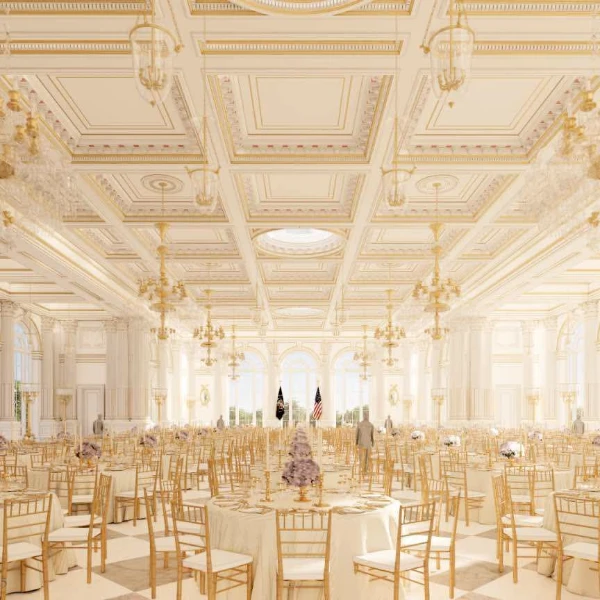
Proposed Ballroom FocusNew 90,000-square-foot facility, distinct from existing State Ballroom [^]
Construction Start AnnouncementJuly 2025 [^]
Early 2026 Construction StatusAhead of schedule [^]
Plans primarily concerned a new White House ballroom, not renovations. Donald Trump and associated entities, including in post-presidency planning, primarily discussed and prepared architectural plans for the construction of a new White House ballroom, rather than specific renovations to the existing White House State Ballroom [^]. This proposed facility was described as a substantial 90,000-square-foot new ballroom [^].
The new ballroom project had a construction timeline. Consistently referred to as "Donald Trump's Ballroom Project," The White House announced its construction was scheduled to commence in July 2025 [^]. Reports in early 2026 indicated that "White House ballroom construction" was progressing "ahead of schedule," according to Trump [^]. One publication referenced "Trump's final version of his new ballroom" and associated "graphics" [^].
Detailed aesthetic directives for the new ballroom remain scarce. While detailed plans for this new ballroom are evident, specific comprehensive aesthetic directives for its interior or exterior design are not extensively detailed in the provided sources [^]. The available information does not outline specific architectural plans or aesthetic directives concerning renovations to the existing White House State Ballroom; instead, the focus consistently centered on the development of a distinct, new ballroom facility [^].

6. What is the Standard Timeline for White House Restoration Projects?

Jacqueline Kennedy's Restoration Start1961 [^]
White House Designated as Museum1961 [^]
CPWH Formal Establishment1964 [^]
Major White House restorations follow a multi-stage process, influenced by precedent. Jacqueline Kennedy's 1961 efforts established key frameworks for these projects [^]. Her initial actions led to the creation of the White House Historical Association (WHHA) and a Fine Arts Committee, which served as a precursor to the Committee for the Preservation of the White House (CPWH) [^]. Congress designated the White House as a museum in 1961, affirming its role as a historical repository [^]. The CPWH was officially formalized by Executive Order in 1964, providing advisory oversight for maintaining the White House's museum character and safeguarding its historic contents [^].
Project initiation involves identifying needs and committee approvals. Major restoration projects typically start with a proposal, often originating from the First Family or White House staff. The Committee for the Preservation of the White House (CPWH) provides advisory guidance to the President regarding the White House's historic and artistic elements, ensuring that any proposed alterations uphold its "museum character" [^]. Simultaneously, the White House Historical Association (WHHA) may fundraise for historically appropriate furnishings and acquisitions, and support public awareness efforts related to the restoration objectives [^].
The General Services Administration (GSA) executes physical work, but specific timelines are unavailable. After conceptualization and historical/aesthetic approval from the Committee for the Preservation of the White House (CPWH) and the White House Historical Association (WHHA), the General Services Administration (GSA) takes charge of the physical execution of the project. The GSA is responsible for the White House's physical upkeep, including structural repairs, renovations, and significant construction [^]. This includes overseeing the procurement process, which involves soliciting bids and selecting contractors for the restoration work. Nevertheless, the available sources do not provide specific data or timelines for the period from an initial proposal to the final selection of a contractor for major White House projects [^].

7. What Funding Challenges Do White House Construction Projects Face?

Renovation Request (Trump)$377 million (White House renovations and repairs) [^]
State Ballroom Request$400 million (new White House State Ballroom) [^]
Ballroom Project OutcomeAllowed to proceed by judge [^]
Major White House renovations typically require specific Congressional appropriations. These projects do not generally rely solely on discretionary funds from agencies such as the General Services Administration (GSA) or the White House Office budget. While the GSA contributes to White House repair and restoration, significant new construction projects necessitate explicit line-item approval or inclusion within broader appropriations bills [^]. For instance, the Trump administration requested $377 million for renovations and repairs, a budget item requiring Congressional approval [^]. Projects classified as "major" or "non-essential" often demand extensive justification and dedicated budgetary allocations beyond standard maintenance funds.
Securing appropriations for non-essential projects, especially from an opposition Congress, is challenging. The historical success rate for these executive residence projects often proves difficult and can generate considerable controversy. The Trump administration's proposal to allocate $400 million for a new White House State Ballroom illustrates this dynamic [^]. This specific funding request sparked significant contention, underscoring the hurdles in obtaining direct Congressional approval for such endeavors [^]. Despite the initial political disputes, the project eventually progressed. A judge subsequently permitted the construction to continue by denying an injunction against it [^], and the President later announced the ballroom project was ahead of schedule [^]. This suggests that even though funding for non-essential projects can be highly contentious and subject to scrutiny, such initiatives can ultimately move forward.

8. What are the security and lead time implications for White House projects?

TS/SCI Clearance Lead Time6-12 months or longer [^]
FSL 1 Security ProfileLow-threat, low-consequence; does not align with White House [^]
2017 West Wing Renovation DurationApproximately 17 days [^]
White House projects demand rigorous security clearances for all personnel. While Facility Security Level 1 (FSL 1) buildings are typically characterized by a low potential for loss of life, injury, economic impact, and symbolic value [^], the White House necessitates significantly more stringent security measures. Personnel, including contractors, generally require Top Secret/Sensitive Compartmented Information (TS/SCI) clearances [^]. The comprehensive investigation process for a Top Secret clearance can span 6 to 12 months or even longer [^]. Historically, managing these high-level clearances for Executive Office of the President (EOP) personnel has faced significant backlogs [^], which represents a substantial logistical consideration for project staffing.
Material sourcing lacks specific lead times but undergoes rigorous vetting. Specific lead times for FSL 1 materials or for projects within the White House are not detailed in available sources. However, the high-security environment implies that specialized or vetted materials could necessitate extended timelines beyond standard commercial procurement. The 2017 West Wing HVAC overhaul serves as a recent significant renovation example. This project, which included the installation of a new HVAC system, was completed over approximately 17 days in August 2017 during a presidential vacation [^]. It was described as having been scheduled for years [^], indicating extensive advance planning. The sources do not explicitly state that security clearance processing times or material sourcing lead times caused delays or directly impacted the renovation's published schedule [^], suggesting these logistical factors were effectively managed within the long-term project planning.

9. What is the Earliest RFP Issuance Date for Federal Renovations?

Major Alteration Project Duration4.5 years (from inception to completion) [1, p [^]. 19] [^]
Design Phase Duration2 years (typically) [1, p [^]. 19, 22] [^]
Congressional Authorization Time10 months (average) [5, p [^]. 12] [^]
Federal building renovation timelines lack specific RFP to completion data [^] . GSA data does not explicitly provide the median duration from Request for Proposal (RFP) issuance to project completion for federal building renovations [^]. However, insights from comparable projects indicate overall timelines [^]. Major alteration projects completed by the GSA between fiscal years 2011 and 2018 averaged 4.5 years from project inception to completion [1, p [^]. 19] [^]. The typical process for major construction projects involves a design phase lasting approximately 2 years [^]. This is followed by the awarding of a construction contract and the construction phase itself, which usually takes 2 to 5 years [1, p [^]. 19, 22] [^]. An RFP for construction is generally issued after the design phase is complete and before construction begins [1, p [^]. 22] [^]. An RFP could be issued by February 2028 for a prioritized project [^]. Assuming a January 2025 presidential inauguration, the earliest feasible date for issuing an RFP for a significant project, such as the White House State Ballroom renovation, would be approximately February 2028 [^]. Federal building projects exceeding certain cost thresholds require GSA to submit a prospectus to Congress for authorization and appropriation [5, p [^]. 1] [^]. The average time from GSA's prospectus submission to congressional authorization for projects between 2005 and 2019 was about 10 months [5, p [^]. 12] [^]. Should a new administration prioritize the project and GSA submit a prospectus by around April 2025, congressional authorization could be secured by February 2026 [^]. Following this, a typical 2-year design phase would lead to design completion around February 2028, enabling an RFP for construction to be issued at that time [^].

10. What Could Change the Odds

Key Catalysts

Catalyst analysis unavailable.

Key Dates & Catalysts

  • Expiration: January 08, 2027
  • Closes: January 01, 2030

11. Decision-Flipping Events

  • Trigger: Catalyst analysis unavailable.

13. Historical Resolutions

No historical resolution data available for this series.