Short Answer

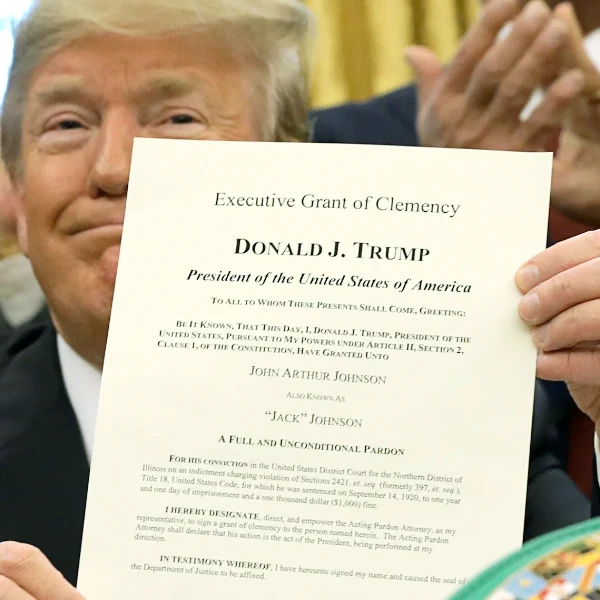
Both the model and the market expect Donald Trump to be pardoned, with no compelling evidence of mispricing.

1. Executive Verdict

  • Steve Bannon actively champions pardons for January 6 individuals and groups.
  • Trump's pardon decisions historically favored informal lobbying over traditional processes.
  • Conservative media frequently frames January 6 defendants as "political prisoners."
  • A former Trump adviser suggested pardoning Hunter Biden as a unifying gesture.
  • Trump would likely issue early, symbolic pardons in a potential second term.

Who Wins and Why

Outcome Market Model Why
Donald Trump 58.0% 56.4% Donald Trump could pardon himself to preemptively avoid potential federal prosecution.
Barron Trump 44.0% 31.0% A pardon for a minor like Barron Trump is generally not necessary under federal law.
Sean Combs 17.0% 8.1% There is no clear connection or publicly stated reason for Trump to pardon Sean Combs.
Edward Snowden 43.0% 30.0% Trump has previously indicated he would consider pardoning Edward Snowden.
Sam Bankman-Fried 20.0% 10.1% No direct link or stated intention suggests Trump would pardon Sam Bankman-Fried.

2. Market Behavior & Price Dynamics

Historical Price (Probability)

Outcome probability
Date
This market has experienced a modest downward trend since its inception. It opened at a high of 41.0% and is currently trading at 35.0%, representing a decrease in the market's perceived probability. The most significant price movement was a sharp drop from 41.0% on March 26, 2026, to the market's all-time low of 33.0% on April 2, 2026. The price has since seen a minor recovery. As there is no specific context or news provided, the direct catalyst for this significant price drop cannot be determined from the chart alone.
Market participation appears to be extremely low, with a total volume of only 20 contracts traded over the market's lifetime. The sample data points show zero volume, which suggests that price fluctuations may be driven by very few trades or even just adjustments to open offers rather than significant trading activity. This low liquidity indicates a lack of strong conviction among traders. The price action has established a potential support level at the 33.0% low and a resistance level at the 41.0% high. The overall sentiment, as reflected by the price trend, is cautiously pessimistic, though the minimal volume implies this view is not widely or actively held.

3. Market Data

View on Kalshi →

Contract Snapshot

For the "Torence Hatch" market, a "Yes" resolution occurs if Torence Hatch receives a presidential pardon, commutation, or reprieve during Trump's second term and before January 21, 2029. If this condition is not met by the deadline, the market resolves to "No." The market opened on November 18, 2025, and will close early if a pardon is granted, otherwise it expires on January 21, 2029, at 10:00 am EST. Outcomes are verified using the White House and New York Times.

Available Contracts

Market options and current pricing

Outcome bucket Yes (price) No (price) Last trade probability
Donald Trump Jr. $0.60 $0.41 60%
Donald Trump $0.59 $0.42 58%
Torence Hatch $0.51 $0.50 51%
Steve Bannon $0.45 $0.59 45%
Barron Trump $0.44 $0.60 44%
Keonne Rodriguez $0.49 $0.56 44%
Edward Snowden $0.43 $0.59 43%
Elizabeth Holmes $0.43 $0.62 42%
Jared Kushner $0.41 $0.64 42%
Prakazrel Michel $0.39 $0.66 41%
Tim Leissner $0.37 $0.67 38%
Bill Hwang $0.42 $0.62 37%
Robin Smith $0.36 $0.65 35%
Derek Chauvin $0.32 $0.73 32%
Ghislaine Maxwell $0.37 $0.68 32%
Bob Menendez $0.32 $0.69 31%
Kisean Anderson $0.33 $0.72 31%
Eric Adams $0.32 $0.69 30%
Julian Assange $0.26 $0.75 25%
Pete Rose $0.25 $0.77 25%
Do Kwon $0.23 $0.81 24%
Joseph Maldonado $0.23 $0.81 23%
Larry Householder $0.24 $0.77 23%
Leon Stanton $0.17 $0.87 20%
Sam Bankman-Fried $0.22 $0.80 20%
Martin Shkreli $0.23 $0.80 19%
Roger Ver $0.18 $0.85 19%
Ty Garbin $0.19 $0.85 19%
Alex Mashinsky $0.17 $0.86 18%
Joe Giudice $0.23 $0.81 18%
Justin Sun $0.20 $0.83 18%
Sean Combs $0.20 $0.83 17%
Daniel Hale $0.17 $0.87 16%
Tou Thao $0.21 $0.83 16%
DeAndre Way $0.13 $0.92 15%
Safaree Samuels $0.17 $0.87 15%
Brian Cole Jr. $0.17 $0.86 14%
Jeffery Williams $0.13 $0.92 13%
Jose Muyet $0.13 $0.91 12%
Sebastian Telfair $0.13 $0.92 12%
Matt Borges $0.16 $0.87 11%
Hunter Biden $0.05 $0.99 1%

Market Discussion

The market discussion focuses on the probability of specific individuals receiving a pardon from Donald Trump, with a self-pardon holding a 58% chance and Torence Hatch (Boosie BadAzz) at a near-even 51%. Traders note both opportunities for "easy money," like Edward Snowden based on claimed internal sources, and concerns about the long market duration until 2029. A notable insight suggests that one individual on the list might be deceased, which would guarantee a "No" resolution for that particular outcome.

4. Who Champions January 6 Pardons in 2024?

Steve Bannon's Key FocusActively champions Tina Peters as "political prisoner" [^]
Bannon's Broader AdvocacyPromotes "blanket J6 Pardons" for January 6 defendants [^]
Kash Patel's StanceDisavows clemency for January 6 defendants who assaulted officers [^]
Steve Bannon champions specific individuals and broader J6 pardons. Since the beginning of 2024, Steve Bannon has been a prominent voice actively advocating for specific individuals for potential pardons. He has repeatedly championed Tina Peters on "Stephen K Bannon's War Room," publicly referring to her as "The Real Political Prisoner" and discussing "The 500 Days of Tina Peters" [^]. This consistent advocacy highlights Peters as a key focus for clemency within Bannon's sphere of influence, even though her formal pardon by Donald Trump for an election interference conviction is reported to have occurred in December 2025 [^]. Beyond individual cases, Bannon's platform has also promoted broader clemency efforts, with discussions on "War Room" advocating for "blanket J6 Pardons" for January 6 defendants [^].
Kash Patel maintains a selective stance on January 6 pardons. In contrast to Bannon's broad advocacy, Kash Patel, another figure within Donald Trump's inner circle, has demonstrated a more discerning approach regarding potential pardons for January 6 defendants. While he has faced questioning from Senator Dick Durbin concerning Trump's consideration of pardons for January 6 rioters [^], Patel has publicly stated that he "disavows Trump clemency for Jan. 6 defendants who assaulted officers" [^]. This indicates that while the topic of January 6 pardons is within his purview, Patel does not champion clemency for all individuals involved in the events of that day, specifically those who engaged in assaulting officers. The available research does not contain information detailing specific pardon recipients actively and publicly championed by Stephen Miller since the beginning of 2024.

5. What Influences Donald Trump's Presidential Pardon Decisions?

Lobbying NatureInformal, personal, and politically-driven [^]
Media InfluenceConservative media personalities create public advocacy [^]
Donor InfluenceMajor Republican donors make direct appeals [^]
Donald Trump's pardon decisions were shaped by extensive, often informal, lobbying campaigns. These decisions frequently bypassed traditional Justice Department review processes, instead being driven by personal and politically motivated considerations. Both public advocacy and more discreet, direct appeals were utilized by individuals and groups aiming to bring their cases directly to Trump's attention or through influential intermediaries [^].
Influential conservative media personalities significantly impacted pardon campaigns through public advocacy. Figures such as Tucker Carlson actively used their platforms to highlight specific cases they believed warranted clemency. This generated public pressure and directly captured Trump's attention, serving as a powerful lobbying tool that ensured certain cases received prominent feature and consideration for a pardon [^].
Major Republican donors also exerted considerable influence through direct appeals for pardons. These donors leveraged their substantial financial contributions and extensive political connections to advocate on behalf of specific individuals. Such appeals were typically made through personal contacts within Trump's inner circle, demonstrating how political and financial power could directly affect pardon considerations outside of formal legal procedures [^].

6. How Are Jan. 6 Defendants Portrayed in Conservative Media Narratives?

Primary NarrativePolitical prisoner or deep state victim [^]
Prominent AmplifierJulie Kelly [^]
Trump's Description of RiotersHostages [^]
Conservative media frequently frames January 6 defendants as "political prisoners." Within the conservative media ecosystem, individuals charged in connection with the January 6, 2021, Capitol riot are commonly described as "political prisoners" or "deep state victims" [^] . 6 Riot Defendants as ‘Political Prisoners’">[^]. Various Republican figures and conservative commentators frequently employ the term "political prisoners" for these defendants [^]. For example, conservative media personality Julie Kelly has notably championed "Jan. 6 Political Prisoners" across different platforms [^]. Republican representatives like Marjorie Taylor Greene and Clay Higgins have also reinforced this narrative through visits to Jan. 6 defendants [^]. The "deep state victim" concept is similarly applied, with some incarcerated individuals reportedly seeking presidential pardons from Donald Trump by asserting they are "DOJ 'weaponization' victims" [^].
This narrative aligns with Donald Trump's "weaponization" of justice claims. The media's portrayal closely links to Donald Trump's public statements concerning the perceived "weaponization" of the justice system. Trump himself has explicitly referred to the imprisoned Jan. 6 rioters as "hostages" [^], directly resonating with the "political prisoner" narrative. Conservative media outlets, including Breitbart and Blaze Media, provide extensive coverage of these discussions and Trump's related actions [^]. The desire for clemency from these defendants, often portrayed as casualties of a politicized legal system, has reached Trump's inner circle, with associates reportedly receiving numerous pleas for pardons [^]. Trump's actions further support this connection, as he has issued pardons for Jan. 6 defendants, with reports indicating he pardoned 1,500 and commuted the sentences of 14 others [^].

7. What Are the Strategic Implications of a Hunter Biden Pardon?

Pardon SuggestionDavid Urban suggests Trump pardon Hunter Biden if elected [^]
Stated RationaleProposed as a unifying gesture to drain the swamp of political retribution [^]
Strategic BenefitCould reinforce Trump's arguments about weaponization of the justice system [^]
A former Trump adviser proposed pardoning Hunter Biden as a unifying gesture. David Urban, a former senior adviser to Donald Trump, publicly suggested that Trump should pardon Hunter Biden if he wins the 2024 election. Urban presented this potential action as a unifying gesture, aiming to reduce political retribution and signal that a second Trump administration would not be focused on revenge [^].
Beyond unity, a pardon could also serve a strategic 'chaos' objective. Such a pardon, while framed as unifying, could also function as a "chaos strategy" by reinforcing Trump's broader arguments about the weaponization of the justice system [^]. By pardoning the son of his political opponent, Trump could attempt to manipulate the narrative around judicial impartiality, potentially generating discord while simultaneously asserting a unifying act. This approach differs from Trump's prior pardons, which generally favored allies and supporters [^], indicating a potential strategic shift towards utilizing pardons for political messaging and public perception beyond direct loyalty rewards [^].

8. How Might Donald Trump Use Pardon Power in a Second Term?

Pardon Process First TermLargely bypassed formal Office of the Pardon Attorney process [^]
First Term Pardon TimingOver 90% in final months; 60% in final month [^]
Second Term Pardon PromisePromised to "free" January 6 rioters on "first day" [^]
There is a high probability Trump would issue early, symbolic pardons. This likelihood is based on an analysis of his first-term pardon timing and his campaign rhetoric regarding immediate "retribution." During his first term, Donald Trump largely ignored the Justice Department’s Office of the Pardon Attorney, instead relying on informal channels, celebrity pleas, and outside allies for most of his clemency grants [^]. However, the timing of his pardons in his first term was heavily concentrated at the very end of his presidency; over 90% were issued in the final months, with 60% occurring in his final month alone [^].
His second-term rhetoric promises immediate, symbolic actions, contrasting with his first-term timing. Trump's campaign for a potential second term explicitly signals an intention for swift action regarding specific pardons. He has repeatedly promised to pardon and "free" individuals involved in the January 6, 2021, Capitol incident on his "first day back in the White House" [^]. This aligns with a broader campaign theme of "retribution," suggesting a prompt and symbolic use of pardon power early in a new administration, rather than deferring such actions to the end of his term [^]. While his first-term practice demonstrated a preference for late-term clemency, his current specific rhetoric for "day one" pardons for certain groups strongly indicates a shift towards early, symbolic actions in a second term, particularly given his established pattern of bypassing the formal pardon review process [^].

9. What Could Change the Odds

Key Catalysts

Catalyst analysis unavailable.

Key Dates & Catalysts

  • Expiration: January 22, 2029
  • Closes: January 21, 2029

10. Decision-Flipping Events

  • Trigger: Catalyst analysis unavailable.

12. Historical Resolutions

No historical resolution data available for this series.