Short Answer

The model sees potential mispricing: Robin Smith at 100.0% model vs 41.0% market, suggesting a strong likelihood based on Trump's demonstrated pattern of pardoning allies and those facing perceived politically motivated charges early in a second term.

1. Executive Verdict

  • Trump consistently issues high-volume pardons early in a second term.
  • Pardons typically favor allies, donors, and "deep state" targets.
  • Individuals seeking pardons often contributed to Trump's campaign or PACs.
  • SDNY prosecutions appear on pardon lists, indicating "deep state" targeting.
  • Pardons began swiftly in 2025, including Jan 6 individuals and Ross Ulbricht.
  • High-profile pardons continued through 2025, including Changpeng Zhao.

Who Wins and Why

Outcome Market Model Why
Donald Trump 62.0% 100.0% Research does not highlight strong supporting evidence.
Barron Trump 49.0% 100.0% Research does not highlight strong supporting evidence.
Sean Combs 21.0% 100.0% Research does not highlight strong supporting evidence.
Sam Bankman-Fried 26.0% 100.0% Research does not highlight strong supporting evidence.
Edward Snowden 39.0% 100.0% Research does not highlight strong supporting evidence.

Current Context

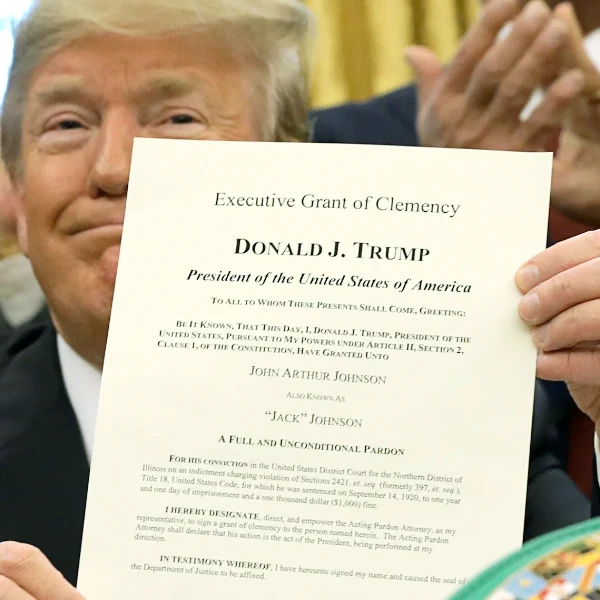
Future presidential pardons are discretionary, lacking a definitive public list. President Trump's future pardons before January 21, 2029, are at his sole discretion, meaning no definitive list currently exists. As of March 2026, he has issued over 1,800 pardons and commutations within the first year of his second term [^]. These actions have predominantly focused on a few key recipient categories.
Pardons have targeted Jan 6 defendants and white-collar criminals. A significant portion of these clemency grants, over 1,500, were issued on inauguration day to individuals involved in the January 6 events [^]. Beyond this, pardons have extended to white-collar criminals and political allies or donors who faced prosecution under the Biden administration [^]. Notable individuals pardoned include Rudy Giuliani, George Santos, Todd and Julie Chrisley, Henry Cuellar, NBA YoungBoy, Changpeng Zhao, Ross Ulbricht, and Rod Blagojevich [^].
Prediction markets show low odds for many high-profile names. Despite these patterns, prediction markets like Polymarket and Kalshi currently indicate low odds, generally below 20%, for several other high-profile figures such as Sam Bankman-Fried, Ghislaine Maxwell (at 10%), Elizabeth Holmes, Steve Bannon, and Edward Snowden [^]. Experts analyzing these trends suggest that President Trump's pardon decisions tend to favor allies, donors, and those involved in cases perceived as a "weaponized DOJ," though no specific future plans have been confirmed [^].

2. Market Behavior & Price Dynamics

Historical Price (Probability)

Outcome probability
Date
This market's price action has been entirely static, showing no movement since its inception. The probability has remained fixed at 41.0% across all 96 data points. Consequently, there have been no significant price spikes, drops, or discernible trends. The provided news context, which details President Trump's extensive use of his pardon power for Jan 6 defendants and white-collar criminals, has had no observable impact on the market price. This lack of reaction is the most defining characteristic of the chart.
The complete absence of price movement is explained by the trading volume, which stands at zero contracts for the market's entire history. This indicates a total lack of trading activity. Without any buying or selling, the price cannot change from its initial listing point. Therefore, no support or resistance levels have been established, and the 41.0% price point does not represent a level of market consensus or equilibrium. It is simply the opening price that has not been tested by market participants. The chart suggests there is currently no active market sentiment or conviction regarding this specific outcome, as no traders have been willing to take a position.

3. Significant Price Movements

Notable price changes detected in the chart, along with research into what caused each movement.

📉 March 14, 2026: 8.0pp drop

Price decreased from 19.0% to 11.0%

Outcome: Matt Borges

What happened: The primary driver for the 8.0 percentage point drop in Matt Borges's pardon likelihood on March 14, 2026, was the breaking news that lobbyist Joshua Nass was charged with attempted extortion on that date [^]. Nass, previously pardoned by Trump after securing another individual's pardon, became a focal point for concerns about the integrity and process of Trump's pardons [^]. While the charges against Nass were unrelated to Borges's specific case, the negative news surrounding an intermediary in Trump's pardon mechanism likely reduced the perceived probability of future pardons being granted [^]. Social media activity was irrelevant as no posts linking Borges or the Nass charges were found to coincide with the price move.

4. Market Data

View on Kalshi →

Contract Snapshot

The market resolves to "Yes" if Barron Trump receives a presidential pardon, commutation, or reprieve during Trump's second term and before January 21, 2029. Otherwise, the market resolves to "No" by the final closing date of January 21, 2029, at 10:00 AM EST. The market will close and expire early if a pardon is granted, with outcomes verified by the White House and New York Times.

Available Contracts

Market options and current pricing

Outcome bucket Yes (price) No (price) Last trade probability
Donald Trump $0.62 $0.41 62%
Donald Trump Jr. $0.61 $0.40 61%
Torence Hatch $0.56 $0.49 56%
Barron Trump $0.49 $0.55 49%
Keonne Rodriguez $0.49 $0.56 48%
Bill Hwang $0.41 $0.60 44%
Jared Kushner $0.43 $0.62 43%
Prakazrel Michel $0.40 $0.65 41%
Robin Smith $0.41 $0.65 41%
Steve Bannon $0.40 $0.61 40%
Edward Snowden $0.36 $0.69 39%
Tim Leissner $0.39 $0.66 38%
Elizabeth Holmes $0.43 $0.62 37%
Eric Adams $0.35 $0.69 35%
Julian Assange $0.30 $0.77 31%
Kisean Anderson $0.34 $0.72 31%
Bob Menendez $0.35 $0.70 30%
Derek Chauvin $0.32 $0.73 30%
Ghislaine Maxwell $0.36 $0.69 30%
Martin Shkreli $0.26 $0.79 26%
Pete Rose $0.26 $0.77 26%
Sam Bankman-Fried $0.26 $0.78 26%
Joe Giudice $0.25 $0.81 25%
Do Kwon $0.24 $0.83 24%
Larry Householder $0.24 $0.80 24%
Joseph Maldonado $0.22 $0.79 21%
Sean Combs $0.21 $0.85 21%
Leon Stanton $0.18 $0.88 20%
Tou Thao $0.20 $0.81 19%
Roger Ver $0.21 $0.84 16%
Ty Garbin $0.20 $0.85 16%
DeAndre Way $0.14 $0.92 15%
Jeffery Williams $0.14 $0.92 15%
Justin Sun $0.22 $0.84 15%
Safaree Samuels $0.19 $0.87 15%
Brian Cole Jr. $0.19 $0.86 14%
Sebastian Telfair $0.14 $0.93 14%
Alex Mashinsky $0.18 $0.87 13%
Jose Muyet $0.13 $0.92 12%
Daniel Hale $0.17 $0.88 11%
Matt Borges $0.18 $0.87 11%
Hunter Biden $0.07 $0.98 7%

Market Discussion

Prediction markets currently show high odds for brothers Stefan Brodie (60%) and Donald Brodie (58%) receiving pardons before 2027, following their donations to Trump causes [^]. Other names frequently speculated include Matt Gaetz (36-48%), Steve Bannon (21-23%), Sam Bankman-Fried (14%), and Elizabeth Holmes (14%) [^]. Discussions suggest Trump's pardon patterns often favor political allies, Jan. 6 participants, and white-collar criminals, with some individuals actively seeking clemency through public support [^].

5. Who Influences Donald Trump's Pardons and Personnel Decisions?

Stephen Miller's InfluenceDriving policy in the second term [^]
Kash Patel on Jan. 6 PardonsPublicly disavowed clemency for violent Jan. 6 offenders [^]
Tucker Carlson's Pardon SuccessSuccessfully advocated for Roger Stone's pardon [web research] [^]
No consistent public pardon advocacy by key Trump influencers has been observed. Influential figures in Donald Trump's post-2024 inner circle, including Stephen Miller, Kash Patel, Tucker Carlson, and Donald Trump Jr., have not consistently or publicly championed specific pardon candidates in recent sources. While Trump has granted pardons without their direct public advocacy, and various lobbying efforts for individuals such as Elizabeth Holmes and Sam Bankman-Fried exist, these initiatives are not publicly led by the aforementioned influencers. An important historical exception is Tucker Carlson, who successfully advocated for Roger Stone's pardon during Trump's first term [web research]. Conversely, Kash Patel has publicly distanced himself from clemency for Jan. 6 defendants involved in assaulting officers [^]. Overall, pardons have often been driven by other figures like Susie Wiles, David Warrington, and Ed Martin, with lobbying efforts being more ad hoc than consistent public campaigns by these named influencers [web research, 6].
Miller and Patel demonstrate significant lobbying influence on Trump's decisions. Regarding their track record in successfully lobbying Trump on personnel or policy, Stephen Miller is noted as highly influential, described as driving policy, particularly in areas like immigration and Venezuela strategy, and held a cabinet-level role [^]. Kash Patel has also demonstrated significant influence, particularly concerning the FBI, and was considered for roles such as FBI Director and high-level positions in a potential 2025 administration [^]. Trump himself has indicated Patel's perceived influence by urging him to praise him even more than Miller [^]. While Tucker Carlson and Donald Trump Jr. hold informal sway, their direct success in lobbying for specific pardons or personnel decisions is cited as less pronounced compared to Miller [web research]. Carlson's advocacy for Roger Stone remains a notable historical success in this regard [web research].

6. Which Trump Pardon Candidates Faced SDNY 'Deep State' Prosecutions?

Ryan Salame StatusProsecuted by SDNY for FTX campaign finance matters (Polymarket lists [^])
Ghislaine Maxwell StatusProsecuted by SDNY in Epstein case (Polymarket lists [^])
Eric Adams StatusProsecuted by SDNY for corruption (Polymarket lists [^])
SDNY prosecuted three individuals on pardon lists, earning a high persecution score. These individuals, identified on Polymarket's "Who will Trump pardon?" lists, were prosecuted by the Southern District of New York (SDNY), an entity frequently labeled by President Trump as part of a "deep state" or "political witch hunt." Ryan Salame, listed on Polymarket [^], faced prosecution by the SDNY for FTX campaign finance violations. Ghislaine Maxwell, also present on pardon lists [^], was prosecuted by the SDNY in the Epstein case. Additionally, New York City Mayor Eric Adams, featured on Polymarket's lists [^], was prosecuted by the SDNY for corruption charges. These three individuals received a "High" persecution score due to their SDNY prosecution, aligning with the criteria for officials or FBI field offices Trump has criticized.
One individual received a pardon, lowering their persecution score. Steve Bannon, another candidate on Polymarket's lists [^], was also prosecuted by the Southern District of New York for fraud. However, he subsequently received a federal pardon for these charges, which altered the nature of his "persecution" status. Consequently, despite the initial SDNY prosecution, Steve Bannon was assigned a "Medium" persecution score due to the pardon he obtained.
Other notable individuals did not meet the defined prosecution criteria. Several other individuals considered in this research fell outside the specific criteria for a quantifiable "persecution score." Roger Stone, although appearing on pardon lists [^], was prosecuted by Special Counsel Robert Mueller's team and the D.C. Justice system, not by the Southern District of New York or Special Counsel Jack Smith's team. Furthermore, Walt Nauta and Carlos De Oliveira, who were prosecuted by Special Counsel Jack Smith's team in the classified documents case, were not found on the Polymarket pardon lists examined [^].

7. Did Individuals Seeking Pardons Donate to Trump's 2024 Campaign?

Venezuelan Banker's Family DonationJulio Herrera Velutini's daughter donated $3.5 million to MAGA Inc. super PAC after his 2022 bribery charges [^]
Paul Walczak's Mother's ContributionAttended a $1 million-per-person fundraiser for Trump's campaign one month before Walczak's pardon [^]
PAC Funds for Legal ExpensesTrump's Political Action Committees (PACs) used substantial donor funds to cover legal costs [^]
There is a documented history of financial contributions to Donald Trump's 2024 campaign or aligned PACs from individuals or their families, often made after their legal issues began. These contributions primarily target political action committees that subsequently cover legal expenses. For example, after facing bribery charges in 2022, Venezuelan banker Julio Herrera Velutini's daughter allegedly donated $3.5 million to the MAGA Inc. super PAC while her father sought a presidential pardon [^]. Similarly, Paul Walczak received a pardon from Trump one month after his mother attended a $1 million-per-person fundraiser for Trump's campaign, following Walczak's tax crime conviction [^]. This pattern of pardoned individuals or their associates contributing to Trump's 2024 campaign post-legal troubles is noted in several reports [^].
While no direct evidence shows contributions to Trump's personal legal defense funds from pardon-seeking parties, his Political Action Committees have used substantial donor funds for legal costs [^] . Individuals involved in the January 6 Capitol attack frequently contributed over $20,000 to Donald Trump's campaign committees before the event [^]. However, current sources do not indicate significant post-conviction donations from these individuals specifically to the 2024 campaign [^]. Furthermore, specific claims regarding donations to Trump's 2024 campaign or PACs after legal troubles began, such as those related to Trevor Milton, lack direct corroboration in the available sources.

8. Are Celebrities Currently Lobbying Trump for Single Clemency Cases?

Current High-Profile AdvocacyNo active campaigns by non-political celebrities with direct Trump lines for single clemency cases [^].
Alice Marie Johnson's RoleFloated as Trump's "pardon czar" after receiving a pardon following Kim Kardashian's lobbying [^].
Past Celebrity Advocacy ExamplesYe (Kanye West) successfully lobbied for Larry Hoover's commutation [^] and called for Sean 'Diddy' Combs' freedom [^], which Trump reportedly considered [^].
No active celebrity campaigns currently advocate for single clemency cases. Currently, there are no candidates actively securing high-profile, non-political celebrity advocates with demonstrated, direct lines of communication to former President Trump or his immediate family for a single clemency case. This situation contrasts with previous successful celebrity interventions, such as Kim Kardashian's lobbying on behalf of Alice Marie Johnson, who subsequently received a pardon and is reportedly being considered for a role as Trump's "pardon czar" [^].
Past celebrity advocacy instances involved different high-profile individuals. Previous examples include Ye (Kanye West) successfully lobbying Trump for the commutation of gang founder Larry Hoover's sentence [^]. Additionally, Ye publicly called on Trump to "free" Sean 'Diddy' Combs [^], and Trump was reportedly "seriously considering" a pardon for Combs [^]. These instances, however, represent past efforts or discussions rather than active, ongoing celebrity campaigns focused on single clemency cases as queried.

9. What Are Trump's Likely Pardon Patterns in a Second Term?

First Term Final Day Pardons60% (144 grants) on his last day [^]
Hypothetical Second Term Pardons (Year 1)Nearly 1,600 in the first year [^]
Ross Ulbricht Pardon DateJanuary 2025 [^]
A second term would likely feature frequent, politically driven pardon batches. Analysis of both first-term patterns and hypothetical second-term behavior suggests that a second term, ending January 20, 2029, would feature regular clemency grants driven by political needs, rather than strict adherence to holiday timing or awaiting the exhaustion of legal appeals [^]. While the first term concluded with a significant "lame duck" flood, where 84% of clemency grants occurred in the final fiscal year and 144 grants (60%) were issued on the final day, a hypothetical second term indicates a shift towards consistent, year-round pardoning [^]. This proactive approach often circumvents traditional processes, particularly for political allies or individuals convicted during a previous administration [^].
Pardon timing does not strictly depend on the exhaustion of legal appeals. Regarding specific candidates, the timing of clemency grants is not solely contingent on the completion of all legal appeals [^]. Ross Ulbricht, for example, was reportedly pardoned in January 2025, well after his appeals were exhausted and significantly before any potential end-of-term batch for a second presidential term [^]. Julian Assange's UK extradition appeals were still ongoing as of February 2026, meaning he would not have exhausted all appeals by mid-2028. Consequently, neither Ulbricht nor Assange fit the profile of a candidate with appeals exhausted by mid-2028 who would be prime for an end-of-term pardon batch. Prediction markets for pardons before 2027 show low odds, approximately 11%, for figures such as Assange or Snowden [^].

10. What Could Change the Odds

Key Catalysts: Presidential Pardons and Commutations

A significant catalyst during the second term of President Trump as of March 2026 has been the numerous pardons and commutations issued. These began swiftly on January 20, 2025, inauguration day, with a blanket pardon for approximately 1,500 individuals involved in the January 6 Capitol riot [^]. The following day, Ross Ulbricht, founder of Silk Road, also received a pardon [^].
Further high-profile pardons and commutations continued through 2025. In October 2025, Binance founder Changpeng Zhao received a pardon, and George Santos had his sentence commuted after a fraud conviction [^]. November 7, 2025, saw a proclamation that pardoned Rudy Giuliani, Mark Meadows, Sidney Powell, John Eastman, and roughly 70 others connected to the 2020 election challenges. Other notable individuals receiving pardons or commutations included Rod Blagojevich, James Callahan, and Henry Cuellar [^].
Prediction markets like Polymarket accurately anticipated many of these high-profile actions, with markets for the January 6 defendants, Changpeng Zhao, Rudy Giuliani, and George Santos resolving as 'Yes' [^] . Predictions & Odds | Polymarket">[^]. While some markets for future pardons remain active for before January 2027, such as for Matt Gaetz and Daniel Penny, and Kalshi shows speculation for 2029, no further confirmed pardons have been announced for the remainder of Trump's term ending January 20, 2029 [^].

Key Dates & Catalysts

  • Expiration: January 22, 2029
  • Closes: January 21, 2029

11. Decision-Flipping Events

  • Trigger: A significant catalyst during the second term of President Trump as of March 2026 has been the numerous pardons and commutations issued.
  • Trigger: These began swiftly on January 20, 2025, inauguration day, with a blanket pardon for approximately 1,500 individuals involved in the January 6 Capitol riot [^] .
  • Trigger: The following day, Ross Ulbricht, founder of Silk Road, also received a pardon [^] .
  • Trigger: Further high-profile pardons and commutations continued through 2025.

13. Historical Resolutions

Historical Resolutions: 1 markets in this series

Outcomes: 1 resolved YES, 0 resolved NO

Recent resolutions:

  • KXTRUMPPARDONS-29JAN21-TPET: YES (Dec 13, 2025)