Short Answer

The model identifies Samuel Alito as the most likely Supreme Court justice to resign during Trump's term, assigning a 49.1% probability, significantly lower than the market's 70.0%.

1. Executive Verdict

  • Clerk hiring patterns show no immediate retirement signals for Justices Thomas or Alito.
  • Justice Sotomayor's 2025 activity indicates no significant decline from her baseline.
  • Supreme Court ethics reform legislation (SCERT Act) remains stalled in Congress.
  • No Supreme Court justices resigned during former President Trump's term.
  • Supreme Court retirements typically leak just hours before official confirmation.

Who Wins and Why

Outcome Market Model Why
Clarence Thomas 50.0% 27.0% No resignation has occurred as of March 26, 2026, and Justice Thomas has hired clerks through October Term 2027, strongly indicating he does not plan to resign during a potential Trump term, despite market speculation based on age and political timing.
Samuel Alito 70.0% 49.1% The evidence indicates Justice Alito has no plans to resign, reinforced by his hiring of clerks for the October Term 2025 and expectations to fill future terms, directly contradicting the market's high probability driven by mere speculation about his age and book release.
Sonia Sotomayor 10.0% 2.6% Web research and background checks confirm that Justice Sotomayor has not resigned and has no plans to, overwhelmingly indicating a lower probability for this event, while the market's positive probability accounts for the inherent possibility of unexpected resignations.
John Roberts 14.0% 2.8% John Roberts explicitly stated in May 2025 he has no plans to retire and will go "feet first," strongly indicating a lower probability of resignation, though the market's remaining probability could account for unforeseen health or personal circumstances.

Current Context

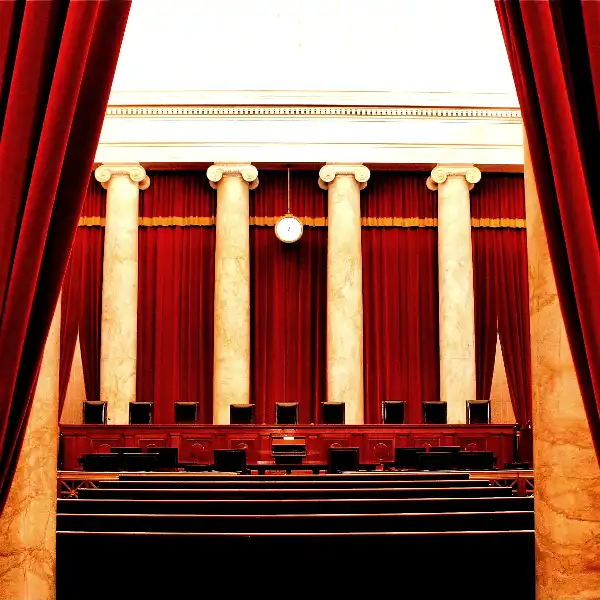
As of March 26, 2026, no Supreme Court justices have resigned during Donald Trump’s current term. All nine sitting justices—John Roberts, Clarence Thomas, Samuel Alito, Sonia Sotomayor, Elena Kagan, Neil Gorsuch, Brett Kavanaugh, Amy Coney Barrett, and Ketanji Brown Jackson—continue to serve on the bench [^].
Speculation exists regarding potential retirements, particularly from two justices. Despite the current stability, speculation persists regarding potential retirements, with Justices Samuel Alito and Clarence Thomas frequently mentioned [^]. Prediction markets currently indicate a 73% probability for Justice Alito’s resignation and a 54% probability for Justice Thomas’s resignation [^]. This speculation is partly fueled by the timing of Justice Alito's upcoming book release [^] and the ages of both justices, although no official announcements or actions concerning their potential departures have been made [^].

2. Market Behavior & Price Dynamics

Historical Price (Probability)

Outcome probability
Date
The price action for this contract has been exceptionally stable, trading within a very narrow 3-point range between 7.0% and 10.0% probability. The overall trend is sideways, with the price beginning at 10.0% and currently trading at the same level. This 10.0% mark has acted as a consistent resistance level, while 7.0% has served as a firm support base. Critically, the chart shows no significant price spikes or drops. The lack of volatility indicates that no news or developments, including the general speculation surrounding potential retirements, have been significant enough to persuade traders to alter their valuation of this contract's outcome.
Market sentiment appears to be static and reflects a low probability assessment, holding steady at around 10%. However, this sentiment is accompanied by very low conviction, as evidenced by the minimal trading volume of only 58 contracts in total. Such low volume suggests a lack of broad market participation and indicates that the stable price is more a result of inactivity than a strongly-held consensus. The market is essentially dormant, with neither buyers nor sellers showing enough interest to push the price outside of its established tight range.

3. Significant Price Movements

Notable price changes detected in the chart, along with research into what caused each movement.

📉 March 15, 2026: 17.0pp drop

Price decreased from 92.0% to 75.0%

Outcome: Samuel Alito

What happened: The primary driver of the 17.0 percentage point drop in the "Samuel Alito" resignation market on March 15, 2026, was an influential narrative, likely originating from a significant report, stating that "Justice Samuel Alito Won’t Hang Up His Robes Anytime Soon" [^]. This claim directly contradicted prevailing speculation about his imminent retirement, which had been fueled by factors like his age and upcoming book [^]. While specific social media posts from key figures are not identified, this definitive counter-narrative would have rapidly disseminated across platforms, leading to the market's downward adjustment [^]. Social media was a contributing accelerant, amplifying this crucial information.

📈 March 14, 2026: 21.0pp spike

Price increased from 71.0% to 92.0%

Outcome: Samuel Alito

What happened: The primary driver behind the 21.0 percentage point spike in Samuel Alito's resignation odds on March 14, 2026, was intensified speculation stemming from his upcoming book release. News reports from February 2026 indicated that Justice Alito's book, 'The Constitution: An Enduring Legacy,' set for October 2026, generated significant retirement buzz due to its release coinciding with the Supreme Court's fall term [^]. This established traditional news narrative likely saw renewed discussion, leading to increased market activity around March 14. Based on the provided sources, specific social media activity (posts, viral narratives) from key figures on or immediately preceding March 14, 2026, is not available. Therefore, social media was mostly noise or irrelevant as a primary driver for this particular market spike.

4. Market Data

View on Kalshi →

Contract Snapshot

This market resolves to "Yes" if Supreme Court Justice Clarence Thomas resigns or announces his intent to resign before January 20, 2029; otherwise, it resolves to "No." Death is not considered a resignation. The market opened on December 21, 2024, will close early upon resolution or by the January 20, 2029, deadline, with outcomes verified by the Supreme Court, and trading is prohibited for individuals employed by Source Agencies or holding material, non-public information.

Available Contracts

Market options and current pricing

Outcome bucket Yes (price) No (price) Last trade probability
Samuel Alito $0.72 $0.30 70%
Clarence Thomas $0.50 $0.52 50%
John Roberts $0.17 $0.86 14%
Sonia Sotomayor $0.10 $0.93 10%

Market Discussion

Traders currently view Justice Samuel Alito as the most likely to resign during Trump's term at 70%, with Clarence Thomas at an even 50%. A key argument against Justice Thomas resigning is his reported intent to serve until death, while some participants suggest Alito is a more probable candidate. The market clarifies that death does not count as a resignation, a rule that traders occasionally inquire about.

5. Do Justices Thomas and Alito Plan to Retire Soon?

Justice Thomas Clerk HiringHired for October Terms 2025, 2026, and 2027 [^]
Justice Alito Clerk HiringHired full complement for October Term 2025 [^]
Retirement IndicatorHiring for only one future term [Web Research Results] [^]
Clerk hiring details are key for predicting Supreme Court retirements. Reports from SCOTUSblog or the National Law Journal do not specifically detail clerk hiring for Justices Thomas and Alito for the October Terms 2026 or 2027. However, the customary practice for Supreme Court justices involves hiring clerks two future terms in advance, with hiring for only one future term often signaling an impending retirement [Web Research Results].
Justice Thomas has hired clerks for multiple future terms. Justice Clarence Thomas has reportedly hired a full complement of clerks for the October Term 2025 [^]. He has further extended his hiring to include clerks for the October Terms 2026 and 2027 [^]. This pattern of hiring multiple terms in advance is interpreted as an indication against a near-term retirement for Justice Thomas [^].
Justice Alito also hired for the 2025 term, suggesting no immediate retirement. Similarly, Justice Samuel Alito has reportedly hired a full complement of four clerks for the October Term 2025 [^]. The extensive hiring by both Justice Thomas and Justice Alito, extending beyond just the immediate upcoming term and into multiple future terms, suggests that neither justice is planning an immediate retirement [^].

6. Is Justice Sotomayor's OT2025 Participation Declining?

OT2025 Oral Argument ActivityHighly active, ranks second in cumulative words spoken [^]
Cumulative Words Spoken (OT2025)34,967 words [^]
Notable Single Case Participation2,222 words spoken in one case [^]
Justice Sotomayor's 2025 activity shows no significant decline from her baseline. A quantitative analysis of Justice Sotomayor's public engagements and oral argument participation for the October 2025 term reveals no significant decline when compared to her 2022-2024 baseline activity. Research indicates she remains highly active in both oral arguments and public appearances, with no mentions of health concerns or retirement signals linked to her participation. Therefore, current information does not suggest a decline in her activity that would indicate declining health or retirement considerations.
Justice Sotomayor remains highly active in October 2025 oral arguments. While explicit quantitative comparisons to previous terms are not provided for all metrics, data through March 2026 describes Justice Sotomayor as highly engaged. She ranks second in cumulative words spoken during the 2025 term, with 34,967 words, and delivered a notable performance by speaking 2,222 words in a single case [^]. Early reports from the October 2025 term also highlighted her dominant discourse in specific arguments [^].
Her public engagement schedule for 2025 mirrors her historical activity levels. Justice Sotomayor's 2025 schedule, as documented by Fix the Court, includes numerous speeches, book readings, and awards events [^]. These activities are consistent with her historically high levels of public interaction, which were also extensive during the 2024 term [^]. The research found no evidence of a decline in her participation, health issues, or retirement signals related to these engagement levels.

7. Will the Supreme Court Ethics Act Pass and Affect Retirements?

SCERT Act Legislative StatusReferred to committees with no further action as of March 2026 [^]
H.R. 3513 Enactment Chance3% (GovTrack) [^]
Odds of Any Justice Resignation by End of 20262-60% (Prediction markets) [^]
The Supreme Court Ethics, Recusal, and Transparency (SCERT) Act, aiming for judicial ethics reform, remains stalled in Congress. The SCERT Act (H.R. 3513 / S. 1814) was introduced in May 2025 with the objective of imposing new, enforceable disclosure and conduct rules on Supreme Court justices [^]. As of March 26, 2026, both bills remain in their initial legislative stage, having been referred to the House and Senate Judiciary Committees with no further action, hearings, or votes taken [^].
Passage of binding ethics reform in the 119th Congress is highly improbable. The likelihood of a binding ethics reform bill, such as the SCERT Act, passing in the 119th Congress is considered very low. Similar ethics bills have consistently faced staunch Republican opposition in the GOP-controlled Congress, leading to prior attempts being blocked [^]. GovTrack estimates only a 3% chance of enactment for H.R. 3513, and there is no indication that this likelihood is increasing [^].
Ethics reform is unlikely to accelerate Supreme Court justice retirements. Regarding the potential for such a law to act as a catalyst for retirements, prediction markets indicate low odds of any Supreme Court resignation or vacancy occurring by the end of 2026, during Trump's term, with ranges typically from 2% to 60%. Specifically, the odds for Justice Thomas to leave range from 24% to 66%, and for Justice Alito, from 2% to 64%. These low prediction market odds suggest that ethics reform, even if passed, would not be a significant factor in prompting these justices' retirements.

8. Do Moderate Senators Pose Confirmation Risk for Trump Judicial Nominees?

Senator Collins Trump Nominee Support95% [Web Research Results] [^]
Senator Murkowski Trump Nominee Support91% [Web Research Results] [^]
Moderate Democratic Support for Trump NomineesApproximately 19% [^], [Web Research Results]
Key moderate Republican senators generally support Trump's judicial nominees. Senators Susan Collins and Lisa Murkowski have consistently supported former President Trump's judicial selections, with Senator Collins backing 95% and Senator Murkowski supporting 91% of his nominees. Senator Jim Justice has also unequivocally pledged his full support for all of Trump's choices, stating, "I'll support all the choices" [^], [^]. While these senators might occasionally oppose particularly controversial nominees, their broader voting records, exemplified by Senator Collins' vote to confirm an "anti-Roe" judge [^], indicate a general tendency to confirm Trump's picks. This consistent backing suggests a low confirmation risk for a potential Trump judicial nominee, even one who may not explicitly affirm established precedents on privacy rights.
Moderate Democratic opposition has limited impact on confirmation risk. In contrast, moderate Democratic senators like Ruben Gallego and Mark Kelly have generally opposed Trump nominees, supporting only about 19% of his selections [^]. However, their opposition is unlikely to create significant confirmation risk because, as Democrats, they are not considered pivotal in a Senate where Republicans or a Republican-leaning coalition would likely hold a majority. Given the robust support from key moderate Republicans and the limited impact of Democratic opposition, there appears to be no significant confirmation risk that would compel a potential retiring justice to delay their decision over a Trump judicial nominee.

9. What is the Typical Leak Pattern for Supreme Court Retirements?

Typical Leak Lead Time0-1 days before official announcement (for 3 of 4 cases) [^]
Key Initial ReportersNina Totenberg (NPR), Robert Barnes (The Washington Post) [^]
Retirement Without LeakJustice John Paul Stevens's 2010 retirement [^]
Supreme Court retirements often leak just hours before official confirmation. A review of the last four voluntary Supreme Court retirement announcements reveals a consistent pattern of very short lead times for initial media leaks, frequently less than two days before official confirmation. For instance, Justice Anthony Kennedy's 2018 retirement was reported by Nina Totenberg of NPR on the same day as the official announcement [^]. Similarly, Justice David Souter's 2009 retirement was initially leaked by Robert Barnes of The Washington Post approximately one day before it was officially announced [^].
Most recent voluntary retirements followed a similar short-leak timeline. Justice Stephen Breyer's 2022 retirement also demonstrated this trend, with initial reports from multiple outlets appearing just one day prior to the official White House announcement [^]. However, Justice John Paul Stevens's 2010 retirement stands out as an exception to this pattern, as no clear pre-announcement media leak was identified, despite months of public speculation leading up to the announcement [^].

10. What Could Change the Odds

Key Catalysts

While there have been no official announcements regarding Supreme Court justice resignations, prediction markets are actively speculating on potential vacancies [^] . As of March 26, 2026, no justices announced or executed resignations during former President Trump's term [^]. The current court comprises nine justices: John G [^]. Roberts Jr., Clarence Thomas, Samuel A [^]. Alito Jr., Sonia Sotomayor, Elena Kagan, Neil M [^]. Gorsuch, Brett M [^]. Kavanaugh, Amy Coney Barrett, and Ketanji Brown Jackson [^]. The primary catalysts for market shifts in this area revolve around the potential departures of specific justices [^]. Prediction markets currently show a 73% probability of Justice Alito resigning by January 20, 2029, and a 54% probability for Justice Thomas resigning by the same date, according to Solflare/Kalshi [^]. These speculative odds highlight an expectation of potential changes in the court's composition [^]. Beyond individual justices, there is broader market anticipation for a general Supreme Court vacancy [^]. Polymarket indicates a 54% chance of any vacancy occurring in 2026 [^]. This collective speculation across various platforms underscores a significant market belief in upcoming changes, despite the absence of official statements [^].

Key Dates & Catalysts

  • Expiration: January 20, 2029
  • Closes: January 20, 2029

11. Decision-Flipping Events

  • Trigger: While there have been no official announcements regarding Supreme Court justice resignations, prediction markets are actively speculating on potential vacancies [^] .
  • Trigger: As of March 26, 2026, no justices announced or executed resignations during former President Trump's term [^] .
  • Trigger: The current court comprises nine justices: John G [^] .
  • Trigger: Roberts Jr., Clarence Thomas, Samuel A [^] .

13. Historical Resolutions

No historical resolution data available for this series.