Short Answer

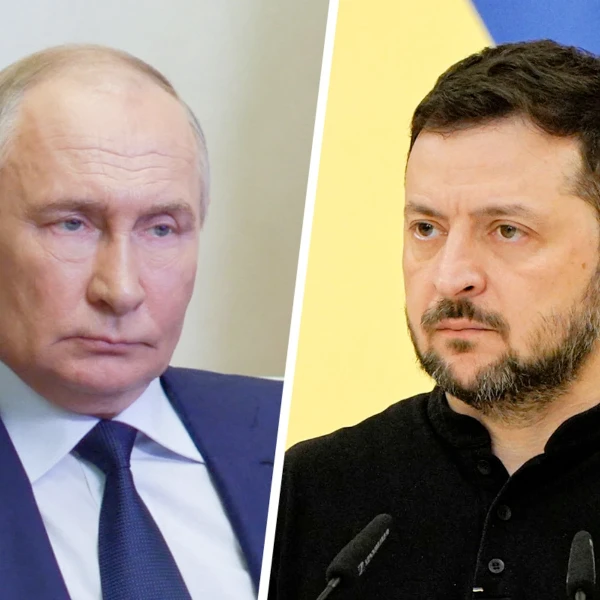
Both the model and the market expect Zelenskyy and Putin to speak before January 20, 2029, with no compelling evidence of mispricing.

1. Executive Verdict

  • Ukraine officially forbids direct negotiations with the current Russian president.
  • A potential Trump presidency might compel Ukraine into talks.
  • Cessation of U.S. aid could force Ukraine to negotiate.
  • Ukraine has previously requested Turkish mediation for talks.
  • Turkey's President Erdoğan actively mediates Ukraine-Russia peace discussions.

Who Wins and Why

Outcome Market Model Why
Before July 2026 5.3% 5.6% A potential Trump presidency could compel Ukraine into talks through aid cessation by July 2026.
Before 2027 23.0% 22.9% A potential Trump presidency could compel Ukraine into talks through aid cessation before 2027.
Before Jan 20, 2029 48.0% 45.8% A potential Trump presidency and past Turkish mediation efforts increase talks likelihood before 2029.

2. Market Behavior & Price Dynamics

Historical Price (Probability)

Outcome probability
Date
Based on the provided chart data, the prediction market for a meeting between Zelenskyy and Putin has been trading in a narrow, sideways range, suggesting a stable, albeit very low, perceived probability of the event occurring. The market opened with a 9.0% chance and briefly touched a high of 10.0% before experiencing a significant drop. The most notable price movement was a decline from 9.0% to the current price of 5.3% around April 27, 2026. Without additional news context, this sharp decrease appears to be driven by an internal market shift rather than a specific external event. The price has since stabilized at this lower level.
The volume patterns provide insight into trader conviction. The market saw very little activity initially, but the significant price drop to 5.3% was accompanied by a surge in volume, with 188.67 contracts traded on that day. This indicates that the move lower was backed by strong selling pressure and a high degree of conviction among traders. The total volume of 8,144 contracts suggests moderate but meaningful engagement. The price action has established a clear support level at 5.3%, which is the current market floor. The previous trading level of 9.0% and the peak of 10.0% now act as resistance levels.
Overall, the chart reflects a deeply pessimistic market sentiment regarding the likelihood of direct talks between the two leaders before the January 2029 deadline. The initial low probability of around 9% was decisively revised downward, and the market has since settled at a new consensus of approximately 5%. This stability at a very low probability indicates that traders currently see no clear path or catalyst that would make such a meeting likely in the foreseeable future.

3. Market Data

View on Kalshi →

Contract Snapshot

This Kalshi market resolves to "Yes" if Volodymyr Zelenskyy and Vladimir Putin have a direct, real-time meeting (in-person or virtual call) before January 20, 2029, as verified by official or accredited media sources. If such a meeting does not occur by this date, the market resolves to "No." The market closes early if the event happens, otherwise by January 19, 2029, 11:59 PM EST, with payouts projected 30 minutes after closing.

Available Contracts

Market options and current pricing

Outcome bucket Yes (price) No (price) Last trade probability
Before July 2026 $0.06 $0.94 5%
Before 2027 $0.24 $0.77 23%
Before Jan 20, 2029 $0.50 $0.53 48%

Market Discussion

Traders are divided on the likelihood of a direct meeting between Zelenskyy and Putin before 2029. Arguments for a meeting highlight potential US efforts, particularly from a future Trump administration, to broker such talks, citing recent discussions between Zelenskyy and Trump's team. However, skepticism persists, with traders arguing that fundamental disagreements and a lack of willingness from either side to surrender make a meaningful meeting or peace deal unlikely.

4. What are Ukraine's preconditions for peace talks with Russia?

Negotiations with current Russian PresidentForbidden by decree from September 30, 2022 [^]
Ukraine's Negotiation PreconditionsRestoration of 1991 territorial integrity, troop withdrawal, compensation, war criminal punishment, non-repetition guarantees [^]
Presidential Office StancePresident Zelenskyy will not negotiate with current Russian president [^]
Ukraine has established specific preconditions for negotiations with Russia. These conditions include the complete restoration of Ukraine's territorial integrity and sovereignty within its 1991 borders, the full withdrawal of Russian troops from Ukrainian territory, respect for the UN Charter, compensation for damages, punishment for war criminals, and guarantees of non-repetition [^]. These requirements outline Kyiv's foundational expectations for any potential diplomatic engagement with Moscow.
Ukraine currently forbids direct presidential talks with Vladimir Putin. President Zelenskyy issued a decree on September 30, 2022, explicitly stating that negotiations with the current Russian president are "impossible" [^]. This position was reinforced by Andriy Yermak, Head of the Presidential Office, who affirmed that President Zelenskyy "will never talk to an aggressor and a person who is not able to keep his promises" [^]. It is important to note that this decree prohibits negotiations solely with the current Russian president and does not generally forbid negotiations with Russia itself [^].
Kremlin preconditions for talks remain unspecified by public sources. The provided research does not detail any publicly stated preconditions from the Kremlin for direct presidential talks. Furthermore, there is no intelligence from sources, including the Turkish Foreign Ministry, suggesting any softening of Ukraine's September 30, 2022 decree concerning negotiations with Putin, with Kyiv's position showing "no signs of changes" regarding talks with the current Russian president [^].

5. What Role is Turkey Playing in Zelenskyy-Putin Talks?

Mediator EngagementPresident Erdoğan is actively engaged in shuttle diplomacy to facilitate direct talks [^]
Ukrainian RequestUkraine explicitly asked Turkey to help arrange a meeting between the two presidents [^]
Venue Offer & VisitErdoğan offered Istanbul as a venue for peace talks; Zelenskyy visited Istanbul in April 2026 [^]
Turkey's President Erdoğan actively mediates Ukraine-Russia peace talks. Turkish President Recep Tayyip Erdoğan is the third-party leader most engaged in shuttle diplomacy to facilitate a direct conversation between Ukrainian President Volodymyr Zelenskyy and Russian President Vladimir Putin. Ukraine has specifically requested Turkey's help in arranging such a meeting [^]. During an April 2026 visit to Istanbul, President Zelenskyy held talks with Erdoğan that covered new security cooperation and the prospect of a truce [^]. Erdoğan has offered Istanbul as a neutral location for potential peace talks [^].
Specific de-escalation framework details requiring direct talks are not fully elaborated. Turkey's active involvement primarily focuses on providing a neutral venue and mediating efforts to bring the two leaders together for discussions on a ceasefire and broader peace [^]. This engagement prioritizes direct dialogue to address the ongoing conflict, with Ukraine agreeing to new security cooperation with Turkey as part of these efforts [^].
Other leaders also engage, but Erdoğan leads direct mediation. While figures such as the Pope and China's President Xi Jinping have undertaken diplomatic roles, their involvement differs. The Pope has communicated with President Zelenskyy, conveying hopes for a cessation of hostilities and a just, lasting peace [^]. China's President Xi Jinping is noted for maintaining a "stabilizing role" through his talks with various international leaders [^]. Nonetheless, based on the provided research, President Erdoğan, through Turkey, appears to be the most consistently and explicitly involved in actively seeking to facilitate a direct meeting between President Zelenskyy and President Putin.

6. Will Trump's Presidency Force Ukraine to Negotiate with Russia?

U.S. Election OutcomeDonald Trump won the 2024 U.S. presidential election [^]
Proposed Foreign Aid2026 budget proposal includes ending all U.S. foreign aid [^]
Military Aid ConditionPlans to halt U.S. military aid to Kyiv unless peace talks occur [^]
Donald Trump's victory signals a major reduction and potential cessation of U.S. aid. Following Donald Trump's win in the 2024 U.S. presidential election [^], a significant decrease and reorientation of military and financial aid to Ukraine is anticipated. Under a new Trump administration, the proposed 2026 budget aims to end all U.S. foreign aid, which would directly affect and potentially terminate assistance to Ukraine [^]. This projected policy change would lead to Ukraine's aid supplies running dry, marking a substantial alteration from consistent support to a halt [^].
Aid will shift to a conditional leverage for peace negotiations. Beyond a mere reduction, the alteration in aid involves a conditional approach. Trump has reportedly reviewed plans to halt U.S. military aid to Kyiv unless Ukraine agrees to peace negotiations with Moscow [^]. This represents a strategic pivot in U.S. policy, moving from direct military and financial assistance towards utilizing aid as leverage to facilitate peace talks [^]. This substantial reduction, or outright cessation, of U.S. military and financial assistance, particularly if tied to demands for negotiation, would constitute the threshold compelling Ukrainian President Zelenskyy to open a direct channel to Putin out of necessity. While Zelenskyy has historically resisted pressure regarding negotiations [^], the complete cessation of U.S. aid and the shift in U.S. approach from aid to negotiation [^] would create an urgent imperative for Ukraine to seek alternative strategies, including direct talks.

7. What Reserve Depletion Levels Could Force Putin to Seek a Summit?

National Wealth Fund Value (April 1, 2026)$165 billion [^]
International Reserves (End of March 2026)$748 billion [^]
Decrease in International Reserves (March 2026)$55.9 billion [^]
Russia is rapidly depleting its National Wealth Fund due to war spending. The National Wealth Fund (NWF) is being drawn down at an accelerating pace to cover budget deficits, primarily driven by increased military spending and reduced oil and gas revenues [^]. This fund serves as the main source for financing Russia's budget deficit, with analysis from the Bank of Finland Institute for Emerging Economies (BOFIT) indicating that war spending has necessitated significant withdrawals [^]. As of April 1, 2026, the NWF's total value was reported to be $165 billion [^].
Russia's international reserves have significantly decreased in recent months. These reserves experienced substantial reductions, notably in March 2026, when they decreased by approximately $55.9 billion. This decline saw the reserves fall from $803.9 billion at the end of February 2026 to $748 billion by the end of March 2026, representing a 7.45% reduction for the month [^]. Earlier in January 2026, the international reserves also saw a $5 billion decrease [^].
No specific depletion level forces Putin to seek a summit. Despite the evident burn rate of both the National Wealth Fund and international reserves, the available research does not provide a precise depletion level that would likely compel President Putin to seek a summit as a potential off-ramp [^]. The reviewed sources focus on the economic impact and financing methods rather than identifying political trigger points tied to specific reserve thresholds [^].

8. Is There Verifiable Back-Channel Support for Zelenskyy-Putin Talks?

Zelenskyy's Negotiation StanceOpen to "any format, at any time" for peace talks [^]
US Proposed GoalDirect talks for a peace deal by June [^]
IAEA Role in Direct TalksMonitoring nuclear safety, not facilitating direct Zelenskyy-Putin calls [^]
Formal peace negotiations show significantly more active, verifiable back-channel support. President Zelenskyy has consistently advocated for direct discussions with Russian President Putin and broader peace negotiations, expressing openness to "any format, at any time," though specifically excluding Russia or Belarus as potential venues [^]. Ukraine has actively engaged Turkey to mediate a potential Zelenskyy–Putin summit, indicating efforts to break diplomatic impasses [^]. Furthermore, the United States has proposed direct talks involving Russia and Ukraine, with an expressed aim for a peace deal by June [^]. Zelenskyy had anticipated the next round of peace talks with Russia in March [^] and emphasized in April 2026 that discussions regarding Ukraine cannot be postponed [^], referencing recent diplomatic efforts and stating Ukraine relies on upcoming talks with the US and Russia [^].
Verifiable back-channel support for crisis management calls is minimal. In contrast to the robust efforts for peace negotiations, available information shows significantly less active and verifiable back-channel support for limited-scope crisis management calls, such as those facilitated by the International Atomic Energy Agency (IAEA) concerning nuclear safety. While the IAEA Director General has issued numerous statements on the nuclear safety situation in Ukraine [^], these communications do not describe or imply any direct channels or proposed calls between Zelenskyy and Putin specifically brokered by the IAEA for crisis management purposes. The IAEA's role in these instances is depicted primarily as monitoring and assessment, rather than facilitating high-level bilateral discussions.

9. What Could Change the Odds

Key Catalysts

Catalyst analysis unavailable.

Key Dates & Catalysts

  • Expiration: July 08, 2026
  • Closes: January 20, 2029

10. Decision-Flipping Events

  • Trigger: Catalyst analysis unavailable.

12. Historical Resolutions

No historical resolution data available for this series.