
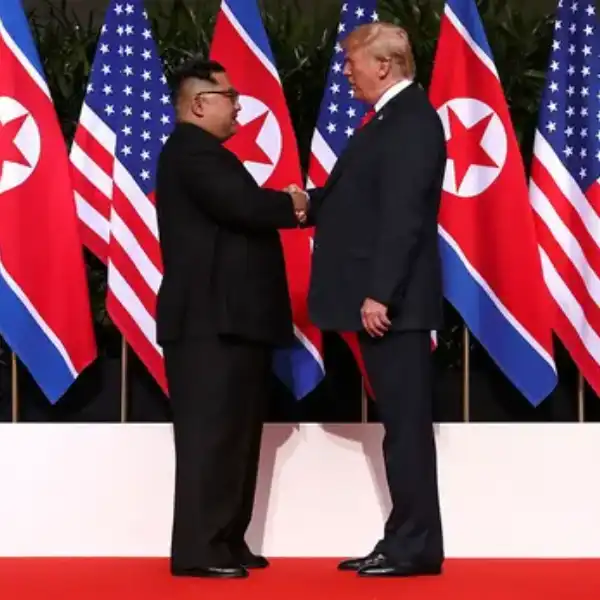
Will Kim Jong-Un visit the US during Trump's term?
Yes refers to: During Trump's term
Short Answer
Both the model and the market expect Kim Jong-Un to visit the US during Trump's term, with no compelling evidence of mispricing.
1. Executive Verdict
- US advisors required denuclearization steps for productive engagement.
- North Korea's engagement demands have significantly shifted per state media.
- Republican hawks demanded denuclearization before legitimizing Kim Jong-Un.
- China consistently emphasized dialogue and denuclearization for regional stability.
- No confirmed reports exist of logistical meetings for a Kim Jong-Un visit.
Who Wins and Why
| Outcome | Market | Model | Why |
|---|---|---|---|
| During Trump's term | 17.0% | 17.0% | Kim Jong-Un did not visit the United States during Donald Trump's presidential term. |
2. Market Behavior & Price Dynamics
Historical Price (Probability)
Outcome probability
Date
This market has exhibited a clear downward trend since its opening. The perceived probability of the event started at 25.0% and has since fallen to its current and lowest price of 17.0%. The most significant movement occurred early in the market's timeline, with a sharp drop from 25.0% to 17.0% over a two-week period. Since this initial decline, the price has remained stable, suggesting that traders quickly re-evaluated the initial odds and settled on a new, lower consensus.
Without any accompanying news or developments, the specific catalyst for the sharp initial drop cannot be identified from the available data. The price action itself, however, points to a strong and swift shift in market sentiment. The current price of 17.0% has acted as a firm support level for the majority of the market's duration. The opening price of 25.0% serves as the key resistance level. The total volume of 1,822 contracts is relatively low across the 312 data points, indicating moderate conviction and participation. This stability at a low probability suggests the market sentiment is consistently pessimistic regarding the likelihood of this visit occurring.
3. Market Data
Contract Snapshot
The market resolves to YES if Kim Jong-Un visits the United States before January 20, 2029, with the outcome verified by The New York Times; otherwise, it resolves to NO. The market opened on December 18, 2024, and will close early upon the event's occurrence, or by January 20, 2029, at 10:00 am EST. Individuals employed by Source Agencies or possessing material, non-public information are prohibited from trading this contract.
Available Contracts
Market options and current pricing
| Outcome bucket | Yes (price) | No (price) | Last trade probability |
|---|---|---|---|
| During Trump's term | $0.21 | $0.83 | 17% |
Market Discussion
Limited public discussion available for this market.
4. What Are Denuclearization Preconditions for Kim Jong-Un's US Visit?
| Fleitz's Denuclearization Demands | Stopping missile and nuclear testing, freezing fissile material production, inviting international inspectors, closing facilities, and shipping out nuclear materials to meet with Trump and discuss easing sanctions [^]. |
|---|---|
| O'Brien's Summit Condition | A summit with Kim would be pursued if it was anticipated to 'produce a deal' [^]. |
| White House Dialogue Stance | Trump remained open to dialogue with Kim 'without any preconditions' [^]. |
Senior advisors outlined denuclearization steps for productive engagement, not scheduling initial meetings. Donald Trump's senior foreign policy advisors articulated denuclearization steps primarily as requirements for successful high-level engagement or as desired outcomes, rather than as explicit, absolute minimum preconditions for scheduling a state visit for Kim Jong-Un to the US. Fred Fleitz, a former National Security Council official, emphasized specific demands for Kim Jong-Un to agree to a full denuclearization plan if he wished to meet with Trump and discuss easing sanctions [^]. These demands included immediately stopping all testing of missiles and nuclear weapons, freezing all production of nuclear fissile material, inviting international inspectors to all nuclear and missile sites, closing all nuclear and missile facilities, and shipping all nuclear warheads and fissile materials out of North Korea [^].
Trump's administration prioritized deal potential and open dialogue, not specific preconditions for initial scheduling. Robert O'Brien, then National Security Advisor, stated that President Trump was open to a summit with Kim Jong-Un if it was anticipated to "produce a deal" [^]. This implied that the potential for a substantive outcome, likely related to denuclearization, would be a motivator for a summit, rather than specific denuclearization steps being a prerequisite for scheduling the event itself. More broadly, the White House publicly indicated a willingness for dialogue, noting Trump remained open to dialogue with Kim "without any preconditions" [^]. Based on the available sources, while advisors like Fleitz outlined comprehensive denuclearization steps as necessary for productive engagement and the discussion of sanctions relief, the materials do not explicitly detail these or other specific denuclearization actions as absolute minimum preconditions for scheduling a state visit for Kim Jong-Un to the US. The focus appears to have been on preconditions for successful meetings or the desired outcomes of such summits, rather than the initial scheduling of a formal state visit to the US.
5. What Are North Korea's New Preconditions for US Engagement?
| US Engagement Condition | Dropping "hostile policy" [^] |
|---|---|
| "Hostile Policy" Component | Discarding "denuclearization obsession" [^] |
| Nuclear Program Approach | Pivot towards arms control talks, not dismantlement [^] |
North Korea's primary demand for US engagement has significantly shifted, according to statements from Kim Jong Un and state media. Pyongyang has moved away from the traditional "denuclearization-for-sanctions relief" framework, instead demanding a fundamental change in US policy, particularly concerning North Korea's nuclear status [^]. Key signals consistently link US engagement to Washington dropping its "hostile policy" [^], a core component of which is discarding the US's "denuclearization obsession" [^]. This demand was also reiterated in North Korea's 2026 UN General Assembly statement, which called for the US to "withdraw its hostile policy" [^].
Pyongyang now seeks US acceptance of its nuclear status as a prerequisite for any talks [^] . While symbolic gestures like a formal declaration ending the Korean War or the establishment of liaison offices could be part of a normalized relationship, current research indicates these are not the primary ask for a US visit. Instead, the overriding demand is for a fundamental reorientation of US policy towards North Korea's existing nuclear capabilities. This is further underscored by Pyongyang's reported pivot towards seeking "arms control talks" with the US in 2026 [^], indicating a willingness to negotiate the management of its nuclear arsenal rather than agreeing to its complete dismantlement.
6. Did Republican Hawks Prepare Legislative Roadblocks for Kim Jong-Un Visit?
| Cotton's Denuclearization Stance | Any future agreement must include the complete, verifiable, and irreversible denuclearization of the Korean Peninsula [^] |
|---|---|
| Graham's Reservations on Agreement | We're a long ways away from an agreement and Kim should not play Donald Trump [^] |
| Legislative Roadblocks Evidence | No direct evidence of pre-emptively preparing legislative roadblocks [^] |
Key Republican national security hawks expressed skepticism, demanding denuclearization before legitimizing Kim Jong-Un. Key Republican national security hawks, including Senators Tom Cotton and Lindsey Graham, demonstrated significant caution regarding engagements with Kim Jong-Un during the previous Trump administration. While they did not explicitly rule out the legitimacy of a visit, their public statements consistently prioritized concrete denuclearization steps over legitimizing the regime through high-level meetings.
Senators Cotton and Graham voiced strong reservations, focusing on conditions, not legislative blocks. Senator Tom Cotton acknowledged President Trump's willingness to meet but underscored North Korea's history of 'making empty promises,' stating that any future agreement 'must include the complete, verifiable, and irreversible denuclearization of the Korean Peninsula' [^]. Senator Lindsey Graham also expressed strong reservations in March 2018, noting, 'We're a long ways away from an agreement' and urging Kim Jong-Un not to 'play Donald Trump' [^]. Graham stressed that diplomacy's goal should be denuclearization, warning against 'talks for talks sake' and repeating past errors where North Korea used negotiations to gain time and resources [^]. Despite their strong caution and skepticism regarding North Korea's intentions and the potential for successful outcomes from high-level meetings, the available sources do not contain evidence that these senators explicitly prepared legislative roadblocks to prevent a Kim Jong-Un visit to the US. Their focus centered more on the substance and stringent conditions of engagement rather than pre-emptively blocking a potential diplomatic event [^], aligning with a general sentiment among many Republicans in Congress to maintain pressure and avoid concessions without tangible denuclearization progress [^].
7. What is China's Stance on US-DPRK Relations and Denuclearization?
| China's Coordination | Emphasizes "closer coordination" with the DPRK [^] |
|---|---|
| High-Level Diplomacy | President Xi Jinping held talks with DPRK leader Kim Jong Un [^] |
| Sidelining Concern | Views being sidelined from US-DPRK talks as a significant risk [^] |
China consistently emphasizes dialogue and denuclearization for regional stability. China's Ministry of Foreign Affairs communicates an official position that consistently highlights the importance of dialogue and denuclearization for peace and stability on the Korean Peninsula. Beijing actively pursues high-level diplomacy, with Chinese President Xi Jinping engaging in talks with DPRK leader Kim Jong Un to strengthen bilateral relations [^]. China's senior diplomats have also met with Kim, advocating for "closer coordination" between the two nations [^]. This ongoing emphasis on bilateral coordination demonstrates China's desire to maintain a central and influential role in all developments concerning the DPRK.
China seeks to prevent marginalization in US-DPRK summit discussions. Regarding a potential bilateral US-DPRK summit, particularly if held on American soil, China's position is shaped by its aim to prevent its influence from being marginalized. While official Chinese statements do not explicitly detail the specific location of such a summit in the titles of its Ministry of Foreign Affairs press conferences [^], external analysis indicates that a primary concern for China in US-DPRK discussions is the risk of being sidelined [^]. China's willingness to collaborate with the United States to build a strong foundation for bilateral ties [^] suggests a preference for cooperative diplomatic approaches where Beijing's role is recognized and integrated into the denuclearization process. Therefore, while China generally supports dialogue that fosters peace, it implicitly views any efforts that bypass or diminish its coordinating role as potentially undermining its influence.
8. Were US-North Korea Logistical Meetings Held For Kim's Visit?
| Unpublicized Meetings for US Visit | No specific reports confirming logistical or security-focused meetings between US and North Korean personnel for a potential visit by Kim Jong Un to the United States [^]. |
|---|---|
| Potential Trump-Kim Meeting | US officials were 'quietly discussing' a potential meeting between Donald Trump and Kim Jong Un during an upcoming Asia trip (October 2025) [^]. |
| Trump Team Contingency Plans | Trump's team was making 'contingency plans' for a potential encounter, including a surprise DMZ visit (October 2025) [^]. |
No specific reports detail unpublicized logistical or security planning meetings. Based on available research, there are no confirmed reports of unpublicized logistical or security-focused meetings involving US State Department or Secret Service personnel and their North Korean counterparts, potentially in a third country like Sweden or Singapore. Such meetings would typically serve as a direct precursor indicating advanced planning for a visit by Kim Jong Un to the United States. While a broader interest in engagement is evident, the detailed planning for a high-level visit to the US is not explicitly mentioned in the provided sources.
Preliminary discussions indicated a potential encounter between leaders in late 2025. There were, however, indications of preliminary discussions regarding a potential meeting between Donald Trump and Kim Jong Un. In October 2025, US officials were "quietly discussing" a possible encounter during an upcoming Asia trip [^]. Concurrently, Trump's team was reportedly making "contingency plans" for a potential meeting during that same October 2025 trip to Korea, with consideration given to a surprise visit to the Demilitarized Zone (DMZ) [^].
The United States consistently expressed openness to dialogue with North Korea. Throughout late 2025 and early 2026, the United States consistently reaffirmed its openness to dialogue and talks with North Korea [^]. While these events signal a diplomatic environment conducive to potential discussions, the specific logistical and security coordination meetings between US and North Korean personnel for a visit by Kim Jong Un to the US are not detailed in the available information.
9. What Could Change the Odds
Key Catalysts
Catalyst analysis unavailable.
Key Dates & Catalysts
- Expiration: January 20, 2029
- Closes: January 20, 2029
10. Decision-Flipping Events
- Trigger: Catalyst analysis unavailable.
12. Historical Resolutions
No historical resolution data available for this series.
Get Real-Time Research Updates
Sign up for early access to live reports, historical data, and AI-powered market insights delivered to your inbox.
