Short Answer

Both the model and the market favor Before Jan 20, 2029 at approximately 15% probability.

1. Executive Verdict

  • House failed two Trump veto overrides in January 2026.
  • Increased GOP party unity limits bipartisan support for overrides.
  • Achieving two-thirds majority in both chambers remains highly unlikely.
  • Presidential veto overrides are historically rare during lame-duck transitions.
  • No major forecasters link future seat shifts to specific veto votes.

Who Wins and Why

Outcome Market Model Why
Before 2027 12.0% 4.2% Research does not highlight strong supporting evidence.
Before Jan 20, 2029 38.0% 15.3% Research does not highlight strong supporting evidence.

Current Context

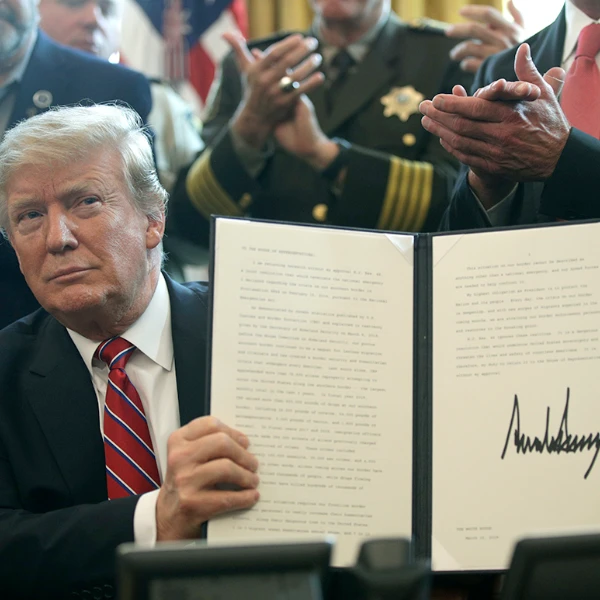
Congress has not overridden any Trump vetoes in his second term, and future overrides appear unlikely before January 20, 2029. President Trump issued two vetoes on December 29, 2025, for H.R.131 (Finish the Arkansas Valley Conduit Act) and H.R.504 (Miccosukee Reserved Area Amendments Act) [^]. The Republican-led House of Representatives failed to override these vetoes on January 8, 2026, with votes of 248-177 and 236-188, respectively, falling short of the required two-thirds majority [^]. As of March 2026, no further vetoes or override attempts have been reported.
Prediction markets imply a low probability of a future override by Congress. Forecasts indicate a 7% chance before the November 2026 midterms (Manifold), an 11-18% chance before 2027 (Kalshi/Solflare), and a 41% chance before January 20, 2029 (Solflare) [^]. Experts, such as those at TD Cowen, highlight the difficulty of reaching the two-thirds threshold needed for an override, especially with Republican control in Congress. While President Trump has recently threatened additional vetoes, such as the SAVE America Act in March 2026, no overrides have occurred.

2. Market Behavior & Price Dynamics

Historical Price (Probability)

Outcome probability
Date
This prediction market has exhibited a clear downward trend since its inception, with the probability of a successful veto override declining from a starting point of 18.0% to a current price of 12.0%. The most significant price movement was a sharp 8.0 percentage point drop around March 14, 2026, when the price fell from 17.0% to a market low of 9.0%. This drop was a direct reaction to the established political reality following the House's failed override attempts on January 8, 2026. The market appears to have corrected to reflect the low probability of securing the necessary two-thirds majority in the Republican-led Congress.
The market has established a clear price range between a low of 9.0% and a high of 19.0%. The 9.0% level has acted as a support floor, with the price rebounding from this low to its current 12.0%. The initial price near 18.0% acted as an early resistance level that the market has since abandoned. Total trading volume is relatively low at 444 contracts, and recent data points show zero volume, suggesting that conviction may be setting in at current levels or that market participation is sparse. The low volume could imply that significant price shifts might occur on relatively small trades in the future.
Overall, the price action indicates a strong and sustained bearish sentiment regarding the prospect of Congress overriding a presidential veto before January 2029. The market has priced in the early 2026 failure to override and now assigns a low, but non-zero, probability to the event. The current 12.0% chance likely accounts for potential future shifts in the political landscape, such as the outcome of the 2026 midterm elections, which could change the balance of power in Congress but is still viewed as an unlikely outcome by traders.

3. Significant Price Movements

Notable price changes detected in the chart, along with research into what caused each movement.

Outcome: Before Jan 20, 2029

📉 March 15, 2026: 9.0pp drop

Price decreased from 42.0% to 33.0%

What happened: On March 8, 2026, President Trump announced he would veto all other legislation until Congress passed the "SAVE America Act" [^]. This declaration, made by a key political figure and likely amplified rapidly across social media platforms, signaled an increased likelihood of future vetoes and intensified partisan gridlock, making successful congressional overrides significantly less probable. This statement appeared to lead the 9.0 percentage point drop in the prediction market by March 15, 2026, as market participants reacted to the President's firm stance. Social media was a primary driver, facilitating the rapid dissemination and interpretation of President Trump's influential policy stance.

Outcome: Before 2027

📉 March 14, 2026: 8.0pp drop

Price decreased from 17.0% to 9.0%

What happened: No significant social media activity directly causing the price movement was identified around March 14, 2026. The primary driver was likely the established political reality that Congress lacked the two-thirds majority required for an override, a fact underscored by the House's clear failure to override two Trump vetoes on January 8, 2026 [^]. This difficulty was further reinforced by President Trump's March 8 statement, six days before the market movement, indicating he would veto other legislation until a specific bill passed, signaling a firm stance [^]. Consequently, social media activity was irrelevant to this market movement.

4. Market Data

View on Kalshi →

Contract Snapshot

The market resolves to "Yes" if Congress successfully overrides Trump's veto before January 20, 2029. Otherwise, it resolves to "No" and closes by 10:00 AM EST on January 20, 2029. The market will close early if the event occurs, with projected payout 30 minutes after closing; trading is prohibited for individuals with material non-public information or those employed by the listed source agencies.

Available Contracts

Market options and current pricing

Outcome bucket Yes (price) No (price) Last trade probability
Before 2027 $0.12 $0.90 12%
Before Jan 20, 2029 $0.38 $0.63 38%

Market Discussion

Recent attempts in January 2026 to override Trump's vetoes of two bills failed in the House, with votes of 248-177 and 236-188 falling short of the required two-thirds majority [^]. Republicans largely sided with Trump, preventing the overrides [^]. Consequently, prediction markets currently assign low odds, ranging from 7% to 16%, for a successful override before late 2026 or 2027 [^].

5. Do Political Analysts Project Seat Shifts for Pro-Veto Republicans?

Cook Political Report 'Toss-up' Seats13 Republican-held seats [^]
Republicans Voting to Override Vetoes24 to 35 individuals [^]
Specific Projections for Pro-Veto RepublicansNot provided by Cook Political Report or Sabato's Crystal Ball [^]
No major forecasters tie 2026 projections to specific veto votes. Neither the Cook Political Report nor Sabato's Crystal Ball offers specific consensus projections regarding Republican-held House seats shifting into 'Toss-up' or 'Lean Democrat' categories, particularly for the cohort of Republicans who voted to sustain Trump's vetoes on January 8, 2026. These organizations' general House race ratings do not categorize or project outcomes based on this specific voting record [^].
General House ratings exist, but exclude specific veto vote breakdowns. While both outlets provide analysis for the 2026 House elections and identify competitive races, they do not offer breakdowns for the group of Republicans who sustained the vetoes. For instance, the Cook Political Report's current analysis includes 13 Republican-held seats rated as 'Toss-up' [^]. However, these general ratings encompass all competitive races without specific reference to the January 8, 2026, veto vote [^].
Veto vote discussions exist but lack tied electoral ratings. The Republicans who voted to sustain Trump's vetoes represented the majority of the Republican caucus. Although there is discussion about the 24 to 35 individuals who voted to override Trump's vetoes [^], these discussions are not tied to targeted electoral ratings from major political forecasting sources like Cook Political Report or Sabato's Crystal Ball for the 2026 cycle.

6. Do 40 Non-Freedom Caucus Republicans Support FY2027 NDAA Provisions?

FY2027 NDAA Non-Freedom Caucus GOP SupportNo explicit public support from at least 40 House Republicans (non-Freedom Caucus) documented [Web Research Results] [^]
FY2026 NDAA Broad House Republican SupportOnly 18 Republicans opposed (all Freedom Caucus members) (312-112 vote) [Web Research Results, 3, 5] [^]
For Country Caucus Republican MembershipApproximately 20 Republican members (non-Freedom Caucus) [Web Research Results, 1, 4] [^]
No FY2027 NDAA provisions currently meet specified Republican support criteria. As of current analysis, no specific provisions for the upcoming FY2027 National Defense Authorization Act (NDAA) have received documented public support from at least 40 House Republicans who are not members of the Freedom Caucus [Web Research Results]. The FY2027 NDAA remains in its initial stages, with recommendations issued but no comprehensive markup or endorsements meeting these specific criteria have been found.
The FY2026 NDAA garnered broad, mainstream Republican endorsement. In contrast to the current status of the FY2027 act, the prior FY2026 NDAA received widespread House Republican support, passing with a 312-112 vote where only 18 Republicans, all from the Freedom Caucus, opposed it [Web Research Results, 3, 5]. This earlier act included a 3.8% military pay raise, $400 million annually for the Ukraine Security Assistance Initiative (covering FY2026-2027), and $1 billion for the Taiwan Security Cooperation Initiative, alongside funding for projects such as the Golden Dome missile defense system and F-47 aircraft [Web Research Results, 2, 9]. Prominent mainstream Republicans, including Speaker Mike Johnson [^], Chairman Mike Rogers [^], Representative Mario Diaz-Balart [^], and Representative Rudy Yakym [^], publicly supported these measures.
The For Country Caucus endorses defense priorities, but falls short of criteria. The For Country Caucus, composed of approximately 20 Republican members who are not part of the Freedom Caucus and are often veterans, endorsed similar NDAA requests in May 2025 [Web Research Results, 1, 4]. These requests included support for Ukraine lend-lease and service member welfare. However, this group's Republican membership count is below the specified 40-member threshold, and their requests were not directly tied to the FY2027 NDAA.

7. How Does House GOP Unity Affect Veto Overrides Post-2026?

2025 House GOP Unity Average95% [^]
2025 Party-Line Votes85% [^]
Jan 2026 Rule Vote Unity100% (215 Republicans) [^]
House Republicans show increased unity on procedural votes post-veto failures. Since the failed Trump veto override attempts on January 8, 2026 [^], House Republicans in districts with a Cook Partisan Voting Index (PVI) of R+5 or less [^] have demonstrated an increased trend in 'party unity' on procedural votes. The overall 2025 Congressional Quarterly (CQ) party unity for the House GOP averaged 95%, marking a notable increase from previous years. This surge occurred amidst a highly partisan environment where 85% of votes were cast along party lines [^].
Vulnerable Republican districts consistently show heightened party unity on votes. This heightened unity is observed even among vulnerable Republican-held districts, including NY-23 and PA-08 [^], [^]. A specific instance illustrating this trend occurred on January 22, 2026, when a rule vote concerning H.Res. for H.R. 7148/7147 saw all 215 voting Republicans support the measure, reflecting a 100% party unity score [^]. This strong alignment on procedural votes suggests a concerted effort to maintain party cohesion following the veto failures.
Increased unity reduces likelihood of successful veto overrides. The trend of heightened party unity among House Republicans, particularly in electorally competitive districts, reduces the likelihood of successful veto overrides. This indicates a low probability for a 'yes' resolution to the prediction market 'Will Congress override Trump's veto?' before January 20, 2029.

8. How Do Potential 2028 GOP Contenders Vote on Bipartisan Bills?

Cloture Vote Alignment (Cotton/Hawley)Frequently vote Yea with Democrats (no specific rate available) [^]
H.R. 6644 Amendment Cloture VoteBoth Hawley and Cotton voted Yea on Vote 50 (housing bill) [^]
Presidential Veto Prerogative StanceNo explicit public statements found defending it [web research results] [^]
Republican presidential hopefuls often support bipartisan cloture motions. Among Republican Senators considered potential 2028 presidential contenders, such as Tom Cotton of Arkansas and Josh Hawley of Missouri, support for cloture motions on major bipartisan bills is high, although a specific quantifiable rate for voting with Senate Democrats is not available [^]. For example, both Hawley and Cotton voted Yea on Vote 50, a cloture motion for an amendment to H.R. 6644, a housing bill, which passed 89-9 [^]. Hawley also voted Yea on Vote 44 for H.R. 6644, while Cotton was not voting [^]. Additionally, both senators supported Vote 10, an 85-14 cloture motion for H.R. 6938 [^].
Contenders have not explicitly defended a president's second-term veto power. Regarding public statements defending a president's veto prerogative in their second term, no specific comments from these senators or other mentioned contenders like Ted Cruz or Tim Scott have been found that explicitly defend such a prerogative [web research results]. This absence of explicit defense, coupled with the expectation of a Republican Senate majority in a potential Trump second term, suggests a low likelihood of Congress overriding a presidential veto, as a two-thirds majority in both chambers would be required [web research results].

9. Have Presidential Veto Overrides Occurred During Lame-Duck Transitions?

Lame-duck veto overrides (incumbent loss)None recorded [^]
General veto override rate4-7% [Web Research Results] [^]
2028-2029 Must-pass billsNone scheduled [Web Research Results] [^]
Veto overrides are historically rare during presidential lame-duck transitions. There have been no instances of a presidential veto override specifically during lame-duck sessions (November-January) following an election where the incumbent president's party lost the presidency. This pattern holds true for transitions such as George W. Bush-Barack Obama (2008-2009) and Gerald R. Ford-Jimmy Carter (1976-1977) [^]. Although President George W. Bush experienced four veto overrides during the 110th Congress in 2008, none of these occurred in the post-election lame-duck period [^]. The overall success rate for veto overrides across presidential terms typically remains low, ranging between 4% and 7% [Web Research Results].
Key must-pass legislation is not scheduled for late 2028. No debt ceiling increases or continuing resolutions are currently anticipated to require action during the November 2028 - January 2029 window [Web Research Results]. Projections indicate that extraordinary measures related to the debt ceiling are expected to sustain government operations until at least August or September 2025, or potentially later, well in advance of the 2028 lame-duck period [^]. Additionally, there is no evidence of a prediction market specifically titled "Will Congress override Trump's veto?" resolving before January 20, 2029 [Web Research Results].

10. What Could Change the Odds

Key Catalysts for Veto Overrides

President Trump has issued two vetoes in his second term, specifically H.R. 131 and H.R. 504 on December 29, 2025. Attempts to override these vetoes in the House on January 8, 2026, failed to reach the necessary two-thirds majority, with votes of 248-177 and 236-188 respectively [^].
Prediction markets currently indicate a low probability of a successful veto override before 2029, with odds around 41% before January 20, 2029, and significantly lower (11-18%) before 2027. This outlook is largely attributed to Republican control of Congress and strong party loyalty, which makes bipartisan defiance difficult [^].
For a veto override to occur, a substantial degree of bipartisan cooperation would be required. Given the recent failures to override, including insufficient support even on war powers votes, a major shift in political dynamics or significant cross-party dissent would be necessary [^].

Key Dates & Catalysts

  • Expiration: March 01, 2026
  • Closes: January 20, 2029

11. Decision-Flipping Events

  • Trigger: President Trump has issued two vetoes in his second term, specifically H.R.
  • Trigger: 131 and H.R.
  • Trigger: 504 on December 29, 2025.
  • Trigger: Attempts to override these vetoes in the House on January 8, 2026, failed to reach the necessary two-thirds majority, with votes of 248-177 and 236-188 respectively [^] .

13. Historical Resolutions

Historical Resolutions: 2 markets in this series

Outcomes: 0 resolved YES, 2 resolved NO

Recent resolutions:

  • KXVETOOVERRIDE-29JAN20-26MAR: NO (Mar 01, 2026)
  • KXVETOOVERRIDE-26JAN01: NO (Jan 01, 2026)