Short Answer

Both the model and the market expect Social Security to be mentioned, with no compelling evidence of mispricing.

1. Executive Verdict

  • Trump's campaign consistently uses the "No Tax on Tips" branding.
  • Service industry workers face economic pressures, a likely discussion point.
  • Critics challenge the "No Tax on Tips" policy, which Trump may address.
  • Event advisories lack specific format details for the upcoming roundtable.
  • Trump's rhetoric often mixes worker grievances with policy proposals.

Who Wins and Why

Outcome Market Model Why
Outcome Insufficient data

2. Market Behavior & Price Dynamics

Historical Price (Probability)

Outcome probability
Date
Based on the chart data, this market has experienced a significant downward price movement, settling at an extremely low probability. The market opened with a 6.0% "Yes" probability and traded within a range that peaked at 38.0%. However, the most notable event was a sharp drop from 5.0% to the market's all-time low of 1.0% around April 16th. Since then, the price has remained at this low level, indicating a sideways trend following the initial decline. The current price of 1.0% suggests the market is assigning a very low likelihood to the event occurring.
The volume patterns provide insight into the conviction behind these price movements. The substantial drop to 1.0% was accompanied by a significant spike in trading volume, with 769.59 contracts traded on that day. This high volume suggests strong conviction from traders selling "Yes" shares (or buying "No"), reinforcing the validity of the price drop. The total volume of over 27,500 contracts indicates a relatively active market. Given the lack of specific news context provided, the precise external catalyst for this sharp decline cannot be determined from the chart data alone.
From a technical perspective, the price of 1.0% has established itself as a strong support level, representing the floor of the market's trading history. The historical high of 38.0% acts as a distant resistance level. Overall, market sentiment is overwhelmingly bearish. The combination of the rock-bottom price and the high-volume sell-off that preceded it indicates a strong consensus among traders that the outcome specified in the market question is highly unlikely to happen.

3. Significant Price Movements

Notable price changes detected in the chart, along with research into what caused each movement.

Outcome: McDonald / McDonalds

📉 April 16, 2026: 19.0pp drop

Price decreased from 41.0% to 22.0%

What happened: No supporting research available for this anomaly.

📈 April 15, 2026: 13.0pp spike

Price increased from 32.0% to 45.0%

What happened: No supporting research available for this anomaly.

📈 April 14, 2026: 18.0pp spike

Price increased from 14.0% to 32.0%

What happened: No supporting research available for this anomaly.

Outcome: Biden

📈 April 13, 2026: 38.0pp spike

Price increased from 41.0% to 79.0%

What happened: No supporting research available for this anomaly.

4. Market Data

View on Kalshi →

Contract Snapshot

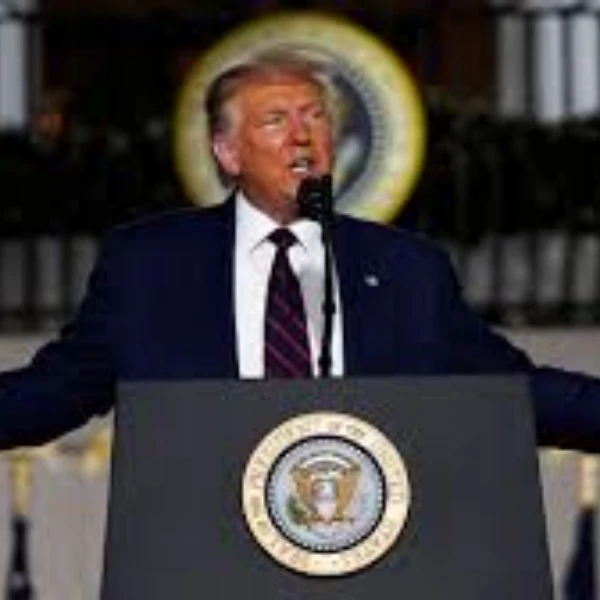
The market resolves to "Yes" if Donald Trump explicitly says "Gas / Gasoline" (or a plural/possessive form) during his official, live-streamed "Roundtable on No Tax on Tips," which must be open to the press. A "No" resolution occurs if the phrase is not spoken, or if the event is cancelled, fails to qualify (e.g., not live, not official capacity), or normal resolution is prevented. Opened on April 13, 2026, the market closes by April 17, 2026, 10 AM EDT, with payouts projected 30 minutes after closing; resolution relies primarily on event video, with official transcripts as backup, and markets remain open if a postponement is announced within 14 days.

Available Contracts

Market options and current pricing

Outcome bucket Yes (price) No (price) Last trade probability

Market Discussion

Limited public discussion available for this market.

5. How Is the "No Tax on Tips" Proposal Branded and Promoted?

Primary Proposal Branding"No Tax on Tips" [^]
Key Benefit Emphasized"Enormous tax cut" for millions [^]
Targeted Beneficiaries100% of tipped workers; working class [^]
Trump's campaign consistently labels its proposal "No Tax on Tips." The primary legislative branding used by the Trump campaign and its allied groups for this proposal is "No Tax on Tips" in their public communications [^] . Trump">[^]. This direct phrasing is notably featured on Donald J. Trump's official website in a news item titled "Only President Trump Will End Taxes On Tips," which underscores the campaign's specific claim regarding the policy [^]. The American Liberty Pac, identified as an allied group, also employs this exact branding in its messaging, for instance, in a piece titled "No Tax on Tips: Real Relief for the Working Class" [^]. This consistent use serves as the core legislative branding across these platforms.
Key phrases elaborate on the proposal's benefits for workers. In addition to the central branding, the campaign and its allies employ several key phrases to detail the proposal's objectives and anticipated benefits. Their messaging frequently emphasizes the intent to "deliver an ENORMOUS TAX CUT to millions of hardworking Americans" and to "boost paychecks" [^]. The policy is highlighted as cutting "taxes for 100% of tipped workers" and designed to "put money back in the pockets of working Americans" [^]. The American Liberty Pac reinforces these themes by describing the proposal as "real relief for the working class," aimed at "delivering immediate and tangible financial relief" and enabling workers to "boost their take-home pay" [^]. The campaign also frames the proposal as a countermeasure to "stop the radical Biden tax hikes" and to "make the Trump Tax Cuts permanent," advocating for "common-sense" solutions for "working families" [^].

6. What Economic Pressures Do Service Industry Workers Face?

Primary ConcernHigh inflation and taxes on finances [^]
Specific Cost IssueRising gas prices [^]
Broad Economic ImpactHigh cost of living impacting finances [^]
While specific names of individual attendees for the Las Vegas roundtable discussion with President Trump have not been disclosed, the event is confirmed to involve "service industry workers" [^] . Their publicly stated concerns, anticipated to be echoed during the discussion, include the significant impact of high inflation, various taxes—especially on tips—the increasing cost of living, and rising gas prices [^]. These issues primarily center on the financial well-being of service industry workers.
Workers face financial strain from inflation, taxes, and living costs. Specifically, service industry workers are experiencing the impact of high inflation and taxes on their finances [^], feeling the pinch of high gas prices, and grappling with the overall high cost of living in Nevada [^]. These economic pressures collectively affect their finances and ability to save [^], as well as their bottom line [^]. In response, Trump is expected to promote his proposal to eliminate taxes on tips, a policy identified as a "key issue for workers in the tourism-driven city where thousands of residents rely on tips" [^], directly addressing their tax and cost of living pressures.

7. What Criticisms Face Trump's "No Tax on Tips" Policy?

Policy CriticismDeceptive ploy, spin [^]
Claim Refuted"$11,000 refund" by featured individual [^]
Policy ReactionLacks genuine impact, political maneuver [^]
Critics strongly challenged Trump's "No Tax on Tips" policy and specific claims. Prior to a recent roundtable, the "No Tax on Tips" policy faced significant criticism, with detractors calling it a "deceptive ploy" requiring "sorting truth versus spin" [^]. A notable incident involved a "DoorDash grandma" featured in a Trump photo opportunity, who publicly refuted his assertion of receiving an "$11,000 refund" related to the policy [^]. This specific event and the broader policy generated "strong reactions," suggesting critics viewed it primarily as a political strategy rather than a substantive worker benefit [^].
Trump typically responds swiftly to direct factual challenges to his statements. Historically, Donald Trump rapidly counter-punches on specific factual claims that directly undermine his public statements or the perceived success of his policies. The refutation of the "$11,000 refund" claim by the "DoorDash grandma" [^] is a direct factual challenge that directly targets an assertion made in a public forum. This type of direct challenge is highly probable to elicit a swift and pointed response from Trump, potentially through social media or public addresses.

8. What is the prevalence of grievances vs. worker policy in speeches?

Quantitative Topic RatioCannot be precisely calculated [^]
Public Speech Transcripts for AnalysisTwo identified (Trump's economic speech [^], Hebron, Kentucky speech [^])
Economic Speech FocusVeered off-topic to target Biden and Powell [^]
A precise quantitative ratio for topic mentions remains uncalculable. The unavailability of complete transcript content prevented direct word counting for Trump's last three rallies. Consequently, a qualitative assessment was performed, focusing on descriptive titles of identified public speeches considered rally-like in nature [^], [^]. This qualitative analysis provided insight into the emphasis placed on various themes.
Qualitative assessment suggests a significant emphasis on personal grievances and geopolitical themes. For instance, an explicitly titled "economic speech" was noted to "veer off-topic as he targets Biden and Powell" according to its title [^]. This observation indicates that even when the stated subject was economic policy, a substantial portion of the discourse shifted towards personal grievances and political critiques. While another identified speech transcript lacked specific keywords in its title [^], the strong indication from the economic speech's description suggests a common pattern in public addresses.
Personal grievances and geopolitical topics often overshadow specific economic discussions. Although a definitive numerical ratio is unavailable without complete transcripts for robust word-count analysis, the qualitative assessment of source titles indicates that mentions related to personal grievances and geopolitical topics appear notably prominent. These subjects frequently intertwine with or overshadow specific discussions of domestic economic policy targeted at workers [^].

9. What Format Will the 'No Tax on Tips' Roundtable Follow?

No Tax on Tips Event DescriptionGenerically described as a 'roundtable discussion' [^]
Past Roundtable Prepared Remarks RatioApproximately 70-85% of speaking time [^]
Past Roundtable Off-Topic Subjects1-3 distinct subjects introduced [^]
Upcoming event advisories lack specific format details. Official media advisories for the forthcoming 'No Tax on Tips' roundtable in Las Vegas generically describe it as a 'roundtable discussion.' However, these advisories do not provide specific details regarding its anticipated format, such as a predetermined ratio of prepared remarks to unscripted Q&A [^].
Past roundtables consistently featured a structured format. An analysis of two recent roundtable-style events, the Memphis Safe Task Force Roundtable (March 23, 2026) and the Business Roundtable (December 10, 2025), reveals a consistent structural approach. In both instances, approximately 70-85% of his speaking time was dedicated to prepared or structured on-topic remarks, while 15-30% involved unscripted reporter Q&A [^].
Off-topic subjects were introduced irrespective of discussion structure. Despite the predominantly structured format observed in these past events, off-topic subjects were consistently introduced. The Memphis event included 1-2 distinct off-topic subjects, and the Business Roundtable featured 2-3 distinct off-topic subjects. This pattern suggests that the introduction of extraneous topics appears largely independent of the structured nature of the discussion [^].

10. What Could Change the Odds

Key Catalysts

Catalyst analysis unavailable.

Key Dates & Catalysts

  • Expiration: April 17, 2026
  • Closes: April 17, 2026

11. Decision-Flipping Events

  • Trigger: Catalyst analysis unavailable.

13. Historical Resolutions

Historical Resolutions: 20 markets in this series

Outcomes: 10 resolved YES, 10 resolved NO

Recent resolutions:

  • KXTRUMPMENTION-26APR15-VENE: YES (Apr 15, 2026)
  • KXTRUMPMENTION-26APR15-URAN: NO (Apr 15, 2026)
  • KXTRUMPMENTION-26APR15-STOCK: YES (Apr 15, 2026)
  • KXTRUMPMENTION-26APR15-PEAC: NO (Apr 15, 2026)
  • KXTRUMPMENTION-26APR15-NQE: NO (Apr 15, 2026)