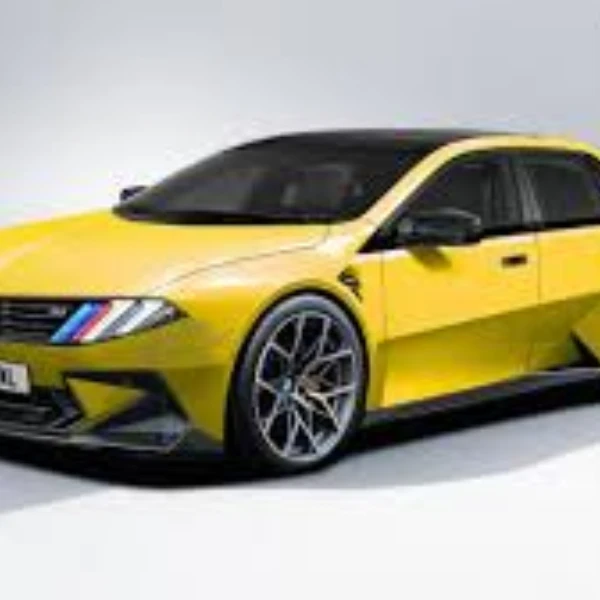
Short Answer

Both the model and the market expect BMW to release a Fully Electric M3 before 2028, with no compelling evidence of mispricing.

1. Executive Verdict

  • BMW's internal roadmap indicates electric M3 production starts March 2027.
  • The fully electric M3 will utilize BMW's Neue Klasse platform.
  • BMW M's quad-motor "Hand of God" system is in advanced development.
  • Production beginning March 2027 aligns with a release before 2028.
  • Historical M test cycles are 18-24 months from prototype to launch.

Who Wins and Why

Outcome Market Model Why
Fully Electric M3 78.0% 70.4% While BMW is aggressively rolling out its 'Neue Klasse' electric platform with 40 new models planned before 2028, historical data indicates a 2-3 year lag for M variants following a new 3-Series generation, and the electric 3-Series equivalent is expected after the initial Neue Klasse SUV launch in 2026, making a pre-2028 M3 release highly improbable.

2. Market Behavior & Price Dynamics

Historical Price (Probability)

Outcome probability
Date
This prediction market has exhibited a stable, sideways trading pattern since its inception. The probability of a fully electric BMW M3 launching before 2028 has consistently remained high, trading within a narrow 11-point range between 76.0% and 87.0%. The market opened with a high degree of confidence at 83.0% and is currently trading near its peak at 86.0%. The price action suggests a clear resistance level at the 87.0% mark and a support floor around 76.0%. Given the lack of external news or developments provided, the minor fluctuations within this range appear to be driven by normal market activity rather than any specific catalyst.
The total volume of 857 contracts traded indicates a moderate level of engagement from participants. The stability of the price at such a high probability suggests a strong and persistent consensus among traders. There are no significant price spikes or drops associated with high volume, which would typically indicate a reaction to new information. Instead, the steady price action reflects a deeply entrenched market sentiment that BMW is very likely to meet this product timeline. The market is effectively in a holding pattern, pricing in the high likelihood of a "YES" resolution, and would likely require a significant, unexpected announcement from BMW to break out of its current range.

3. Market Data

View on Kalshi →

Contract Snapshot

The market resolves to "Yes" if BMW releases a Fully Electric M3 to the public before January 1, 2028, with models like "BMW M3e" counting towards this condition. If no such release occurs by this deadline, the market resolves to "No." The outcome will be verified from BMW's official website, and the market closes by December 31, 2027, 11:59 PM EST if the event has not occurred.

Available Contracts

Market options and current pricing

Outcome bucket Yes (price) No (price) Last trade probability
Fully Electric M3 $0.86 $0.23 78%

Market Discussion

Traders generally believe BMW will not release a fully electric M3 before 2028, with the market currently showing a 7.3% chance of "Yes." The main argument for "No" posits that BMW is transitioning to hydrogen cell technology and has halted its fully electric program development. No specific arguments supporting a "Yes" outcome are present in the discussion.

4. When Are BMW's Neue Klasse and M Variants Expected?

Neue Klasse Pre-series Production Start2026 [^]
First Neue Klasse Model Launch2026 [^]
M Variant Development Lag (Average)2.33 years [^]
BMW's 'Neue Klasse' platform marks a strategic shift towards electric vehicles. This platform is central to BMW's future strategy, emphasizing electric vehicles and digital innovation [^]. Pre-series production for models built on the 'Neue Klasse' platform is scheduled to begin in 2026 at the BMW Group Plant Munich [^]. The first 'Neue Klasse' vehicles, expected to include an SUV like the iX3, are slated for market release in 2026 [^]. This launch aligns with BMW's broader goal of introducing 40 new car models by 2028, integrating the 'Neue Klasse' into its diverse product lineup [^].
High-performance M variants consistently follow standard 3-Series introductions by over two years. An analysis of the last three generations of the BMW 3-Series demonstrates an average development lag of 2.33 years between the release of a new 3-Series generation and its high-performance 'M' counterpart [^]. For example, the E90 3-Series debuted in 2005, followed by the E90 M3 in 2007, a two-year interval. Similarly, the F30 3-Series launched in 2011, with the F80 M3 appearing three years later in 2014. Most recently, the G20 3-Series was introduced in 2018, preceding the G80 M3 in 2020 by two years [^].

5. What is the Latest on BMW M's Electric Quad-Motor Powertrain?

Development StatusAdvanced development and testing in prototype vehicle [^]
Key Powertrain FeatureFour electric motors with millisecond-level torque distribution [^]
Anticipated Release Year2027 [^]
BMW M's quad-motor 'Hand of God' system is in advanced development. This custom-built powertrain, currently undergoing advanced testing in a prototype vehicle, features a dedicated electric motor for each wheel controlled by a central unit, enabling precise, millisecond-level torque distribution [^]. BMW M CEO Frank van Meel confirms this technology is crucial for delivering an authentic M driving experience in an electric car [^]. Prototype testing indicates the technology is highly mature, likely at a Technology Readiness Level (TRL) of 6-7, signifying system demonstration in a relevant environment.
The quad-motor system is targeted for a 2027 production debut. BMW plans to release its first fully electric M car incorporating this advanced drivetrain in 2027 [^]. This timeline implies that BMW expects its entire supply chain, including key component suppliers, to be ready for mass production by then. Frank van Meel has emphasized that the 'Hand of God' system is a fundamental element of this forthcoming electric M car, highlighting its anticipated readiness for integration into production models within the stated timeframe [^].

6. When Will BMW's Electric M3 Go Into Production?

Electric M3 Production StartMarch 2027 [^]
Mercedes Electric C-Class LaunchBy 2027 [^]
BMW Total Vehicle Launches40 new vehicles by 2027 [^]
BMW's internal roadmap indicates its first fully electric M3 production begins March 2027. This vehicle, sometimes referred to as the "2028 BMW M3," will be built on the Neue Klasse platform and is confidently projected to achieve a "new level" of performance, surpassing the current gas-powered version [^]. This electric M car is part of BMW's broader strategic plan to introduce 40 new vehicles by 2027 [^].
Mercedes-Benz's electric C-Class will compete directly with BMW's M3. Mercedes-Benz unveiled its "all-new electric C-Class," described at its world premiere as "redefining the segment" [^]. This electric C-Class is projected to launch by 2027, positioning it as a direct competitor in the premium electric performance sedan market around the same timeframe as BMW's electric M3 [^]. The available research does not contain specific information about an Audi RS4 e-tron, nor is there direct evidence suggesting BMW has accelerated its internal roadmap for the electric M3 in response to Mercedes-Benz's electric C-Class prototypes or launch announcements. BMW's confirmed production start for the electric M3 in March 2027 appears to align with its existing strategic plans [^].

7. When Will the Fully Electric BMW M3 Be Released?

Fully Electric M3 Production StartMarch 2027 [^]
BEV M3 Expected ReleaseAround 2028 [^]
M Performance BEVs LaunchFrom 2025 [^]
BMW is reportedly planning for a fully electric M3, with production anticipated to commence in March 2027 [^] . Multiple sources align with an expected release timeframe around 2028 for the Battery Electric Vehicle (BEV) M3 [^]. While a hybrid M3 is speculated to be a transitional model, there are no explicit statements from BMW executives or investor presentations indicating that a plug-in hybrid (PHEV) M3 is specifically designed to delay the full BEV M3 beyond 2028 due to brand risk or R&D costs [^].
BMW emphasizes electric M performance, dispelling delay concerns. BMW's investor communications highlight the "Neue Klasse M" with BEV power as "The Ultimate Driving Machine with BEV Power," with M Performance BEVs slated for launch starting in 2025 [^]. Frank van Meel, CEO of BMW M, has discussed the electrification of M models, emphasizing their enhanced performance and stating they will be "much quicker" and "faster than you think," without expressing concerns about potential delays [^], [^].
Speculated hybrid M3 is unconfirmed, not delaying BEV. Despite speculation about an M3 hybrid bridging the gap, BMW has not officially confirmed its existence [^]. Importantly, reports suggest that the current internal combustion M3 will be directly replaced by the Neue Klasse-based EV M3 around 2027 or 2028 [^]. This indicates that the BEV M3 is expected to arrive within or before the 2028 timeframe, rather than being postponed by a transitional PHEV model.

8. When Must Electric BMW M3 Prototypes Be Spotted for Launch?

Latest spotting for pre-2028 launch (24-month cycle)December 31, 2025 [^]
Latest spotting for pre-2028 launch (18-month cycle)June 30, 2026 [^]
Documented electric M3 prototype sightingsMarch 2025 [^], June 2025 [^], August 2025 [^]
For an electric M3 to launch before January 1, 2028, prototype spotting dates are crucial. Based on BMW M's historical 18-24 month test-to-launch development cycle, a production-intent electric M3 prototype would need to be publicly observed testing at the Nürburgring by specific deadlines to enable a launch before January 1, 2028. Following an 18-month development cycle, the latest such spotting would need to occur by June 30, 2026. If a 24-month cycle is anticipated, the deadline for public observation would be December 31, 2025.
Electric M3 prototype sightings in 2025 met pre-2028 launch criteria. Public sightings of an electric BMW M3 prototype undergoing Nürburgring testing have already been documented in 2025. These observations occurred on March 27 [^], June 7 [^], and August 26 [^]. These reported sightings fall within the required timeframe, predating the latest necessary spotting dates for a launch prior to January 1, 2028, based on the established historical development cycle.

9. What Could Change the Odds

Key Catalysts

Catalyst analysis unavailable.

Key Dates & Catalysts

  • Expiration: January 08, 2028
  • Closes: January 01, 2028

10. Decision-Flipping Events

  • Trigger: Catalyst analysis unavailable.

12. Historical Resolutions

No historical resolution data available for this series.