Short Answer

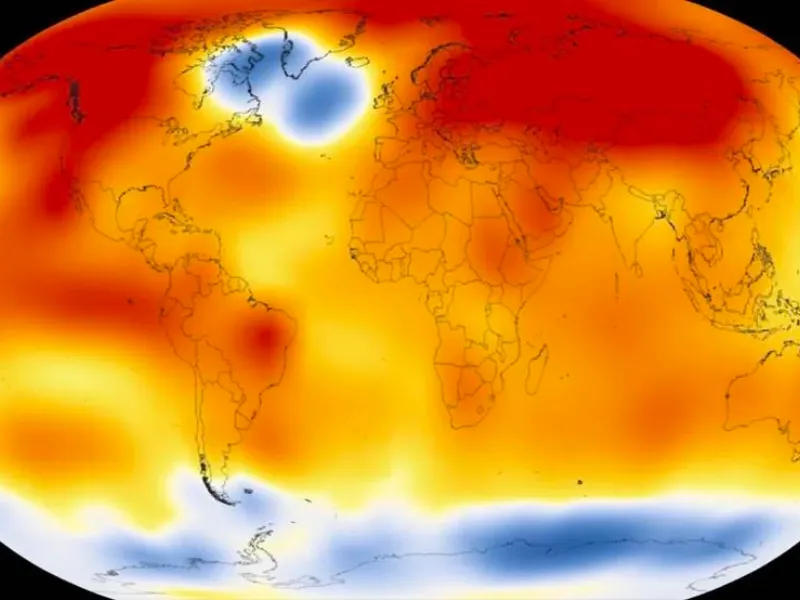
Both the model and the market expect the April 2026 temperature increase to fall within the 1.17 to 1.23 range, with no compelling evidence of mispricing.

1. Executive Verdict

  • No specific El Niño/La Niña forecasts are available for late 2025-early 2026.
  • No major volcanic eruptions post-mid-2024 are impacting global temperatures.
  • Solar Cycle 25 exceeded predictions, showing higher sunspot numbers than expected.
  • NOAA GlobalTemp 6.1 introduces key methodological revisions for 2025-2026 data.
  • April 2026 temperature anomaly calculation period is April 2025 through March 2026.

Who Wins and Why

Outcome Market Model Why
1.17 to 1.23 52.0% 50.9% Market higher by 1.1pp
1.10 to 1.16 19.0% 21.8% Model higher by 2.8pp
1.30001 or above 6.0% 7.6% Model higher by 1.6pp
1.24 to 1.30 2.0% 2.6% Model higher by 0.6pp
1.03 to 1.09 12.0% 14.5% Model higher by 2.5pp

2. Market Behavior & Price Dynamics

Historical Price (Probability)

Outcome probability
Date
This market has experienced a significant downward shift in perceived probability. Initially, the price held stable at a 5.0% probability, establishing this level as an early ceiling. However, the market saw a sharp, decisive drop to its current price of 2.0%. This constitutes the most significant movement in the chart's history and has established 2.0% as the new potential support level. The overall trend, while previously stable, is now defined by this singular, substantial price decrease.
The price drop from 5.0% to 2.0% was accompanied by a notable increase in trading volume. While the market has seen a total of 229 contracts traded, a significant portion of that activity occurred during this downward move. This correlation suggests that the price drop was not arbitrary but was driven by active trading and reflects a shift in conviction among market participants. The provided context does not offer a specific catalyst for this change, indicating the repricing was based on traders' internal reassessments rather than a public news event.
Overall, market sentiment has turned decisively more pessimistic regarding the likelihood of the event occurring. The initial 5.0% probability has been firmly rejected on significant volume, and the market is now consolidating at the new, lower probability of 2.0%. The low total number of data points and contracts traded suggests the market may be relatively illiquid, where a small number of trades can have an outsized impact on the price.

3. Significant Price Movements

Notable price changes detected in the chart, along with research into what caused each movement.

Outcome: 1.10 to 1.16

📉 April 29, 2026: 10.0pp drop

Price decreased from 29.0% to 19.0%

What happened: No supporting research available for this anomaly.

Outcome: 1.17 to 1.23

📉 April 27, 2026: 13.0pp drop

Price decreased from 65.0% to 52.0%

What happened: No supporting research available for this anomaly.

📈 April 26, 2026: 40.0pp spike

Price increased from 59.0% to 99.0%

What happened: No supporting research available for this anomaly.

📈 April 25, 2026: 11.0pp spike

Price increased from 49.0% to 60.0%

What happened: No supporting research available for this anomaly.

📈 April 16, 2026: 12.0pp spike

Price increased from 38.0% to 50.0%

What happened: No supporting research available for this anomaly.

4. Market Data

View on Kalshi →

Contract Snapshot

The "April temperature increase?" contract resolves to YES if the Land Ocean-Temperature Index for April 2026 is between 1.17-1.23, verified by the National Oceanic and Atmospheric Administration (NOAA). If the index falls outside this range, the market resolves to NO, as the event is mutually exclusive. The market closes on May 15, 2026, with a projected payout on May 17, 2026, and trading is prohibited for those with material, non-public information or employment by source agencies.

Available Contracts

Market options and current pricing

Outcome bucket Yes (price) No (price) Last trade probability
1.17 to 1.23 $0.56 $0.50 52%
1.10 to 1.16 $0.26 $0.81 19%
1.03 to 1.09 $0.13 $0.95 12%
1.30001 or above $0.06 $0.95 6%
1.02999 or below $0.02 $1.00 2%
1.24 to 1.30 $0.10 $0.98 2%

Market Discussion

Limited public discussion available for this market.

5. Are Strong El Niño or La Niña Expected in Late 2025-Early 2026?

Specific ONI AnomaliesNot explicitly provided for late 2025-early 2026 in research [^].
Probabilistic ENSO ForecastsNot explicitly provided for late 2025-early 2026 in research [^].
Forecast UncertaintyIncreases beyond 6-9 months lead time [^].
Specific Oceanic Niño Index forecasts are unavailable for late 2025 through early 2026. The provided research does not explicitly offer specific numerical Oceanic Niño Index (ONI) anomalies or precise probabilistic forecasts for El Niño, La Niña, or Neutral conditions for this core period. However, major climate model centers such as NOAA's Climate Prediction Center (CPC), the International Research Institute for Climate and Society (IRI), and ECMWF routinely issue these types of forecasts [^]. These institutions' ENSO Diagnostic Discussions, Official ENSO Probabilities, and Quick Look forecasts typically provide ensemble predictions for ONI anomalies and probabilities for different ENSO states across overlapping three-month seasons, which would span the target timeframe.
ENSO forecast skill diminishes considerably beyond a 6-9 month lead time. Generally, climate model forecasts for the El Niño-Southern Oscillation (ENSO) tend to exhibit reduced skill and increased uncertainty as the lead time extends, especially beyond this 6-9 month window [^]. As lead times increase, probabilities for various ENSO states often converge towards a neutral condition, unless strong and persistent signals are projected. The question highlights critical thresholds, such as a strong El Niño (exceeding +1.5°C ONI) or a significant La Niña (below -1.0°C ONI), which would strongly influence global temperature outcomes.
Direct consultation of current forecasts is essential for specific ONI anomalies. To determine if strong El Niño or significant La Niña conditions are anticipated for late 2025 through early 2026, direct consultation of the latest forecasts from the cited institutions is necessary [^].

6. Have Post-Mid-2024 Volcanic Eruptions Caused Global Cooling?

Major Eruption ActivityNo VEI 6+ eruption since mid-2024 [^]
Ruang Eruption VEI4 (April 2024) [^]
Background Stratospheric AODApproximately 0.005 [^]
No volcanic eruption since mid-2024 has achieved a VEI of 6 or higher. Web research indicates no such event through 2024 and 2025 [^]. For example, the Ruang volcano in Indonesia, which erupted in April 2024, registered a Volcanic Explosivity Index (VEI) of 4 [^]. Other documented activities, such as the Kanlaon eruptions spanning 2024-2026, also do not indicate an event reaching a VEI of 6 or higher [^].
Current eruptions have not significantly elevated global stratospheric aerosol optical depth. The typical background level for global mean stratospheric aerosol optical depth (AOD) is approximately 0.005 [^]. While the April 2024 Ruang eruption (VEI 4) did inject a considerable amount of sulfur dioxide and ash into the stratosphere, leading to a detectable, regionally observed increase in stratospheric AOD in the tropics and Southern Hemisphere [^], this has not resulted in a sustained global mean stratospheric AOD significantly above the background level. Such a sustained increase would be required to exert a strong cooling pressure on the global climate, but the impact of a VEI 4 eruption is generally insufficient to significantly alter global mean stratospheric AOD to that extent [^].

7. How Did Solar Cycle 25 Exceed Predicted Activity Levels?

Forecasted Sunspot Number Peak115 (July 2025) [^]
Observed Sunspot Number Peak169.9 (October 2024) [^]
Forecasted F10.7cm Flux Peak150 solar flux units (sfu) [^]
The NOAA/NASA SWPC predicted a relatively weak Solar Cycle 25. The official forecast anticipated a smoothed sunspot number (SSN) peaking at 115 in July 2025 [^]. This prediction also included a peak in the F10.7cm solar radio flux around 150 solar flux units (sfu) [^]. The consensus among experts generally suggested a cycle strength similar to Solar Cycle 24 [^].
Solar Cycle 25 significantly surpassed initial predictions in strength and timing. Its maximum activity was observed in October 2024, notably earlier than the forecasted July 2025 peak [^]. The smoothed monthly total sunspot number reached 169.9 at this peak [^], considerably higher than the predicted 115, and marking the highest sunspot number in over two decades [^]. The F10.7cm solar radio flux also consistently tracked above its forecasted curve, further confirming a stronger cycle across various metrics [^].
The stronger, earlier peak of Solar Cycle 25 suggests marginal warming. This progression, significantly exceeding the NOAA/NASA SWPC forecast, implies a marginal warming forcing. The observed deviation indicates that solar activity, which contributes to the Earth's energy budget, has been more robust than initially anticipated for the current cycle.

8. What Recent Methodological Changes Impact Global Temperature Datasets?

NOAA GlobalTemp V6.1 UpdateReleased December 2023, with AI-based gap-filling for polar regions [^]
NASA GISTEMP v4 MethodologyUnchanged, routine data updates, minor bug fixes [^]
HadCRUT5.1.0.0 UpdateReleased December 2021, minor adjustments to HadSST4 data [^]
NOAA GlobalTemp version 6.1 introduces significant methodological revisions for 2025-2026 data. Released in December 2023, this update to the NOAA GlobalTemp dataset primarily addresses polar region interpolation and homogenization. Version 6.1 utilizes artificial intelligence and improved computational methods to enhance spatial coverage, particularly in polar regions, through an AI-based gap-filling technique, and to improve the homogenization of station data. The ocean component of NOAAGlobalTemp V6.1 is derived from NOAA ERSST Version 5 [^], with the overall methodology representing a major update for integrating data and addressing gaps [^]. These changes are scheduled for application to 2025-2026 data.
NASA GISTEMP and HadCRUT methodologies remain largely consistent for 2025-2026 data. The NASA GISS Surface Temperature Analysis (GISTEMP v4) methodology is largely consistent, with its analysis unchanged. Updates are confined to routine processes, such as daily and monthly data updates and minor bug fixes, which typically alter reported anomalies by a few thousandths of a degree Celsius [^]. Similarly, the HadCRUT dataset's most recent minor release, HadCRUT5.1.0.0, implemented in December 2021, involved minor adjustments to its underlying HadSST4 data due to routine updating [^]. The fundamental methodology of HadCRUT5 itself, which improved Arctic coverage, was established in 2020. No further significant methodological shifts for GISTEMP or HadCRUT beyond routine data updates are scheduled for application to 2025-2026 data.

9. What Is the Temperature Anomaly Calculation Period for April 2026?

Calculation PeriodApril 2025 through March 2026 [^]
Designated Source AgencyNASA Goddard Institute for Space Studies (GISS) [^]
Data Release LagApproximately 2-3 weeks after month-end [^]
The final 12-month temperature anomaly calculation for a market resolving in April 2026 spans from April 2025 through March 2026. This timeframe is crucial because the prediction market event, "Apr 2026 temperature increase?", resolves within April 2026 [^]. Therefore, March 2026 represents the latest full month for which processed temperature data can be obtained. This defined period ensures the market resolves using verified data within its specified resolution month [^].
NASA GISS provides data with a typical two-to-three week lag. The designated source for global temperature anomaly data is NASA GISS, specifically their GISS Surface Temperature Analysis (GISTEMP v4) [^]. This agency typically publishes its monthly surface temperature analysis with an approximate 2-3 week delay following the close of the data month [^]. Consequently, the GISTEMP data for March 2026 is anticipated to be released by mid-April 2026. This schedule guarantees that all necessary data covering the April 2025 - March 2026 period will be available for calculation during the market's resolution window [^].

10. What Could Change the Odds

Key Catalysts

Catalyst analysis unavailable.

Key Dates & Catalysts

  • Expiration: August 13, 2026
  • Closes: May 16, 2026

11. Decision-Flipping Events

  • Trigger: Catalyst analysis unavailable.

13. Historical Resolutions

Historical Resolutions: 18 markets in this series

Outcomes: 3 resolved YES, 15 resolved NO

Recent resolutions:

  • KXHMONTHRANGE-26MAR-T1.30: YES (Apr 15, 2026)
  • KXHMONTHRANGE-26MAR-T1.03: NO (Apr 15, 2026)
  • KXHMONTHRANGE-26MAR-B1.270: NO (Apr 15, 2026)
  • KXHMONTHRANGE-26MAR-B1.200: NO (Apr 15, 2026)
  • KXHMONTHRANGE-26MAR-B1.130: NO (Apr 15, 2026)