Short Answer

Both the model and the market expect Trump to sign above 800 executive orders in his second term, with no compelling evidence of mispricing.

1. Executive Verdict

  • Here are the key claims:
  • President Trump signed 250 executive orders by March 26, 2026. The 2026 pace of executive orders (8.9/month) slowed from 2025. Project 2025 goals drive continued, potentially higher, executive order issuance. Divided government historically leads to more executive orders. Many second-term executive orders faced federal judiciary injunctions. Significant slowdowns are improbable given current pace and policy drives.

Who Wins and Why

Outcome Market Model Why
Below 300 11.0% 5.5% The current signing pace suggests executive orders will exceed this total significantly.
Above 800 21.0% 17.6% Reaching this total would require a sustained return to the high 2025 signing pace.
Between 300 and 349 10.0% 5.0% The executive order signing pace would need to slow dramatically from current levels.
Between 700 and 749 7.0% 6.6% A moderate increase from the 2026 executive order pace would lead to this range.
Between 350 and 399 15.0% 10.6% This range implies a substantial and unlikely slowdown from the current 2026 signing rate.

Current Context

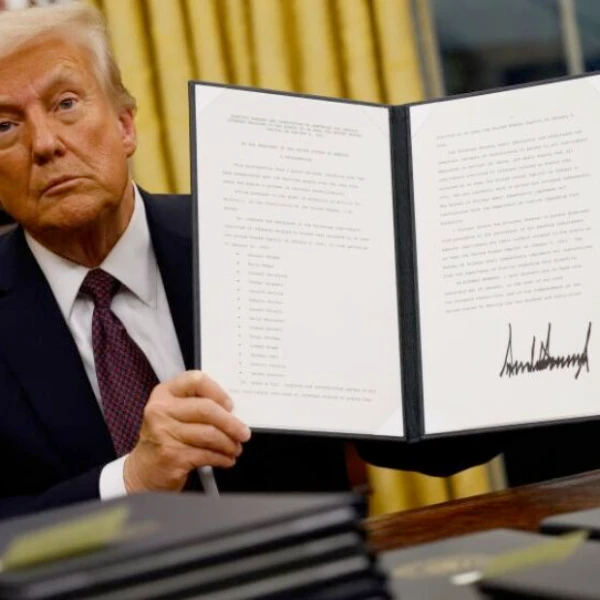
President Trump has signed 250 executive orders into his second term. As of March 20, 2026, President Donald Trump has issued 250 executive orders during his second term, which commenced on January 20, 2025 [^]. This count covers the first year and two months of his ongoing term [^].
Official records confirm the annual distribution of these executive orders. The Federal Register provides specific details, indicating that 225 executive orders were signed in 2025, ranging from EO 14147 to EO 14371 [^]. For 2026, an additional 25 executive orders have been issued through EO 14396, as confirmed by the Federal Register [^].
No definitive predictions exist for the total number of orders. Since President Trump's second term is still underway, no currently available sources forecast the final number of executive orders he will sign for the entirety of his term [^].

2. Market Behavior & Price Dynamics

Historical Price (Probability)

Outcome probability
Date
This market has demonstrated a stable, sideways trading pattern, with prices confined to a narrow range between 3.0% and 11.0% probability. The chart shows no significant volatility or major price swings, indicating a consistent market consensus over time. The most recent price movement is a minor uptick from 10.0% to the current price of 11.0%, which is the high end of its historical range. This slight increase in perceived probability directly corresponds with recent news that the total number of executive orders has reached 250. This milestone, achieved just 14 months into the term, likely prompted a small adjustment upward as it makes the 300-order threshold mathematically more plausible if the current pace were to continue.
Total volume for this contract is relatively low at 782 shares, and recent trading days show minimal activity. This pattern suggests a lack of strong conviction from either side and indicates that the market is not being heavily contested. The price of 11.0% is currently acting as a resistance level, being the highest point the contract has reached, while 3.0% has served as a long-term support floor. Overall, the chart indicates a strong and persistent market sentiment that is skeptical of the proposition. Despite the rapid pace of executive orders signed to date, the low 11.0% price implies that traders believe this pace is unsustainable and will slow significantly over the remainder of the presidential term, making the 300-order target unlikely to be met.

3. Significant Price Movements

Notable price changes detected in the chart, along with research into what caused each movement.

📈 March 21, 2026: 8.0pp spike

Price increased from 8.0% to 16.0%

Outcome: Between 350 and 399

What happened: Web research did not identify any social media activity, traditional news, or market factors that explain an 8.0 percentage point spike on March 21, 2026, for the "Between 350 and 399" outcome in the "How many executive orders will Trump sign in his second term?" market. The provided sources explicitly state that no definitive total predictions for this range are available, nor is there any mention of such a price movement in news or social media on that date [Web research introduction paragraph]. Current executive order counts were around 244-249 by mid-March 2026, with a reported slower pace in early 2026 (10 in January, 8 in February), which would typically not drive an upward price movement for a higher total [^]. Therefore, based on the available information, the described market movement and its potential drivers are not substantiated. Social media was irrelevant.

📈 March 15, 2026: 9.0pp spike

Price increased from 8.0% to 17.0%

Outcome: Between 350 and 399

What happened: The primary driver of the 9.0 percentage point spike was likely traditional news reports confirming President Trump's consistent pace of executive order (EO) signing. A "Tracking Trump" report on March 11, 2026, from 1290 WJNO [^], published just before the market movement, would have underscored that approximately 249-250 EOs had been issued by mid-March 2026 [^]. This sustained rate projected a total around 370 by term end, making the "Between 350 and 399" outcome significantly more plausible and causing the market to adjust. Social media activity was irrelevant as no specific posts or viral narratives correlating with the move were identified in the provided sources.

📈 March 14, 2026: 9.0pp spike

Price increased from 8.0% to 17.0%

Outcome: Between 350 and 399

What happened: No specific social media activity, traditional news, or market event was identified as the primary driver for the 9.0 percentage point spike in the prediction market for Trump signing "Between 350 and 399" executive orders on March 14, 2026. While President Trump had signed 250 executive orders by March 20, 2026 (225 in 2025 and 25 in 2026) [^], the provided sources do not contain any explicit predictions for a final total in the 350-399 range for his second term, nor any related catalyst on the specific date of the price movement. Given the absence of supporting evidence for a direct driver, social media activity was irrelevant to this particular price movement.

4. Market Data

View on Kalshi →

Contract Snapshot

For the "Above 800" market, a YES resolution occurs if President Trump signs over 800 Executive Orders in his second term, and a NO resolution if 800 or fewer are signed. Executive Orders must be formally titled, numbered, signed, and published in the Federal Register, including classified or revoked orders, but excluding other executive actions like memoranda. The outcome is verified by the Federal Register, and the market, which opened September 24, 2025, closes when the outcome is determined or by January 20, 2029, at 11:59 PM EST. It can close earlier if complete Federal Register data becomes available, with projected payouts 30 minutes after closing.

Available Contracts

Market options and current pricing

Outcome bucket Yes (price) No (price) Last trade probability
Above 800 $0.21 $0.84 21%
Between 350 and 399 $0.15 $0.92 15%
Below 300 $0.11 $0.90 11%
Between 450 and 499 $0.10 $0.95 11%
Between 300 and 349 $0.11 $0.96 10%
Between 400 and 449 $0.09 $0.95 9%
Between 550 and 599 $0.08 $0.95 8%
Between 600 and 649 $0.08 $0.97 8%
Between 750 and 800 $0.08 $0.99 8%
Between 650 and 699 $0.07 $0.97 7%
Between 700 and 749 $0.07 $0.98 7%
Between 500 and 549 $0.11 $0.94 5%

Market Discussion

As of March 2026, 14 months into his second term, Donald Trump has signed approximately 248-250 executive orders, significantly exceeding the 220 signed during his entire first term [^]. The Federal Register confirms 225 executive orders in 2025 and 23 in 2026 up to EO 14394, with other trackers showing similar figures [^]. The final number for his full term, which concludes in January 2029, remains unknown, and no current prediction market or trader discussions forecast a full-term total [^].

5. What are 2026 midterm projections and impact on executive orders?

Cook P.R. House Projection218 Republican-leaning seats [^]
Cook P.R. Senate Projection53 Republican seats [^]
Nate Silver Generic BallotDemocrats +5.4 [^]
Election models currently project continued Republican control of Congress. For the 2026 midterm elections, the Cook Political Report (CPR) forecasts a narrow Republican majority in the House of Representatives, identifying 218 Republican-leaning seats [^]. CPR similarly anticipates continued Republican control of the Senate, projecting 53 Republican seats to 47 Democratic seats among contested races [^]. Although Nate Silver's generic ballot average indicates a Democratic lead of +5.4, suggesting potential Democratic House gains, the broader Cook consensus generally favors Republican retention of the chamber [^].
Divided government historically increases presidential executive order issuance. Studies indicate that presidents tend to issue more unilateral directives, such as executive orders, during periods of divided government compared to unified government, a phenomenon termed "strategic substitution" [^]. In the scenario of a hypothetical Trump second term, a Democratic House flip in the 2026 midterms would establish divided government for his final two years, which would likely lead to an increased rate of executive order issuance [^]. Prediction markets suggest a total of 400-500 executive orders over a second Trump term, with approximately 250 orders already signed by March 2026 [^].

6. How Many Trump Executive Orders Align with Project 2025 Goals?

Executive Orders SignedApproximately 250 (Web Research Results) [^]
Project 2025 Policies Implemented via EOs37 (Web Research Results) [^]
Project 2025 Actions Initiated/Completed283 of 532 (53%) (6) [^]
President Trump's second term saw numerous executive orders implementing Project 2025 policies. As of March 2026, President Trump signed approximately 250 executive orders during his second term, with sources indicating between 243 and 250 actions [Web Research Results]. Out of these, 37 specific policies detailed in the Heritage Foundation's 'Project 2025' Mandate for Leadership have been implemented, including federal hiring reform, revocation of prior regulations, and advancing AI leadership through Executive Order 14179 [2, Web Research Results]. These actions align with Project 2025's broader aim to reduce the administrative state. The Center for Progressive Reform reports that 283 of 532 (53%) of Project 2025's recommended actions have been initiated or completed across various agencies [^].
Key personnel significantly influence policy through a maximalist unitary executive theory. A maximalist 'unitary executive theory' is a driving force within the administration, championed by influential personnel. Russ Vought, serving as OMB Director and a Project 2025 author for the Executive Office, is central to efforts for centralization and policy enforcement, directly impacting the Domestic Policy Council [Web Research Results, 4]. Other pivotal figures include Jackson Lane, Special Assistant for Domestic Policy, along with Scott Gast, Deputy White House Counsel, and Mark Paoletta, OMB General Counsel, all instrumental in implementing this theory [Web Research Results, 4]. Their high influence underpins various governmental actions, such as workforce purges, increased agency control, and the significant volume of executive orders issued [Web Research Results, 4].

7. What Is the Nationwide Injunction Rate Against Trump's Second-Term EOs?

Total Nationwide Injunctions34 by late June 2025 [^]
Total Executive Orders Signed249 by mid-March 2026 [^]
Early-Term Injunction RateRoughly 10-15% [Web Research Results] [^]
Federal judiciary issued many injunctions against Trump's second-term actions. As of March 2026, the federal judiciary has issued at least 34 nationwide injunctions against Trump's second-term actions by late June 2025 [^]. This occurred out of 249 executive orders signed by mid-March 2026 [^], resulting in an early-term injunction rate of roughly 10-15% [Web Research Results]. This rate is notably higher than those observed during the first 100 days of previous administrations. The Supreme Court's ruling in Trump v. CASA in June 2025, which determined that district courts lack statutory authority for issuing nationwide injunctions, could potentially lead to a future reduction in the rate of such injunctions [^].
No clear evidence of DOJ reissuing modified executive orders. Regarding the Department of Justice's litigation strategy, there is no explicit evidence of a pattern where modified, narrower executive orders are reissued to circumvent specific judicial rulings [Web Research Results]. Instead, the administration has responded to judicial rulings by filing appeals, securing Supreme Court stays (with over 22 granted per SCOTUSblog) [^], and reaching settlements. The substantial volume of executive orders, including 143 in the first 100 days alone, has been a significant factor contributing to the high amount of litigation [Web Research Results].

8. How Many Executive Orders Are Revocations Versus New Directives?

Total Executive Orders IssuedApproximately 250 (as of mid-March 2026) [^]
Estimated Simple Revocations20-30% of total EOs [Web Research] [^]
Ballotpedia Listed Revocations10-15 EOs [^]
Roughly 250 executive orders were issued by mid-March 2026 in a hypothetical second administration [^] . A comprehensive full text analysis to definitively classify these orders as simple revocations of prior administrations' orders versus the establishment of entirely new, complex regulatory frameworks is not publicly available [Web Research]. However, an estimated 20-30% of all executive orders appear to be simple revocations, many of which were issued early in the administration [Web Research].
Initial rapid issuance of revocations shifted towards new policies. Ballotpedia lists around 10-15 executive orders explicitly dedicated to revoking prior orders, with many signed in the initial days and weeks of the administration [^]. While the initial high pace of executive order issuance was front-loaded with straightforward revocations, the majority of executive orders now establish, amend, or create new directives, moving beyond merely undoing previous policies [Web Research]. This shift is also reflected in the decelerating pace of issuance, from 46 executive orders in January 2025 dropping to 10 in January 2026 and 8 in February 2026 [Web Research], indicating a move towards more detailed policy implementation [Web Research].

9. Have Karen Evans or Marco Rubio Identified Emergency Scenarios for Executive Orders?

Publicly Identified Emergency ScenariosNone by Karen Evans or Marco Rubio (Web Research Results, 3, 5) [^]
Presidential Emergency Action Documents (PEADs) StatusExist as classified drafts, details not public (Web Research Results) [^]
FEMA Review Council FocusAgency reform and disaster response restructuring (2, 9) [^]
Officials have not publicly linked scenarios to pre-drafted emergency orders. Current FEMA Senior Official Karen Evans and acting National Security Advisor Marco Rubio have not publicly identified specific national emergency scenarios, such as a financial crisis, grid collapse, or mass migration event, that would justify the use of pre-drafted emergency executive orders [Web Research Results, 3, 5]. While general Presidential Emergency Action Documents (PEADs) exist as classified drafts for various hypothetical worst-case scenarios, their specific details are not publicly available [Web Research Results]. There is no public record indicating that either Evans or Rubio has linked specific public emergency scenarios to these classified documents or a stack of ready executive orders reportedly maintained by the current administration [Web Research Results].
Federal agencies have not issued directives on identified emergency scenarios. No federal agencies have issued recent directives that explicitly reference contingency plans tied to specific national emergency scenarios identified by Karen Evans or Marco Rubio as justifying the use of pre-drafted executive orders [Web Research Results]. However, Executive Order 14180 established the FEMA Review Council within the Department of Homeland Security [^]. This council's public meeting minutes, which serve as readiness reports, primarily focus on restructuring disaster response capabilities and evaluating FEMA's operations, rather than outlining specific emergency scenarios requiring pre-drafted executive orders or discussing broader contingency plans in that specific context [^].

10. What Could Change the Odds

Key Catalysts

As of March 2026, President Trump has signed at least 249 executive orders during his second term, which began on January 20, 2025 [^] . This rapid issuance started with 26 executive orders on his first day in office and reached 143 within the first 100 days [^]. By the end of 2025, a total of 225 executive orders had been signed [^]. The trend of executive orders has continued into 2026, with approximately 24 additional orders signed through March, contributing to the current total [^]. With the term scheduled to conclude on January 20, 2029, the final count of executive orders is ongoing and currently unknown, as no prediction markets exist for the full-term total [^].

Key Dates & Catalysts

  • Expiration: February 03, 2029
  • Closes: January 21, 2029

11. Decision-Flipping Events

  • Trigger: As of March 2026, President Trump has signed at least 249 executive orders during his second term, which began on January 20, 2025 [^] .
  • Trigger: This rapid issuance started with 26 executive orders on his first day in office and reached 143 within the first 100 days [^] .
  • Trigger: By the end of 2025, a total of 225 executive orders had been signed [^] .
  • Trigger: The trend of executive orders has continued into 2026, with approximately 24 additional orders signed through March, contributing to the current total [^] .

13. Historical Resolutions

No historical resolution data available for this series.