
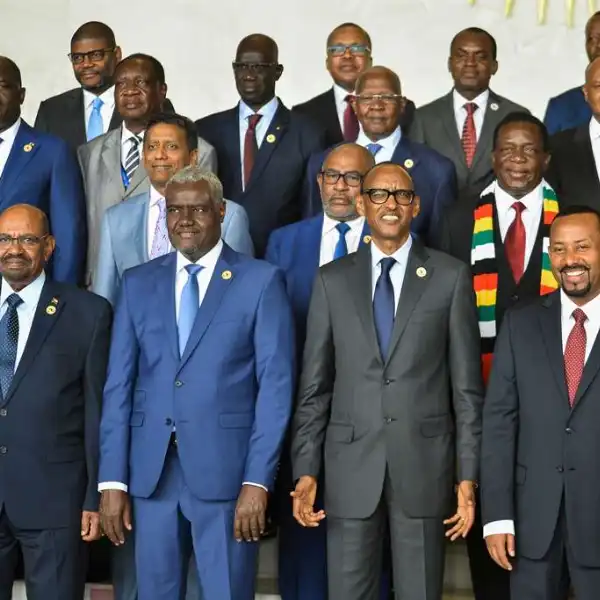
Which of these African leaders will leave office next?
Short Answer
Both the model and the market expect Bola Tinubu to be the next African leader to leave office before 2035, with no compelling evidence of mispricing.
1. Executive Verdict
- MK party demands Ramaphosa's resignation by July 2025, threatening nationwide action.
- Tinubu's recurring public absences and health concerns pose near-term risks.
- A May 2024 coup attempt indicates Tshisekedi faces persistent political instability.
- US sanctions create international pressure, potentially destabilizing Kagame's regime.
- Tebboune demonstrates strong stability, actively strengthening his grip on power.
Who Wins and Why
| Outcome | Market | Model | Why |
|---|---|---|---|
| Félix Tshisekedi | 15.0% | 12.6% | Persistent political instability or health issues could lead to an unexpected departure from office. |
| Paul Kagame | 5.0% | 4.1% | His long tenure and potential future health challenges could lead to an unexpected departure. |
| Taye Atske Selassie | 1.0% | 1.1% | Cabinet reshuffles or shifts in the political landscape could lead to an early departure. |
| Bola Tinubu | 30.0% | 29.8% | Recurring health concerns and public absences indicate near-term health-related risks to his tenure. |
| William Ruto | 10.0% | 9.4% | Ongoing political opposition and public protests create potential instability for his presidency. |
2. Market Behavior & Price Dynamics
Historical Price (Probability)
Outcome probability
Date
This prediction market has exhibited a sideways trading pattern within a relatively narrow range. The implied probability started at 14.0% before experiencing its most significant movement, a drop to a low of 9.0%. Since then, the price has stabilized and currently sits at 10.0%. The lack of any significant external news or developments provided in the context suggests that this initial price adjustment was likely due to early market positioning and the establishment of an initial price rather than a reaction to a specific event. The market has since failed to establish a clear directional trend, oscillating within this defined range.
The total trading volume of 81 contracts is quite low, indicating limited market participation and liquidity. This low volume suggests that the price movements observed are not backed by strong market conviction and could be the result of a small number of trades. The absence of volume spikes corresponding with price changes further supports the idea that there is no significant influx of informed capital reacting to new information. The market appears to be in a state of equilibrium, with neither buyers nor sellers demonstrating enough conviction to push the price out of its current channel.
Based on the price action, a support level has formed around the 9.0% mark, which represents the market's low point. Conversely, the starting price of 14.0% has acted as a resistance level that has not been retested. The current price of 10.0% reflects a sustained, low-probability sentiment that this specific leader will be the next among the candidates to leave office before 2035. The overall chart suggests a market that is waiting for a catalyst, as the current sentiment is stable but lacks strong conviction.
3. Market Data
Contract Snapshot
For Bola Tinubu, a YES resolution occurs if he is the first among the listed African leaders to actually leave office and no longer hold the title, as confirmed by specified news sources. The market resolves to NO if he is not the first to leave, or if no listed leader leaves office by the final closing date of January 1, 2035. In the event of a leader's death, all markets resolve based on the last traded price prior to death or another fair price determined by the Exchange.
Available Contracts
Market options and current pricing
| Outcome bucket | Yes (price) | No (price) | Last trade probability |
|---|---|---|---|
| Bola Tinubu | $0.32 | $0.72 | 30% |
| Félix Tshisekedi | $0.15 | $0.89 | 15% |
| Emmerson Mnangagwa | $0.19 | $0.86 | 13% |
| William Ruto | $0.15 | $0.91 | 10% |
| Abdel Fattah el-Sisi | $0.08 | $0.97 | 8% |
| Abdelmadjid Tebboune | $0.08 | $0.98 | 7% |
| Cyril Ramaphosa | $0.07 | $0.98 | 7% |
| John Mahama | $0.07 | $0.98 | 7% |
| Paul Kagame | $0.05 | $1.00 | 5% |
| Taye Atske Selassie | $0.05 | $1.00 | 1% |
Market Discussion
Limited public discussion available for this market.
4. What Are MK and DA's Demands for Ramaphosa's Resignation?
| MK Party's Coalition Condition | Demands President Cyril Ramaphosa's resignation [^] |
|---|---|
| MK Party's Resignation Deadline | July 18, 2025 (Mandela Day) [^] |
| DA's Stance on Ramaphosa | Has not demanded Ramaphosa's resignation [^] |
The MK party demands President Ramaphosa's resignation for coalition talks. The uMkhonto we Sizwe (MK) party has explicitly made President Cyril Ramaphosa's resignation a non-negotiable condition for engaging in coalition government discussions with the African National Congress (ANC) [^]. Led by former President Jacob Zuma, the party further set a deadline for Ramaphosa to step down by Mandela Day, July 18, 2025, and warned of nationwide action should this demand remain unmet [^]. The ANC has, in response, dismissed this demand as a "no-go" for any coalition negotiations [^].
The Democratic Alliance has not demanded Ramaphosa's removal. In stark contrast to the MK party, the Democratic Alliance (DA) has not stipulated President Ramaphosa's resignation as a condition for forming a coalition government. Following the 2024 elections, the DA joined other parties in establishing a Government of National Unity (GNU) with the ANC, which subsequently led to Ramaphosa's re-election as president [^]. While reports indicate ongoing disagreements and "fallouts" between the ANC and DA, these issues have not centered on demands for Ramaphosa's departure from office [^].
5. How Do President Tinubu's Absences Compare to President Tebboune's?
| Tinubu Public Absence Reports | August 2025 and January 2026 [^] |
|---|---|
| Tinubu Health Rumors Denied | By Presidency [^] |
| Tebboune Summit Absence Reason | Lack of coordination, March 2025 [^] |
Nigerian President Bola Tinubu exhibits a more consistent pattern of public absences and health speculation. Concerns regarding his health and absence from public view were initially reported in August 2025, specifically noting his "absence from key events" and "alleged absence from state functions" [^]. These reports prompted the Presidency to issue denials regarding his health status [^]. This pattern recurred in January 2026, when further public absences again sparked concerns and led to demands for his whereabouts [^].
In contrast, Algerian President Abdelmadjid Tebboune does not show a similar pattern of unscheduled multi-day absences. His public engagements, as described in available sources, do not indicate health-related postponements. For example, in March 2025, Tebboune opted not to personally attend an emergency Arab summit, with the reason attributed to a "lack of coordination" rather than any health issues [^]. Furthermore, a March 2026 source discusses him strengthening his grip on power, with no mention of absences or health concerns [^]. Therefore, the available information points to a more consistent pattern of reported concerns and official responses regarding President Tinubu's public visibility and health.
6. How Did DRC Military Leadership Change After May 2024 Coup Attempt?
| Military Reshuffle Date | December 19, 2024 [^] |
|---|---|
| Army Chief of Staff | General Christian Tshiwewe Songesa replaced [^] |
| Republican Guard Commander | General Ephraim Kabi Kiriza replaced [^] |
The May 2024 coup attempt triggered significant military leadership changes. Following the May 19, 2024, coup attempt against President Félix Tshisekedi, a major reshuffle occurred within the Democratic Republic of Congo's military on December 19, 2024. President Tshisekedi replaced General Christian Tshiwewe Songesa, the army chief of staff, with General Jules Banza Mwilambwe. This extensive restructuring also included the appointment of General Jacques Nduru Yamba as the new commander of the elite Republican Guard, succeeding General Ephraim Kabi Kiriza, among other high-ranking military officials [^].
Republican Guard units maintain a visible, heightened presence across Kinshasa. Since the coup attempt, these units have sustained an increased and noticeable deployment throughout the capital. A local report from July 2024 indicated that 8,000 Republican Guard soldiers participated in a show of force within Kinshasa [^]. This was corroborated by a November 2024 UN Secretary-General report on MONUSCO, which observed heightened vigilance and a visible security force presence, including Republican Guard elements, in strategic areas of Kinshasa, particularly near government buildings and officials' residences, following the May 19 incident [^].
7. Is There Internal Dissent Over Rwanda's M23 Support Risks?
| Prominent defector | Lt. General Faustin Kayumba Nyamwasa (ex-RDF Chief of Staff) [^] |
|---|---|
| Defector's critique | Criticized Kagame's repression and DRC exploitation [^] |
| International response | US sanctions on Rwandan military for M23 support [^] |
Direct intelligence reports on M23 dissent are scarce. While a high-level defector has criticized President Paul Kagame's regime and its actions in the Democratic Republic of Congo (DRC) [^], the provided research does not contain specific credible intelligence reports indicating widespread dissent within the senior ranks of the Rwandan Defence Force (RDF) or the ruling Rwandan Patriotic Front (RPF) directly concerning the strategic risks or resource drain of supporting the M23 insurgency. Evidence generally confirms Rwanda's backing of M23 [^], but explicit details of internal disagreements regarding the strategic costs or resource drain within the RDF or RPF senior ranks are not provided.
A high-level defector criticized President Kagame's policies. Lt. General Faustin Kayumba Nyamwasa, an exiled former Chief of Staff of the RDF, represents a significant high-level defection and has openly criticized President Kagame's political repression and the exploitation of the DRC [^]. Although Nyamwasa's public statements include concerns about 'DRC exploitation,' which could be broadly linked to resource issues, the available information does not explicitly detail that his or other senior officials' dissent specifically targeted the strategic risks or the direct resource drain of the M23 insurgency itself. Notably, Nyamwasa's defection occurred in 2010, preceding the major resurgence of the M23 campaign in 2022 [^].
US sanctions confirm Rwanda's M23 involvement, not internal dissent. External bodies, such as the United States, have imposed sanctions on the Rwandan military and four of its senior officers due to their alleged support for M23 rebels in the DRC [^]. These actions underscore international recognition of Rwanda's involvement. However, the available sources do not indicate that these sanctions or the underlying intelligence revealed internal dissent within Rwanda's senior leadership specifically over the strategic risks or resource implications of supporting M23 [^].
8. Which African Countries Face the Most Near-Term Sovereign Debt Pressure?
| Egypt 5-year CDS spread | 357 basis points (bps) [^] |
|---|---|
| Egypt external debt projection | $161.2 billion by June 2025 [^] |
| Kenya Eurobond refinancing | KSh 290.3 billion (approximately $2.1 billion) [^] |
Egypt exhibits the most acute near-term sovereign debt pressure among the three countries. The nation's 5-year Credit Default Swap (CDS) spread, a key indicator of market-perceived default risk, was recently reported at 357 basis points, despite a fall of 11 basis points [^]. This still signifies considerable market concern regarding Egypt's creditworthiness. Furthermore, Egypt's total external debt is substantial, projected to reach $161.2 billion by June 2025 [^]. While specific foreign currency bond maturities within the next 12 months are not detailed in the provided sources, the high overall debt burden combined with a noticeable CDS spread indicates ongoing financial pressure.
Data limitations hinder direct comparisons for Nigeria and Kenya. Explicit 5-year CDS spreads for these two countries are not available in the provided sources, making a direct metric-based comparison challenging. Regarding upcoming foreign currency bond maturities, Kenya has proactively managed its debt by raising KSh 290.3 billion to refinance existing Eurobond obligations [^], demonstrating active efforts to address significant maturities. For Nigeria, the available sources primarily reference Eurobond closing prices and yields for future dates in 2026 [^], which do not offer specific details on foreign currency bond maturities within the immediate 12-month period or its current CDS spread.
Egypt therefore shows the clearest and most acute near-term sovereign debt pressure. Based on the direct evidence of market concern through its 5-year CDS spread and the substantial overall external debt, Egypt currently exhibits the most transparent near-term sovereign debt pressure among the countries for which data is provided. Severe and unmanaged sovereign debt pressure can significantly strain national finances, potentially leading to austerity measures, economic instability, and public discontent, which in extreme circumstances could escalate into political crises and demands for leadership change.
9. What Could Change the Odds
Key Catalysts
Catalyst analysis unavailable.
Key Dates & Catalysts
- Expiration: January 01, 2035
- Closes: January 01, 2035
10. Decision-Flipping Events
- Trigger: Catalyst analysis unavailable.
12. Historical Resolutions
No historical resolution data available for this series.
Get Real-Time Research Updates
Sign up for early access to live reports, historical data, and AI-powered market insights delivered to your inbox.
