
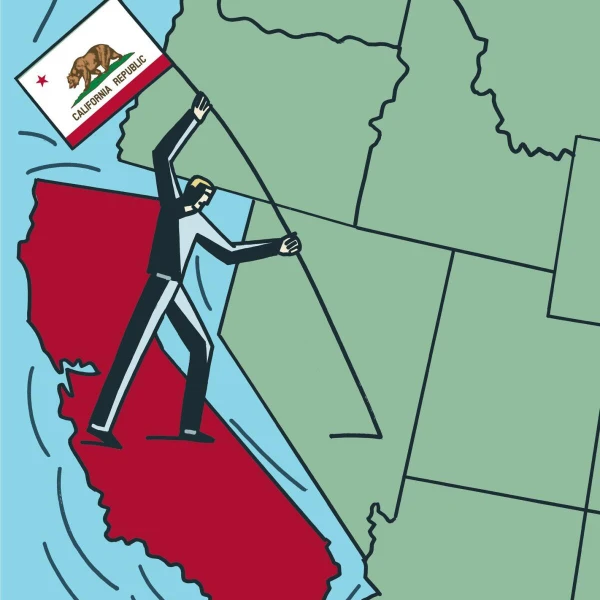
Will a ballot initiative on California secession qualify for a vote before 2030?
Yes refers to: Before 2030
Short Answer
Both the model and the market expect a ballot initiative on California secession to qualify for a vote before 2030, with no compelling evidence of mispricing.
1. Executive Verdict
- Calexit.Now is the primary proponent fundraising for secession ballot access.
- Mainstream California politicians lack public commitment to secession initiatives.
- 2026 gubernatorial election turnout determines future signature gathering needs.
- Secession proponents cite no specific external triggers for their efforts.
Who Wins and Why
| Outcome | Market | Model | Why |
|---|---|---|---|
| Before 2030 | 28.0% | 19.4% | Qualifying a California secession ballot initiative faces immense legal, political, and financial barriers. |
2. Market Behavior & Price Dynamics
Historical Price (Probability)
Outcome probability
Date
The price action for this market indicates a stable, sideways trend with low volatility. The market opened with a 30.0% probability and has since traded within a narrow nine-point range. A clear support level has formed near 22.0%, while resistance is established at the upper bound of 31.0%. The current price of 28.0% sits near the top of this channel but remains slightly below its opening level. The chart does not show any significant breakouts or dramatic price swings, with movement confined to minor fluctuations within this established range.
A defining feature of this market is its exceptionally low trading volume, with only 54 contracts traded. This low level of activity suggests a lack of broad market participation and conviction from traders. With no specific news or external events provided as context, the minor price shifts appear to be driven by internal market dynamics rather than any clear catalysts. The consistent trading below 31.0% indicates a stable market sentiment that views the qualification of a secession initiative as an unlikely event, with traders consistently assessing the probability at less than one-in-three. The sideways pattern and low volume together suggest this sentiment has been static and is not held with strong conviction by a large number of participants.
3. Market Data
Contract Snapshot
The market resolves to "Yes" if a ballot initiative on California secession qualifies for a vote before January 1, 2030. Conversely, it resolves to "No" if no such initiative qualifies by this date. The market closes early if the event occurs, otherwise, it will close by December 22, 2029, at 9:59 am EST.
Available Contracts
Market options and current pricing
| Outcome bucket | Yes (price) | No (price) | Last trade probability |
|---|---|---|---|
| Before 2030 | $0.28 | $0.73 | 28% |
Market Discussion
Limited public discussion available for this market.
4. How Do Calexit Fundraising Efforts Compare to Ballot Costs?
| Initial Funds Raised | $100,000 [^] |
|---|---|
| Signature-Gathering Goal | $1 million [^] |
| Estimated Ballot Qualification Cost | $10-15 million [Question context] [^] |
Calexit.Now pursues secession, setting specific fundraising targets for ballot access. This organization is the primary proponent for California's secession [^]. Their fundraising efforts have successfully achieved an initial target of $100,000 [^]. The organization has publicly stated a further goal to raise $1 million specifically to fund the signature-gathering process required to place a measure on the ballot, with a new "Calexit" bid approved for signatures aiming for the 2028 ballot [^].
Qualifying a statewide amendment is significantly more expensive than Calexit's goals. Successfully placing a contentious statewide constitutional amendment on the California ballot is estimated to cost between $10 million and $15 million [Question context]. This substantial amount typically covers the costs associated with extensive paid signature-gathering operations, which are essential for collecting the hundreds of thousands of valid signatures mandated by law [^]. The Calexit organizations' stated fundraising goal of $1 million for signature gathering [^] represents only a small fraction of this estimated total, indicating a significant financial gap between their current fundraising trajectory and the likely cost of successful ballot qualification.
5. Have California Officeholders Financially Backed Secession Initiatives?
| Political Officeholder Commitment | No public indication from current or former California statewide officeholders or members of Congress [^] |
|---|---|
| Primary Leadership Source | Primarily private citizens and advocacy groups [^] |
| Key Secession Figures | Louis J. Marinelli and Marcus Ruiz Evans [^] |
Mainstream California political figures lack public commitment to secession. Available research indicates no public commitment, financial or organizational, from any current or former California statewide officeholders or members of Congress to a specific secession ballot initiative. This absence of mainstream political backing aligns with historical observations regarding the primary failure point for past secession attempts, which have lacked significant institutional support [Question Context].
Calexit movements are primarily led by private citizens. The various initiatives and movements for California secession, often collectively known as 'Calexit,' are largely spearheaded by private citizens and their associated advocacy groups [^]. Key figures consistently mentioned in the leadership of these efforts include Louis J. Marinelli, associated with the California Independence Plebiscite Initiative (2026) and the California Freedom Coalition, and Marcus Ruiz Evans, linked to the Yes California Independence Campaign, the California National Party, and CalExit.Now [^]. These individuals and their organizations are responsible for developing initiatives, collecting signatures, and promoting the concept of California independence.
6. What is California AG's strategy for secession initiative summaries?
| Summary word limit | 100 words [^] |
|---|---|
| Mandated summary standard | True and impartial statement [^] |
| Success rate of summary lawsuits | Rarely succeed [^] |
The California Attorney General drafts critical, 100-word initiative summaries. The California Attorney General's office is legally mandated to prepare the official title and summary for all proposed ballot initiatives, with a strict 100-word limit [^]. This summary is crucial as it appears on signature-gathering petitions and the ballot itself, significantly shaping public perception [^]. While the law requires a "true and impartial statement" of the initiative's purpose and effect, the Attorney General's office has historically faced criticism for allegedly crafting summaries perceived as biased or politically charged, which critics contend can function as "political weapons" [^].
Summaries for controversial initiatives often highlight significant, perceived negative impacts. For an initiative such as secession, the California Attorney General's office would likely draft language that is factually accurate regarding the initiative's intent and legal consequences, while adhering to the 100-word limit and the requirement for impartiality [^]. However, based on precedents like Proposition 8, this factual language may still be framed in a way that emphasizes potentially controversial or significant impacts, which critics could interpret as an attempt to influence public opinion negatively or create a "poison pill" effect [^]. Although lawsuits challenging the impartiality of Attorney General-drafted summaries are common, they rarely succeed in compelling significant changes, thus underscoring the Attorney General's broad discretion [^].
7. How Will 2026 Election Turnout Impact California Ballot Initiatives?
| Current Verified Signature Requirement | 779,028 (8% of 2022 gubernatorial votes) [^] |
|---|---|
| New Baseline for Future Requirements | 2026 California gubernatorial election voter turnout [^] |
| Median Cost for 850K Verified Signatures | Approximately $5.0 million to $17.0 million [^] |
The 2026 gubernatorial election will determine future signature needs. The voter turnout in the 2026 California gubernatorial election will directly establish the new calculation base for the number of raw signatures required to qualify a constitutional amendment. Currently, qualifying a constitutional amendment demands verified signatures equal to 8% of the total votes cast for governor in the preceding gubernatorial election [^]. For initiatives circulating presently, this requirement stands at 779,028 verified signatures, a figure derived from the 9,737,845 votes cast in the November 8, 2022, General Election [^]. The actual number of votes cast for governor in the 2026 election will replace the 2022 figure, meaning that a higher turnout will increase the verified signature requirement, while a lower turnout will decrease it. Proponents typically collect 1.5 to 2 times the necessary verified signatures to account for invalid ones, so the raw signature collection targets will adjust proportionally [^].
Collecting 850,000 signatures presents significant financial hurdles. There is no direct historical success rate identified in the provided sources for an initiative requiring over 850,000 verified signatures within a budget not exceeding $20 million. The current verified signature requirement for a constitutional amendment is 779,028 [^]; therefore, 850,000 verified signatures would exceed this present threshold, suggesting it would be a future requirement resulting from potentially higher gubernatorial turnout. Gathering such a large volume of signatures is a substantial financial challenge. The median cost for collecting signatures in California typically ranges from $5.89 to $20.01 per verified signature [^]. Consequently, the cost for signature gathering alone to achieve 850,000 verified signatures would fall between approximately $5,005,000 and $17,008,500 [^]. This considerable portion of a $20 million budget would leave very limited funds available for other essential campaign activities, such as legal fees, advertising, or voter outreach, thereby making overall qualification highly difficult.
8. What Catalysts Trigger California Secession Signature Gathering Efforts?
| Signature gathering window duration | 180 days [^] |
|---|---|
| Target ballot year for independence | 2028 [^] |
| Deadline for signature collection | Late 2025 [^] |
California secession proponents do not cite specific external triggers. Groups advocating for California's independence, such as those associated with the "Calexit" movement, have not identified particular, measurable catalysts—like an unfavorable Supreme Court ruling or a specific presidential election outcome—as the direct triggers for commencing their 180-day signature gathering periods for ballot initiatives [^]. Instead, this 180-day window is a procedural phase that starts once an initiative receives official approval for circulation, rather than being initiated by an external event [^].
A current initiative aims for the 2028 ballot. An initiative seeking to place the question of California's independence on the 2028 ballot has been approved for signature collection [^]. Marcus Ruiz Evans, a prominent figure in the "Calexit" movement, suggests that the drive for secession is "gaining traction" as Californians increasingly feel detached from federal policies and Washington [^]. While historical events, such as reactions to certain federal actions, may contribute to the sentiment for secession, they are not formally cited as the triggers for beginning the signature collection phase for a ballot measure [^]. Proponents are required to gather the necessary signatures by late 2025 to qualify the measure for the 2028 ballot [^].
9. What Could Change the Odds
Key Catalysts
Catalyst analysis unavailable.
Key Dates & Catalysts
- Expiration: January 08, 2030
- Closes: December 22, 2029
10. Decision-Flipping Events
- Trigger: Catalyst analysis unavailable.
12. Historical Resolutions
No historical resolution data available for this series.
Get Real-Time Research Updates
Sign up for early access to live reports, historical data, and AI-powered market insights delivered to your inbox.
