
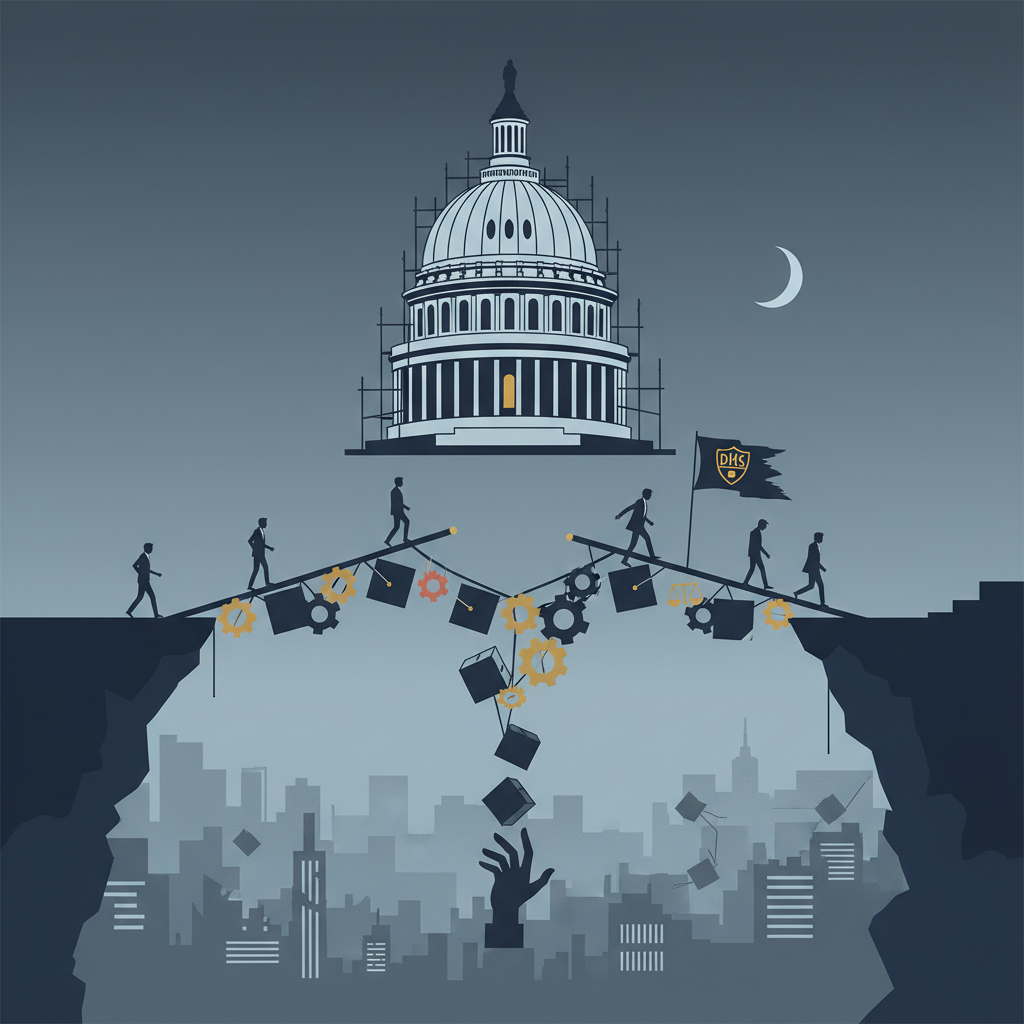
Prediction markets tracking the end of the record-long Department of Homeland Security (DHS) shutdown sharply repriced on Thursday, April 02, 2026, erasing the prospect of a quick resolution. Probabilities for a funding deal being enacted in the first half of April collapsed, with the market consensus shifting the expected timeline to later in the spring or summer. The move coincided with the House of Representatives declining to vote on a Senate-passed funding measure, signaling that a leadership-backed deal announced just a day prior faces significant opposition and will not be passed before Congress returns from its recess in mid-April.
Distribution Analysis
The most dramatic declines occurred in contracts for an April resolution. The probability of DHS being funded "Before Apr 8, 2026" fell by 71.0 percentage points to just 3%, while the "Before Apr 15, 2026" contract dropped 68.0 percentage points. This cascading pessimism extended to later deadlines, with contracts for May and June resolutions also seeing notable declines. The market's long-term outlook remains stable, with the probability of funding occurring "Before Jan 1, 2027" holding at 99%, indicating traders are pricing in a delay, not a failure to fund the department entirely in 2026.
| Outcome | Current Prob | Change | Volume |
|---|---|---|---|
| Before Apr 8, 2026 | 3% | -71.0pp | 613,696 |
| Before Apr 15, 2026 | 23% | -68.0pp | 323,950 |
| Before Apr 22, 2026 | 51% | -36.0pp | 108,175 |
| Before May 1, 2026 | 65% | -16.0pp | 101,680 |
| Before Jun 1, 2026 | 91% | -13.0pp | 89,641 |
| Before Jul 1, 2026 | 91% | -8.0pp | 15,560 |
| Before Jan 1, 2027 | 99% | ~0pp | 4,197 |
Net: 6 of 7 contracts declined on over 1.25 million in total volume, shifting the implied timeline for a funding resolution out of April and into later in 2026.
What's Driving the Shift
The sharp repricing appears to be a direct reaction to legislative inaction in Washington D.C., which undermined hopes of a swift end to the 48-day shutdown.
- House Punts on Senate Bill: On Thursday, April 2, the Senate advanced a bipartisan bill to fund most of DHS [6]. However, the House met only for a brief pro forma session and did not take up the measure, quickly gaveling out [4]. This inaction effectively postponed any potential resolution until at least next week, and likely until after the congressional recess ends [4, 6].
- Conservative Opposition Stalls Deal: The House's refusal to vote reflects intense opposition from conservative members to the leadership-backed plan [4]. A day earlier, on April 1, House Speaker Mike Johnson and Senate Majority Leader John Thune announced a two-track plan to fund DHS, which had received President Trump's endorsement [1, 2, 8]. Despite this, conservative hardliners have rejected the deal, which would fund DHS except for Immigration and Customs Enforcement (ICE) and Customs and Border Protection (CBP) initially [4, 5]. Rep. Scott Perry, R-Pa., stated his opposition, calling the plan "caving to Democrats" [5].
- Recess Reality: Both chambers of Congress are on a scheduled two-week recess until the week of April 13 [2, 3]. While legislative business can be conducted in pro forma sessions via unanimous consent, the vocal opposition from some Republicans makes this impossible [5]. The market's collapse of April probabilities reflects the logistical reality that no contentious legislation can pass until lawmakers are back in Washington.
Market Context
The partial DHS shutdown began on February 14, 2026, and at over 47 days, it is the longest in U.S. history [1, 3, 10]. The political impasse stems from Democratic demands for reforms to ICE and CBP following controversial actions by federal agents earlier in the year [3, 6]. The market's reaction on April 2 indicates that traders believe the internal divisions within the House Republican conference are a more significant obstacle to a deal than the prior stalemate between the two parties. While a deal was announced by leadership, the market immediately priced in the high probability that it would not have enough votes to pass, a fear confirmed by the House's subsequent inaction.
What to Watch
The next key date is the end of the congressional recess, when lawmakers are scheduled to return the week of April 13 [6]. Attention will be on Speaker Johnson and his leadership team's efforts to persuade conservative members to support the two-track funding plan [7]. President Trump has publicly called for a separate reconciliation bill funding ICE and CBP to be on his desk by June 1, a deadline that puts pressure on Republicans to resolve the first part of the funding plan soon after they return [3, 7].
