
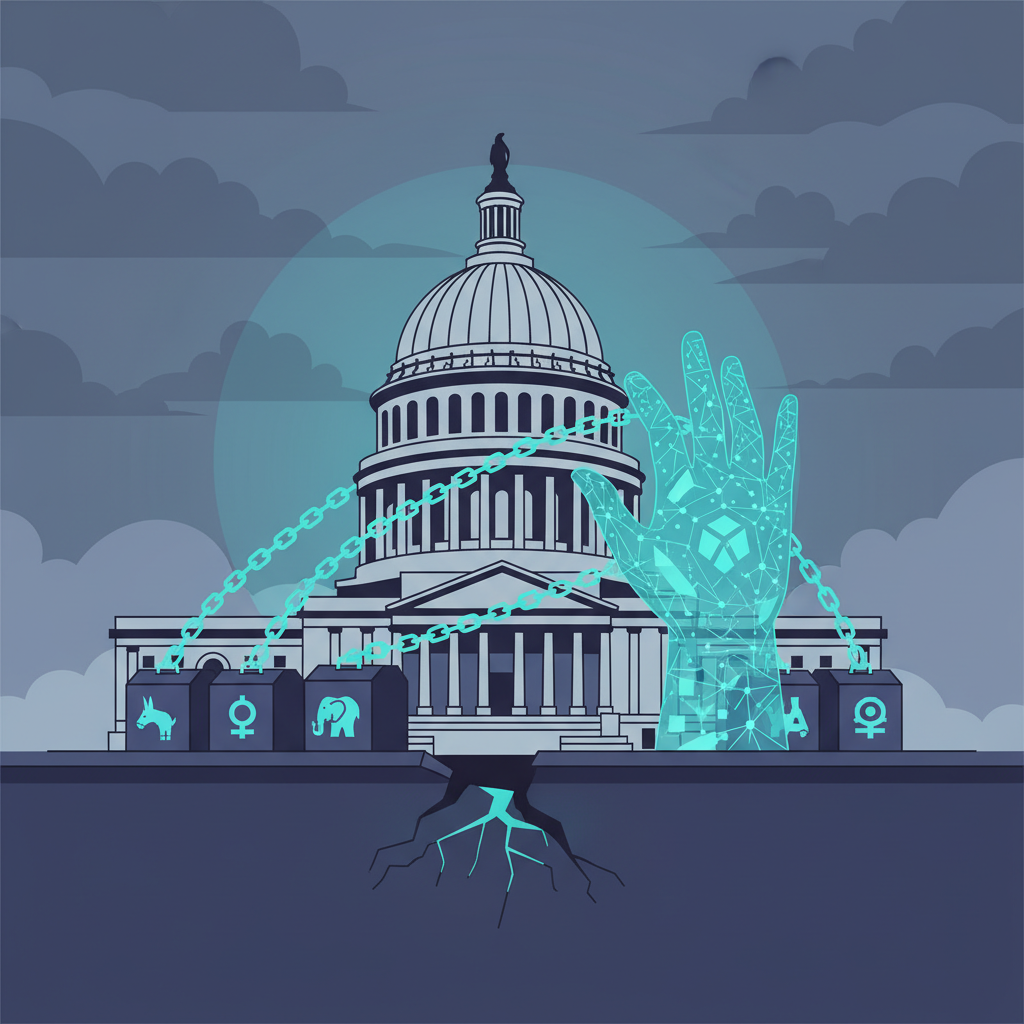
Prediction market odds for the passage of comprehensive crypto market structure legislation have shifted significantly, with traders pushing back the expected timeline for the bill to become law. Probabilities for passage in the second quarter of 2026 fell sharply, as the market reallocated risk toward a later timeframe amid continued legislative gridlock in the U.S. Senate. The move reflects growing concerns over a tight legislative calendar and persistent policy disagreements that have stalled the bill.
The most significant repricing occurred in contracts resolving before the summer. The "Before July" contract experienced a sharp 15.0 percentage point drop, while the "Before June" contract fell by 11.0 percentage points. While the "Before August" contract absorbed some of this probability, rising 6.0 percentage points, the overall trend was negative. Four of the six contracts declined, including the overarching "Before 2027" contract, signaling diminished confidence in a near-term resolution.
Distribution Analysis
The market’s recalibration shows a clear flight from near-term optimism. The significant volume on declining contracts, totaling over 10,700 trades, underscores the conviction behind the move toward a later timeline.
| Outcome | Current Prob | Change | Volume |
|---|---|---|---|
| Before 2027 | 71% | -2.0pp | 1,070 |
| Before August | 64% | +6.0pp | 531 |
| Before July | 43% | -15.0pp | 1,903 |
| Before June | 18% | -11.0pp | 714 |
| Before May | 7% | +2.0pp | 7,778 |
| Before April | 2% | -1.0pp | 7,100 |
What's Driving the Shift
The shift in market sentiment appears directly linked to the slow pace of legislative progress for the Digital Asset Market Clarity Act (CLARITY Act) in the U.S. Senate. Despite passing the House of Representatives in July 2025, the bill has been mired in committee negotiations [2, 5].
Recent developments suggest the impasse, while not absolute, continues to create delays:
- Shrinking Legislative Calendar: A primary catalyst for the repricing is the dwindling legislative calendar ahead of the 2026 midterm elections. An analysis published on March 17 noted that only 18 working weeks remain on the Senate calendar before the October recess [6]. The bill must still clear five sequential steps, starting with a Senate Banking Committee markup that has yet to be formally scheduled, making the timeline exceptionally tight [6].
- Persistent Policy Stalemate: The core of the delay is a long-running dispute between the banking and cryptocurrency industries over whether crypto platforms can offer yield on stablecoins [1]. A White House meeting in early February failed to produce a compromise [1]. While Senators Thom Tillis (R-N.C.) and Angela Alsobrooks (D-Md.) recently reached a tentative "agreement in principle" on the issue, this has not yet translated into a formal breakthrough or been fully vetted with industry stakeholders [4].
- Unscheduled Key Vote: The Senate Banking Committee had previously targeted late March for a markup of the bill, a critical first step for it to advance [6]. With the Senate’s Easter recess beginning March 30, that window is closing rapidly, and no date has been confirmed. The market seems to be pricing in the high likelihood that this crucial step will be pushed to mid-April at the earliest, cascading delays through the rest of the process.
Market Context
The CLARITY Act (H.R. 3633) is considered landmark legislation designed to end years of regulatory uncertainty in the U.S. by establishing clear jurisdictional lines between the Securities and Exchange Commission (SEC) and the Commodity Futures Trading Commission (CFTC) [7, 8]. Its passage is seen as a primary goal for the crypto industry, which has long argued that existing financial regulations are inadequate for digital assets [3].
The current market movement represents an alignment of speculative odds with political reality. While industry observers and the White House had previously signaled hopes for a spring 2026 signing, the procedural and political hurdles in the Senate have proven formidable [5]. The bill must be reconciled between the Senate Banking Committee and the Agriculture Committee before it can be reconciled with the version passed by the House, a multi-stage process that consumes significant time [6].
This repricing is not an isolated event but part of a broader trend of diminishing optimism since early 2026, when legislative momentum appeared stronger. The continued inability of banking and crypto lobbies to resolve fundamental disagreements on issues like stablecoin yield remains the primary obstacle to the bill's advancement [1, 9].
What to Watch
The market's direction will hinge on tangible legislative progress. The most critical near-term event is the formal scheduling and completion of the Senate Banking Committee's markup vote. This will be the first concrete signal that the current impasse is breaking. Traders will also be closely monitoring public statements from committee leaders, including Chairman Tim Scott, as well as Senators Tillis and Alsobrooks, for any confirmation that their tentative agreement can secure enough support to move the bill forward [4, 5]. Until that first procedural domino falls, the market is likely to continue pricing in a protracted timeline.
