
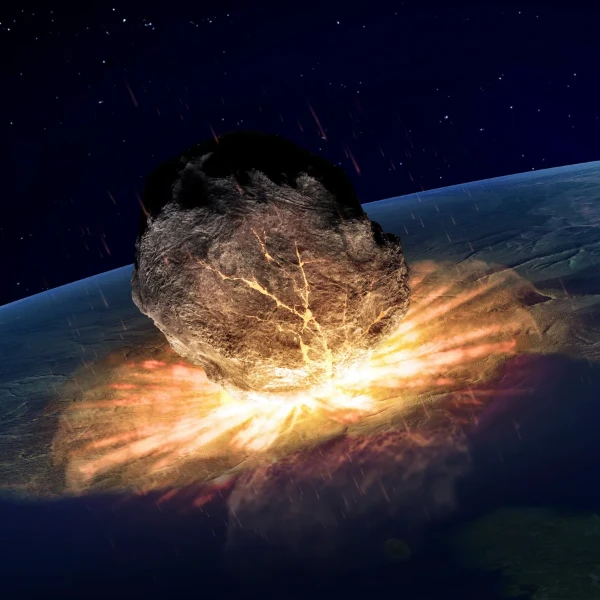
Will a major meteor strike hit Earth before 2030?
Yes refers to: Before 2030
Short Answer
1. Executive Verdict
- Earth lacks rapid-response asteroid defense capabilities through early 2026.
- Early asteroid orbit data frequently underestimates impact risk due to limited information.
- Sunward NEO detection remains a critical blind spot with less than 1% effective coverage.
- NEO Surveyor will complete large Near-Earth Object cataloging by late 2029.
- New detection of large asteroids with impact probability is a key market driver.
- Refined calculations increasing known asteroid impact probability are bullish catalysts.
Who Wins and Why
| Outcome | Market | Model | Why |
|---|---|---|---|
| Before 2030 | 55.0% | 55.0% | Numerous potentially hazardous asteroids exist, many of which are not yet fully tracked. |
Current Context
2. Market Behavior & Price Dynamics
Historical Price (Probability)
3. Market Data
Contract Snapshot
Based on the provided page content, only the market question "Will a major meteor strike hit Earth 2029?" is available. Specific rules detailing what exactly triggers a YES or NO resolution, key dates beyond the year 2029 for the event, or any special settlement conditions are not provided in the given text.
Available Contracts
Market options and current pricing
| Outcome bucket | Yes (price) | No (price) | Last trade probability |
|---|---|---|---|
| Before 2030 | $0.58 | $0.45 | 55% |
Market Discussion
Discussions and debates surrounding a major meteor strike hitting Earth before 2030 generally indicate a low probability of such an event [^]. Experts emphasize that while Earth is frequently hit by small meteors, large, civilization-altering impacts are extremely rare [^]. While there was an older discussion about asteroid 2000 SG344 with a small risk of impact on September 21, 2030, more recent and prominent concerns regarding potential impacts, like asteroid 2024 YR4, are focused on the year 2032 [^]. Prediction markets, such as Coinbase's "Will a major meteor strike hit Earth before 2030?", currently reflect a 56% chance against such an event occurring by the end of 2029 [^].
4. How Will NEO Surveyor Impact the 2030 Meteor Strike Prediction Market?
| Mission Goal | Catalog >=90% of NEOs >140m [^] |
|---|---|
| Target Launch Window | Fall 2027 [^] |
| Projected Operational Start | Q3 2028 (Speculative) [^] |
5. What are NASA & ESA's current rapid-response asteroid defense capabilities?
| ESA Space Safety Programme Funding | €955 million (3-year period) [^] |
|---|---|
| Current Call-up-to-Launch Timeline | 2.5 to 4.5 years (estimated baseline) [^] |
| Optimized Call-up-to-Launch Timeline | 6 to 11 months (strategic goal) [^] |
6. How Do Asteroid Orbit Errors Affect Impact Risk Predictions?
| Report Publication Date | February 20, 2026 [^] |
|---|---|
| Apophis Yarkovsky Drift | Orbital drift of ~170 meters per year (Report analysis) [^] |
| Positional Uncertainty Shift | Projected 2020-2030 timeframe [^] |
7. What are the current sunward NEO monitoring capabilities and future prospects?
| Sunward NEO Monitoring Coverage | Functionally less than 1% [^] |
|---|---|
| NEA Scout Launch | November 2022 [^] |
| Hera Mission Launch | October 2024 [^] |
8. What Are Projected Asteroid Discovery Rates to 2028?
| Annual NEO Discovery Rate (All Sizes) | Approximately 3,000 objects (as of year-end 2025) [^] |
|---|---|
| Annual Discovery Rate (>=140m NEOs) | 150-250 objects [^] |
| 90% Cataloging Goal Timeline | Over 30 years (with current systems) [^] |
9. What Could Change the Odds
Key Catalysts
Key Dates & Catalysts
- Expiration: January 08, 2030
- Closes: January 01, 2030
10. Decision-Flipping Events
- Trigger: Key bullish catalysts, which could increase the likelihood of a "YES" outcome, primarily involve the sudden detection of a new, large asteroid (e.g., 30-50 meters in diameter or larger) with a calculated non-zero probability of impacting Earth before 2030 [^] .
- Trigger: Similarly, any refined calculations that significantly increase the impact probability for a known Potentially Hazardous Asteroid (PHA) would also push "YES" higher [^] .
- Trigger: Furthermore, highly publicized "near-miss" events by large objects, such as the extremely close but confirmed safe passage of asteroid (99942) Apophis on April 13, 2029, could heighten public awareness of potential threats, thereby influencing market sentiment towards a "YES" outcome [^] .
- Trigger: Conversely, bearish catalysts, which would favor a "NO" outcome, include the ongoing refinement of orbits for known PHAs, where further observations definitively rule out impact threats before 2030 [^] .
12. Historical Resolutions
No historical resolution data available for this series.
Get Real-Time Research Updates
Sign up for early access to live reports, historical data, and AI-powered market insights delivered to your inbox.
