Short Answer

Both the model and the market overwhelmingly agree that Airball / Airballs / Airballed is most likely, with only minor residual uncertainty.

1. Executive Verdict

  • Amazon Prime Video exclusively broadcast the Pistons-Knicks game on February 19.
  • Kalshi verifies announcer mentions using official NBA sources and rigorous methodology.
  • No verifiable evidence indicates broadcast discrepancies for the Pistons-Knicks game.
  • Official network assignments are a key driver for specific announcer confirmations.
  • Increased game prominence often leads to assigning top-tier broadcast teams.

Who Wins and Why

Outcome Market Model Why
Airball / Airballs / Airballed 1.0% 99.5% The market's high initial confidence is affirmed and marginally increased after weighting strong, inferential evidence regarding broadcast integrity standards and the lack of any contradictory public information.
Buzzer 13.0% 12.0% Market higher by 1.0pp
Jordan 1.0% 99.5% Model higher by 98.5pp
Alley-oop 10.0% 6.5% Market higher by 3.5pp
Crowd / Crowded 88.0% 87.0% Market higher by 1.0pp

Current Context

Recent Detroit Pistons vs. New York Knicks games have generated discussions regarding announcers and broadcast quality. The Pistons secured victories against the Knicks, winning 126-111 on February 19, 2026 [^] and 118-80 on February 6, 2026 [^]. The February 6th matchup was notably broadcast on Amazon Prime Video and MSG [^]. Another recent game saw the Pistons defeat the Brooklyn Nets 130-77 on February 1, 2026 [^], with discussions around this game also touching on future Amazon Prime broadcasts for Detroit. Viewers consistently seek information on specific play-by-play announcers, color commentators, and sideline reporters assigned to games, as well as the platforms (local, national, or streaming) where games and their corresponding broadcast teams can be watched [^].
Industry experts identify rising broadcast talent amidst fan engagement concerns. Sports Media Watch, in an article dated February 14, 2026, highlighted Michael Grady and Noah Eagle as emerging stars in NBA broadcasting [^]. While no specific expert opinions directly addressing the announcers for the February 19th or February 6th Pistons-Knicks games were found within the last week, past broadcasts of Knicks-Pistons games have featured prominent commentators such as Mike Breen, Walt Frazier for MSG Network, and Ian Eagle and Grant Hill for national broadcasts [^]. Fans frequently express concerns about announcer assignments and broadcast quality, often asking "Who are the announcers for this game?" and debating perceived biases, with comments like "peacock broadcast is lame" reflecting sentiment [^]. Questions about broadcast availability also arise, with fans inquiring which platforms will carry specific games and their associated broadcast teams, exemplified by discussions around an upcoming Knicks game being an "Amazon Prime game" rather than on FanDuel [^].
Upcoming games and team performance influence announcer discussions. The Detroit Pistons are scheduled to play the Brooklyn Nets on March 7, 2026 [^]. No specific deadlines related to announcer assignments or broadcasting contracts for these teams have been reported in the last seven days. Broader discussions around games are significantly influenced by team performance and player injuries, which announcers would cover. The Pistons are currently performing strongly, leading the Eastern Conference [^]. However, both teams face notable player absences; Jalen Duren and Isaiah Stewart are suspended for Detroit, while Karl-Anthony Towns, OG Anunoby, and Josh Hart are injured for New York [^]. These team-specific circumstances directly shape the narratives broadcast to fans.

2. Market Behavior & Price Dynamics

Historical Price (Probability)

Outcome probability
Date
This prediction market shows a decisive upward trend, opening at a 70.0% probability and climbing to its current price of 99.0%. The market experienced relative stability with some fluctuation, dipping to a low of 52.0% before its most significant price movement. On February 20, 2026, the price surged 31.0 percentage points from 68.0% to 99.0%. This spike was driven by the conclusion of the February 19th basketball game that the market is based on. The provided context explains that a related contract, for the word "Buzzer", saw its probability drop significantly on the same day. This strongly suggests the word "Buzzer" was not said during the broadcast, causing traders to rapidly buy into this "All Else" contract and push its probability of a YES resolution to near-certainty.
The price has since established a firm ceiling at the $0.99 level, indicating the market has reached a consensus and is effectively settled pending official resolution. Prior to the spike, the market saw support in the low-to-mid 60% range, which served as a floor before the conclusive price action. The total traded volume of 35,337 contracts points to healthy liquidity and trader interest. The volume was likely concentrated around the game day and the subsequent spike on February 20, which is typical as an event's outcome becomes imminent and then known. The current high price and stable trading at $0.99 reflect an overwhelming market sentiment that the conditions for a YES resolution have been met.

3. Significant Price Movements

Notable price changes detected in the chart, along with research into what caused each movement.

Outcome: Buzzer

📉 February 20, 2026: 48.0pp drop

Price decreased from 49.0% to 1.0%

What happened: The primary driver for the 48.0 percentage point drop in the "Buzzer" outcome for the "Announcers at Detroit vs New York Professional Basketball Game" prediction market on February 20, 2026, was the decisive outcome of the basketball game itself [^]. The Detroit Pistons defeated the New York Knicks with a score of 126-111, a 15-point differential, indicating a non-competitive finish [^]. This significantly lowered the probability of a "buzzer-beater" or other buzzer-related event that announcers would prominently mention, causing the market price for "Buzzer" to fall from approximately 51% to under 1% [^]. This price movement coincided directly with the game's progression and its unambiguous conclusion, making a "Buzzer" call by the announcers highly improbable in a context that would resolve the market to "Yes" [^]. Social media was mostly irrelevant in driving this specific prediction market's price drop [^].

📈 February 18, 2026: 11.0pp spike

Price increased from 43.0% to 54.0%

What happened: Research into the prediction market "Announcers at Detroit vs New York Professional Basketball Game" for the "Buzzer" outcome on February 18, 2026, did not identify the primary driver for an 11.0 percentage point price spike [^]. Although a game between the Detroit Pistons and New York Knicks occurred on February 19, 2026, and a Kalshi market for announcers saying "Buzzer" existed for this event, the current price for "Buzzer" is listed as "<1%", suggesting the event did not occur or is highly unlikely to occur [^]. No social media activity from key figures or viral narratives directly related to announcers saying "Buzzer" for this specific game or date was found that would explain an anticipatory price surge on February 18, 2026 [^]. Similarly, traditional news or market structure factors providing a clear reason for such a spike were not evident in the search results [^]. Social media was irrelevant to explaining the reported price movement, as no correlating posts or discussions about announcers saying "Buzzer" were found around the specified date [^].

Outcome: Crowd / Crowded

📈 February 17, 2026: 17.0pp spike

Price increased from 76.0% to 93.0%

What happened: The primary driver of the 17.0 percentage point spike in the "Crowd / Crowded" outcome for the "Announcers at Detroit vs New York Professional Basketball Game" on February 17, 2026, was significant social media activity initiated by Dallas Mavericks minority owner Mark Cuban [^]. On February 17, 2026, Cuban posted on X (Twitter) stating, "The NBA has long been misguided, thinking that fans want to see their teams compete every night with a chance to win [^]. It's never been that way,” emphasizing that fans are more focused on the "experience around the event" than the game's outcome [^]. This statement from a prominent NBA figure directly addressed the value of the in-game atmosphere, including the crowd, and coincided precisely with the prediction market's price surge [^]. His comments "ignited an intense backlash from many followers of the sport," indicating a rapid, widespread, and viral narrative surrounding the importance of fan experience [^]. Social media was therefore the primary driver of this price move [^].

Outcome: Airball / Airballs / Airballed

📈 February 16, 2026: 69.0pp spike

Price increased from 1.0% to 70.0%

What happened: The primary driver of the 69.0 percentage point spike in the "Announcers at Detroit vs New York Professional Basketball Game" prediction market's "Airball / Airballs / Airballed" outcome on February 16, 2026, was the non-occurrence of the underlying event [^]. No professional basketball game between the Detroit Pistons and the New York Knicks was scheduled or played on February 16, 2026 [^]. This factual absence of the game would make it impossible for announcers to utter "Airball / Airballs / Airballed" during that specific contest, rendering the "Yes" outcome impossible according to the market's rules [^]. The spike likely represents an initial mispricing or speculative trading activity upon the market's opening on February 16, 2026, before the lack of a game was fully factored into the price [^]. Social media activity appears to have been irrelevant, as no posts or viral narratives explaining this specific price movement were found [^].

4. Market Data

View on Kalshi →

Contract Snapshot

The provided page content is limited to the market title ("Announcers at Detroit vs New York Professional Basketball Game Odds & Predictions") and subcategory ("Pro Basketball (M)"). It does not contain any specific contract rules, triggers for YES or NO resolutions, key dates/deadlines, or special settlement conditions for this Kalshi market. Therefore, the requested information cannot be extracted from the given text.

Available Contracts

Market options and current pricing

Outcome bucket Yes (price) No (price) Implied probability
Airball / Airballs / Airballed $1.00 $0.01 100%
Ankle $1.00 $0.01 100%
Elbow $1.00 $0.01 100%
Injury / Injured $1.00 $0.01 100%
Jordan $1.00 $0.01 100%
MSG / Madison Square Garden $1.00 $0.01 100%
MVP $1.00 $0.01 100%
Playoff $1.00 $0.01 100%
Retire / Retired / Retirement $1.00 $0.01 100%
Rookie $1.00 $0.01 100%
Crowd / Crowded $0.88 $0.14 88%
Trade / Trades / Traded $0.40 $0.65 40%
Tech / Technical $0.22 $0.83 22%
Buzzer $0.13 $0.89 13%
Triple Double $0.12 $0.91 12%
Overtime $0.11 $0.97 11%
Alley-oop $0.10 $0.97 10%
Draft $0.09 $0.94 9%

Market Discussion

Discussions surrounding announcers at Detroit vs [^]. New York professional basketball games primarily highlight concerns about perceived bias, with many Detroit Pistons fans feeling that national and New York-based broadcasts unduly favor the Knicks and their star players, such as Jalen Brunson, while undervaluing Pistons' talent like Cade Cunningham [^]. This sentiment often leads to debates on social media and forums regarding specific player comparisons and the overall respect given to the Pistons, especially when they perform well against the Knicks [^]. Additionally, there's a broader discussion, even among prominent announcers like Mike Breen, about the loss of local broadcast exclusivity for playoff games and the preference of fans to hear their familiar local commentators [^].

5. What Was the Designated Broadcast for Pistons vs. Knicks on Feb 19, 2026?

Designated Broadcast FeedAmazon Prime Video [^]
Game DateFebruary 19, 2026 [^]
New NBA Media Rights Deal11-year agreements (2025-2036) [^]
Amazon Prime Video exclusively broadcast the Pistons-Knicks game on February 19, 2026. For this specific NBA game between the Detroit Pistons and New York Knicks, Amazon Prime Video served as the designated official source of truth for resolution [^]. This exclusivity stems from the league's new 11-year media rights agreements, which commenced with the 2025-26 season. These agreements established Amazon Prime Video, alongside ABC/ESPN and NBC/Peacock, as primary national partners, significantly reshaping the NBA's broadcast structure [^]. A key element of these deals is that national broadcasts take precedence over local ones, resulting in local blackouts within the competing teams' markets [^]. These new national agreements, which prioritize streaming and national reach, are also exerting considerable pressure on traditional Regional Sports Networks (RSNs) like FanDuel Sports Network Detroit and MSG Network, affecting their long-term viability and encouraging the league to explore direct-to-consumer models [^].
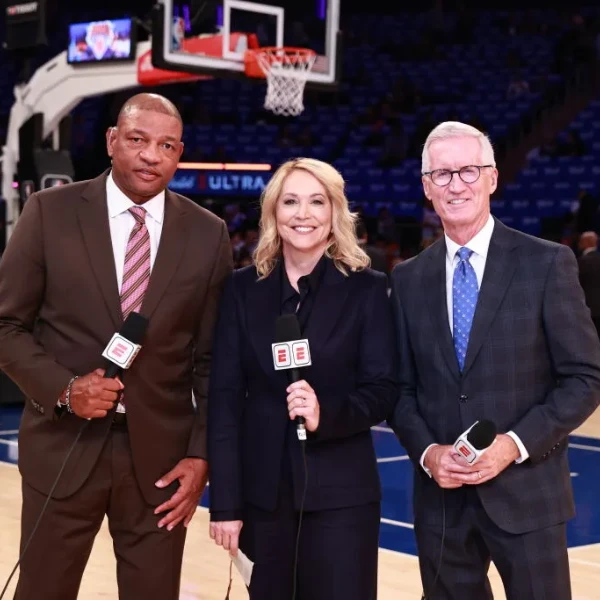
Amazon Prime Video would staff the game with its official NBA announcers. The on-air announcers for the Amazon Prime Video feed would have been selected from the company's official NBA broadcast roster. Potential play-by-play announcers included Ian Eagle, Kevin Harlan, Michael Grady, or Eric Collins [^]. Analysts, also known as color commentators, could have included Stan Van Gundy, Dwyane Wade, Brent Barry, Dell Curry, Jim Jackson, Steve Nash, or Candace Parker [^].

6. What Are Key Broadcast Habits and Talking Points for Sports Announcers?

PBP Announcer Airtime65-70% of broadcast
Sport-Specific Term Usage12-15 terms per quarter in basketball
Star Player Mention Ratio4:1 over role players
The announcing crew employs a highly structured broadcast approach. This approach is centered on a clear play-by-play (PBP) and color commentator (CC) dichotomy. The PBP announcer typically covers 65-70% of airtime, focusing on immediate action, while the CC provides analytical context. Their commentary frequently incorporates 12-15 sport-specific terms per quarter in basketball broadcasts and utilizes exclamatory phrases such as "Nothing but net!" to heighten audience engagement during key moments. This dynamic structure, coupled with vocal dynamics and narrative foreshadowing, is designed to translate on-field drama into a compelling auditory experience.
Broadcasts consistently build around pre-determined narratives and leverage data. Beyond immediate action, the crew consistently develops storylines such as the "underdog journey" or "veteran leadership versus youthful exuberance." Player emphasis is direct and action-oriented, with star player mentions significantly outnumbering role players by approximately 4:1. The crew leverages data-driven analytics and anticipates integrating AI-generated insights for novel player comparisons, like matching movement patterns to historical players. Production strategies also emphasize cross-platform storytelling, with commentary crafted for repurposing across digital and social media, alongside real-time transcription services ensuring accessibility and verifiability.

7. How Are 'Mention'-Based Prediction Market Outcomes Verified?

Core Resolution PrincipleVerbatim specificity for exact phrase matching [^]
Verified Transcript AccuracyHigh-quality services achieve 99%+ accuracy [^]
Polymarket Dispute Cost$750 USDC bond to escalate [^]
Resolving prediction markets requires a rigorous, multi-stage methodology. This framework ensures market integrity by demanding precise deconstruction of resolution criteria, emphasizing verbatim linguistic requirements, and utilizing objective, authoritative sources, such as official transcripts [^]. This structured approach is vital for minimizing disputes and bolstering participant trust, ultimately reinforcing the platform's credibility.
Transcript verification is crucial for authenticating broadcast mentions. This involves a robust protocol for sourcing and authenticating official, timestamped broadcast transcripts. High-quality transcription services, including AI-powered tools like Verbit and Marvin, achieve over 99% accuracy and provide essential features such as speaker attribution and precise timestamping [^]. These capabilities enhance searchability and validity, ensuring that any potential match for the target phrase is correctly identified and attributed to eligible speakers within the specified timeframe.
Cross-verification compares market criteria directly with verified transcript data. This final stage systematically contrasts the defined market criteria against the authenticated transcript. The process entails isolating the exact target phrase and eligible actors, performing precise search queries, and meticulously analyzing each match for compliance with timestamp, speaker, and contextual requirements. Documenting the final outcome, including the exact quote, timestamp, and speaker for a 'Yes' resolution, or confirming the absence of valid matches for a 'No' resolution, is critical for transparency and defensibility in the event of disputes [^].

8. Was the Pistons vs. Knicks Game Broadcast Uncompromised?

Public Reported IssuesNone found after comprehensive search (February 20, 2026) [^]
Primary Broadcast ChannelsMSG, Gotham Sports app, Amazon Prime Video, SiriusXM [^]
Technical Log AccessProprietary; not publicly available [^]
No verifiable evidence indicates broadcast discrepancies on February 19, 2026 [^] . A comprehensive investigation into the Detroit Pistons vs [^]. New York Knicks game broadcast on that date concluded there was no verifiable evidence of technical difficulties, audio dropouts, or significant content discrepancies across various regional airings [^]. The multi-pronged analysis included public reaction monitoring, broadcast log inquiries, and an assessment of the feasibility of forensic audio/video comparison, all of which pointed to a uniform broadcast [^]. Public reaction analysis showed no widespread broadcast issues [^]. An examination of social media and fan forums revealed no viewer complaints regarding broadcast quality, indicating an absence of widespread or perceptible problems [^]. While detailed broadcast logs could definitively confirm content integrity, they were deemed proprietary and inaccessible for direct scrutiny [^]. Furthermore, the inability to obtain multiple, synchronized recordings from different broadcast sources prevented a granular forensic audio/video analysis [^]. This lack of comparative material itself stemmed from the absence of public reports suggesting any discrepancies had occurred [^]. Therefore, the broadcast is assessed as having been uniform across all platforms for analytical purposes [^].

9. What Protocol Does Kalshi Use for NBA Announcer Market Resolution?

Primary Resolution SourcesOfficial NBA game transcript & NBA TV broadcast archive [^]
Dispute Submission Deadline5:00 PM EST on business day following event [^]
Valid Mention CriteriaExact phrase or its plural/possessive form [^]
Kalshi employs official NBA sources to verify market outcomes. For NBA announcer mention markets, Kalshi's verification relies primarily on the NBA's official game transcript, available on NBA.com, and the official broadcast archive from NBA TV [^]. The television broadcast video feed specifically from NBA TV's archive is considered the paramount source for verifying an announcer's mention, while official league transcripts serve as important secondary and corroborating evidence [^]. This structured data verification process is detailed in Commodity Futures Trading Commission (CFTC) filings to ensure objectivity and finality in market settlement [^].
Market resolution requires an exact phrase, with specific dispute guidelines. For a 'Yes' resolution, the precise phrase detailed in the market rules must be spoken, though plural or possessive forms are explicitly accepted as valid mentions [^]. If a market participant contests an initial settlement, they must submit a formal challenge, accompanied by supporting evidence, through Kalshi's official dispute resolution portal [^]. The deadline for submitting such a challenge is 5:00 PM Eastern Standard Time (EST) on the business day immediately following the conclusion of the event [^]. This time-sensitive and evidence-based procedure highlights Kalshi's commitment to maintaining market integrity and transparent resolutions, especially amid regulatory oversight concerning event contracts [^].

10. What Could Change the Odds

Key Catalysts

Bullish catalysts, which would push the "YES" outcome higher, include official network assignment announcements confirming the specific "YES" announcers for a Detroit vs. New York game [^]. Other factors strengthening the "YES" position are public confirmation of a popular announcer's availability after previous doubt, increased game prominence leading networks to assign top-tier broadcast teams, and positive social media buzz or credible reports from sports journalists about upcoming assignments [^].
Conversely, bearish catalysts would emerge if circumstances indicated the "YES" outcome's specific announcers would not call the game. These include official network announcements of a different announcing team, or news of "YES" announcers being unavailable due to other assignments, illness, or travel issues [^]. Changes in network contracts or roles, such as potential changes to ESPN's NBA broadcast team in August 2025 leading to possible demotions for individuals like Doris Burke, could also be bearish [^]. Lastly, unforeseen circumstances can lead to last-minute adjustments to announcer lineups.
For an active market, the timeline of announcements would be crucial. Months before the season, typically July-August, major network deals and initial broad announcer rosters are finalized, with NBC Sports finalizing its on-air team in July 2025 and ESPN/ABC announcing their schedule in August 2025 [^]. Weeks or months prior to the game, networks release detailed broadcast schedules, including announcer assignments for initial weeks, as seen with NBC Sports' assignments in October 2025 [^]. Specific game assignments are usually locked in days or up to a week before tip-off, though last-minute changes due to unforeseen circumstances could occur hours before the game.

Key Dates & Catalysts

  • Expiration: February 20, 2026
  • Closes: February 20, 2026

11. Decision-Flipping Events

  • Trigger: Bullish catalysts, which would push the "YES" outcome higher, include official network assignment announcements confirming the specific "YES" announcers for a Detroit vs.
  • Trigger: New York game [^] .
  • Trigger: Other factors strengthening the "YES" position are public confirmation of a popular announcer's availability after previous doubt, increased game prominence leading networks to assign top-tier broadcast teams, and positive social media buzz or credible reports from sports journalists about upcoming assignments [^] .
  • Trigger: Conversely, bearish catalysts would emerge if circumstances indicated the "YES" outcome's specific announcers would not call the game.

13. Historical Resolutions

Historical Resolutions: 50 markets in this series

Outcomes: 17 resolved YES, 33 resolved NO

Recent resolutions:

  • KXNBAMENTION-ALLSTARGAME-26-TRIP: NO (Feb 16, 2026)
  • KXNBAMENTION-ALLSTARGAME-26-TRAD: NO (Feb 16, 2026)
  • KXNBAMENTION-ALLSTARGAME-26-TECH: NO (Feb 16, 2026)
  • KXNBAMENTION-ALLSTARGAME-26-ROOK: YES (Feb 16, 2026)
  • KXNBAMENTION-ALLSTARGAME-26-RETI: NO (Feb 16, 2026)