
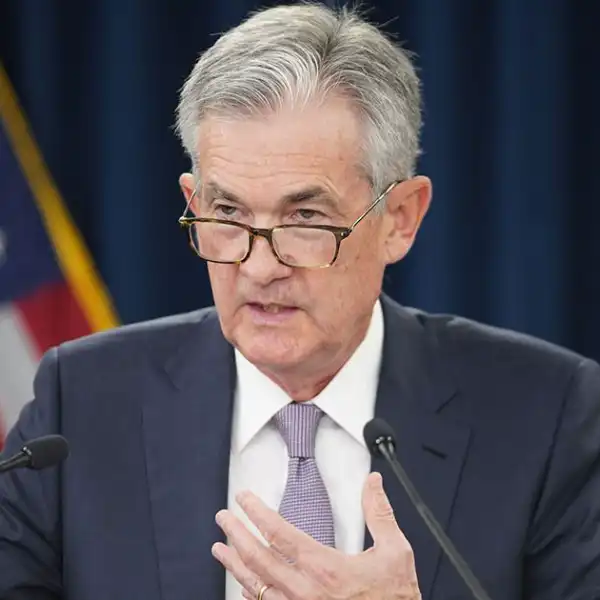
What will Powell say during his April press conference?
Short Answer
1. Executive Verdict
- Core PCE inflation significantly exceeded Fed's March 2026 projections.
- FOMC speech analysis was limited, key word ratios undetermined.
- April 2026 Financial Stability Report was unavailable for analysis.
- White House emphasized "full employment" in early 2026 commentary.
- Market expected no June 2026 rate cut on April 29.
Who Wins and Why
| Outcome | Market | Model | Why |
|---|---|---|---|
| Good Afternoon | 97.0% | 96.7% | The provided background research is high-quality secondary evidence regarding recent economic data and Fed projections, but it offers no information relevant to whether Jerome Powell will say "Good Afternoon" during an April press conference, thus providing no shift from the debiased probability that assumes this common greeting. |
| Projection | 63.0% | 74.5% | Recent Core PCE inflation and U-3 unemployment data show significant deviations from the Fed's March 2026 SEP projections, compelling Powell to address these trends and provide updated economic projections or outlooks in his April press conference. |
| Trump | 7.0% | 2.7% | The provided background research details economic data and Fed projections, offering no relevant information regarding whether Powell will mention Trump, thus leading to a neutral shift in probability as the evidence supports neither the market being correct nor incorrect on this specific outcome. |
| Oil | 92.0% | 89.8% | The evidence, based on primary official sources, indicates Core PCE inflation running above Fed projections and unemployment below projections, suggesting a hawkish Fed concerned with underlying inflation; however, the research's specific focus on *core* inflation, which excludes energy, slightly weakens the direct relevance to Powell specifically mentioning oil compared to the 91% debiased anchor. |
| Dollar | 53.0% | 63.7% | The evidence shows Core PCE inflation and U-3 unemployment are both stronger than the Fed's March SEP projections, strongly supporting a hawkish stance from Powell and thus a stronger dollar, despite the possibility of Powell attempting to temper expectations. |
2. Market Behavior & Price Dynamics
Historical Price (Probability)
3. Significant Price Movements
Notable price changes detected in the chart, along with research into what caused each movement.
📈 April 08, 2026: 9.0pp spike
Price increased from 3.0% to 12.0%
Outcome: Trade War
4. Market Data
Contract Snapshot
This market resolves to "Yes" if the Federal Reserve Chair says "Dollar" (including plural or possessive forms) during his April 2026 post-FOMC meeting introductory remarks and Q&A; otherwise, it resolves to "No." Verification relies primarily on video, with official transcripts as backup, and confirms the exact word without other grammatical inflections. The market, covering an event on April 29, 2026, opened on March 24, 2026, and will close after the outcome occurs or by April 30, 2026, 10:00 am EDT, with payouts projected 30 minutes post-closing.
Available Contracts
Market options and current pricing
| Outcome bucket | Yes (price) | No (price) | Last trade probability |
|---|---|---|---|
| Expectation | $0.98 | $0.03 | 97% |
| Good Afternoon | $0.98 | $0.03 | 97% |
| Unchanged | $0.98 | $0.03 | 97% |
| Anchor / Anchored | $0.96 | $0.05 | 96% |
| Oil | $0.92 | $0.09 | 92% |
| Restrictive | $0.90 | $0.12 | 88% |
| Uncertainty | $0.88 | $0.14 | 88% |
| Layoff | $0.86 | $0.15 | 85% |
| Shock | $0.84 | $0.17 | 83% |
| Gas / Gasoline / Natural Gas | $0.80 | $0.22 | 80% |
| Productivity | $0.79 | $0.26 | 79% |
| AI / Artificial Intelligence | $0.78 | $0.23 | 78% |
| Pandemic | $0.75 | $0.26 | 74% |
| Projection | $0.63 | $0.39 | 63% |
| Tariff Inflation | $0.63 | $0.38 | 63% |
| Balance Sheet | $0.62 | $0.39 | 62% |
| Goods inflation | $0.65 | $0.38 | 62% |
| Central Bank | $0.56 | $0.45 | 56% |
| Softening | $0.55 | $0.47 | 55% |
| Credit | $0.55 | $0.46 | 54% |
| Dollar | $0.54 | $0.47 | 53% |
| Recession | $0.43 | $0.58 | 43% |
| Median | $0.31 | $0.70 | 33% |
| Shutdown / Shut Down | $0.30 | $0.71 | 30% |
| Slowdown / Slow Down | $0.30 | $0.74 | 30% |
| Probability | $0.26 | $0.75 | 26% |
| Iran | $0.24 | $0.77 | 24% |
| Volatility | $0.24 | $0.77 | 24% |
| Stagflation | $0.22 | $0.79 | 22% |
| President | $0.21 | $0.80 | 21% |
| Replace / Replaces / Replaced / Replacement | $0.19 | $0.83 | 19% |
| Tax | $0.17 | $0.84 | 16% |
| Consumer Confidence | $0.15 | $0.86 | 15% |
| QT / Quantitative Tightening | $0.15 | $0.86 | 15% |
| Dissent | $0.15 | $0.86 | 14% |
| Yield Curve | $0.12 | $0.90 | 14% |
| Pardon | $0.11 | $0.91 | 11% |
| QE / Quantitative Easing | $0.08 | $0.93 | 11% |
| Dot Plot | $0.10 | $0.91 | 10% |
| Gold | $0.07 | $0.94 | 8% |
| Soft Landing | $0.08 | $0.93 | 8% |
| Trade War | $0.06 | $0.95 | 8% |
| National Debt | $0.07 | $0.94 | 7% |
| Trump | $0.07 | $0.94 | 7% |
| Renovation | $0.06 | $0.95 | 5% |
| Bitcoin | $0.05 | $0.96 | 4% |
| Egg | $0.03 | $0.98 | 3% |
| Kalshi | $0.03 | $0.99 | 3% |
Market Discussion
The market indicates a slight majority expects Powell to mention "Softening" (55%), "Credit" (54%), and "Dollar" (53%) during his April press conference, with traders arguing these are common phrases for a Fed Chair. However, some participants express dissatisfaction with the current market options, suggesting more relevant economic terms such as "disinflation," "inflation," or "assess/assessment" should be included. There's no strong consensus for or against any specific word, but a general lean towards 'Yes' for the listed terms.
5. How Do Recent Economic Data Compare to Fed Projections?
| Fed 2026 Core PCE Projection | 2.0 - 2.1% (Q4/Q4) [^] |
|---|---|
| Actual Core PCE Inflation | 2.4% in January 2026 (year-over-year) [^] |
| Actual U-3 Unemployment Rate | 3.8% in March 2026 [^] |
6. Why Is FOMC Speech Analysis Limited for March-April 2026?
| Total 2026 FOMC Voting Members | 12 [^] |
|---|---|
| Identified Hawkish 2026 Voting Members | 2 (Christopher Waller, Lorie Logan) [^] |
| Identified Dovish 2026 Voting Members | 1 (Austan Goolsbee) [^] |
7. What Risks Were Highlighted in the April 2026 Financial Stability Report?
| Report Requested | April 2026 Financial Stability Report (Not available) [^] |
|---|---|
| Most Recent Available Reports | April 2025, November 2025 Financial Stability Reports [^] |
| Other Available Report | April 2024 Financial Stability Report [^] |
8. What Economic Mandates Does the White House Emphasize to the Fed?
| March Jobs Report | Strong, signaling accelerating momentum [^] |
|---|---|
| Fed Rate Cut Pressure | Ramped up by President Trump [^] |
| Rate Cut Justification | To stimulate economic activity and employment [^] |
9. How do market and Fed views on 2026 rate cuts compare?
| Implied probability June 2026 rate cut | Approximately 0% (Fed Funds futures, April 29, 2026) [^] |
|---|---|
| Probability of rate cut by median projection | 100% (March 2026 dot plot) [^] |
| Difference in probabilities | 100 percentage points [^] |
10. What Could Change the Odds
Key Catalysts
Key Dates & Catalysts
- Expiration: April 30, 2026
- Closes: April 30, 2026
11. Decision-Flipping Events
- Trigger: Catalyst analysis unavailable.
13. Historical Resolutions
Historical Resolutions: 20 markets in this series
Outcomes: 8 resolved YES, 12 resolved NO
Recent resolutions:
- KXFEDMENTION-26MAR-OIL: YES (Mar 18, 2026)
- KXFEDMENTION-26MAR-IRAN: NO (Mar 18, 2026)
- KXFEDMENTION-26MAR-DOLL: YES (Mar 18, 2026)
- KXFEDMENTION-26MAR-SHOC: YES (Mar 18, 2026)
- KXFEDMENTION-26MAR-SLOW: NO (Mar 18, 2026)
Get Real-Time Research Updates
Sign up for early access to live reports, historical data, and AI-powered market insights delivered to your inbox.
