
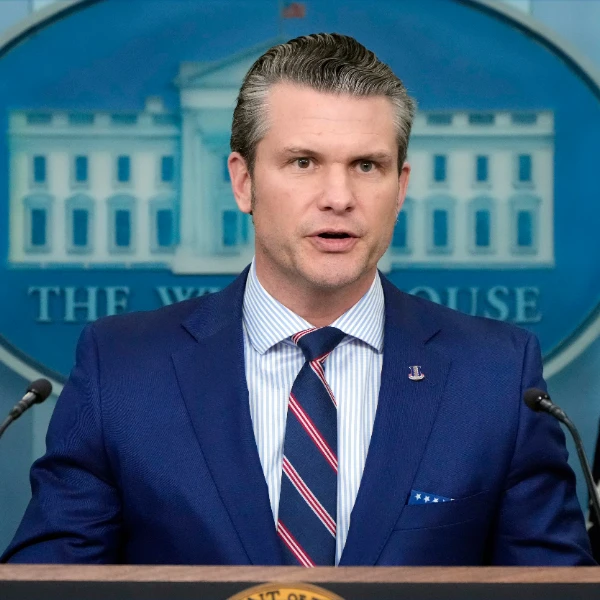
What will Pete Hegseth say during the Iran Press Briefing?
Short Answer
Both the model and the market expect Pete Hegseth to mention "Nuclear" during the Iran Press Briefing, with no compelling evidence of mispricing.
1. Executive Verdict
- Pete Hegseth often uses "terror" and "obliterate" when discussing Iran.
- U.S. military operations against Iran feature aggressive "Epic Fury" terminology.
- Prominent Republicans emphasize Iran as an immediate, severe threat.
- Israel and Saudi Arabia advocate a robust U.S. stance against Iran.
- Political appointees primarily shape Pentagon press briefing notes and messaging.
- Market sentiment for this prediction dropped significantly on April 8.
Who Wins and Why
| Outcome | Market | Model | Why |
|---|---|---|---|
| Hormuz | 92.0% | 87.8% | Hegseth frequently addresses strategic choke points and maritime security concerns involving Iran. |
| Ayatollah / Khamenei | 21.0% | 19.5% | Hegseth often criticizes the leadership of adversarial nations, including Iran's Supreme Leader. |
| Oil | 52.0% | 46.4% | Discussions about Iran frequently involve global energy markets and the country's oil production. |
| CIA | 47.0% | 39.8% | Hegseth often refers to intelligence operations when discussing geopolitical adversaries like Iran. |
| Rescue / Rescued | 79.0% | 78.9% | Hegseth often highlights efforts to protect American interests or personnel abroad. |
2. Market Behavior & Price Dynamics
Historical Price (Probability)
Outcome probability
Date
The market has traded between 1.0% and 22.0% YES probability, with a current reading of 7.0%. Total volume: 1,476 contracts.
3. Significant Price Movements
Notable price changes detected in the chart, along with research into what caused each movement.
📉 April 08, 2026: 13.0pp drop
Price decreased from 51.0% to 38.0%
Outcome: Obliterate / Obliterated / Obliteration
What happened: No supporting research available for this anomaly.
4. Market Data
Contract Snapshot
The provided page content does not contain the contract rules, resolution criteria, key dates, or special settlement conditions for the "What will Pete Hegseth say during the Iran Press Briefing?" market. The content only shows the market title and navigation links.
Available Contracts
Market options and current pricing
| Outcome bucket | Yes (price) | No (price) | Last trade probability |
|---|---|---|---|
| Hormuz | $0.93 | $0.10 | 92% |
| Nuclear | $0.93 | $0.08 | 92% |
| Israel / Israeli | $0.89 | $0.12 | 89% |
| Trump (5+ times) | $0.86 | $0.15 | 86% |
| Rescue / Rescued | $0.77 | $0.24 | 79% |
| Drone | $0.71 | $0.30 | 76% |
| America First | $0.64 | $0.37 | 63% |
| Terrorist / Terrorism | $0.57 | $0.46 | 57% |
| Oil | $0.54 | $0.47 | 52% |
| CIA | $0.47 | $0.55 | 47% |
| Obliterate / Obliterated / Obliteration | $0.38 | $0.63 | 38% |
| Civilian / School | $0.35 | $0.67 | 35% |
| Fake News | $0.26 | $0.75 | 26% |
| Hamas / Hezbollah | $0.26 | $0.75 | 26% |
| Ayatollah / Khamenei | $0.18 | $0.84 | 21% |
| Event does not qualify | $0.12 | $0.98 | 13% |
| Democrat | $0.22 | $0.89 | 10% |
| Russia | $0.10 | $0.95 | 10% |
Market Discussion
Limited public discussion available for this market.
5. What Keywords Does Pete Hegseth Use When Discussing Iran and U.S. Military?
| Frequent Keyword 'Terror' | Consistently used to describe Iran's state sponsorship and the IRGC [^] |
|---|---|
| Frequent Keyword 'Obliterate' | Used for military objectives against Iranian capabilities and IRGC [^] |
| Leadership Reference | 'Ayatollah' is used to denote Iran's leadership [^] |
Pete Hegseth frequently uses "terror" and "obliterate" concerning Iran and military actions. Hegseth consistently employs the terms "terror" and "obliterate" when discussing Iran and U.S. military posture in the Middle East. He often characterizes Iran as the "world's foremost state sponsor of terror" [^] and designates the Iranian Revolutionary Guard Corps (IRGC) as a "foreign terrorist organization" [^]. This language serves to justify military interventions aimed at "dismantle[ing] Iran's state sponsorship of terror" [^] and "crush[ing] terrorist networks" [^]. The term "obliterate" is central to describing U.S. military objectives, specifically to "obliterate any attempts to disrupt stability" [^] and "utterly obliterate their capacity to project terror and destabilize the region" [^], directly targeting the IRGC and its military capabilities [^].
Hegseth frames Iranian leadership as oppressive, aligning with "America First" principles. Hegseth’s rhetoric also includes "Ayatollah" to refer to Iran's leadership, portraying it as an oppressive regime [^], which helps frame the conflict against a specific ruling structure. Conversely, the phrase "America First" is not directly quoted from Hegseth in the reviewed televised appearances or statements. However, external analysis indicates his discourse closely aligns with the "America First" foreign policy stance, emphasizing American national interests [^], suggesting an underlying philosophical alignment rather than an explicit keyword usage in these particular contexts.
6. What Key Military Actions Define Operation Epic Fury Against Iran?
| Named Military Operation | Operation Epic Fury [^] |
|---|---|
| Attack Drones Deployed | Hundreds [^] |
| B-2 Bomber Target | Iranian Revolutionary Guard meetings [^] |
U.S. military operations against Iran feature aggressive terminology and actions. U.S. Central Command (CENTCOM) has launched "Operation Epic Fury," a named military operation reported through various sources [^]. This operation involves "hundreds" of U.S. "attack drones" as part of what has been termed an "Iran war" [^]. Additionally, B-2 bombers conducted a 36-hour mission specifically to "target Iranian Revolutionary Guard meeting[s]" [^]. External news outlets also reported an F-15E was shot down near Isfahan, leading to a multi-day rescue mission for aircrew [^].
Official communications consistently demonstrate a deterrence-focused and retaliatory posture. The consistent use of phrases such as "Operation Epic Fury" and direct references to an "Iran war" signals a state of active conflict and a robust military response [^]. This assertive posture, including the targeting of the Iranian Revolutionary Guard and the deployment of numerous "attack drones," aims to impose consequences and deter further Iranian actions without any indication of de-escalatory language [^].
7. How Do Influential Republicans View and Plan Iran Responses?
| Senator Cotton's Message to Iran | "Help is here" (March 1, 2026) [^] |
|---|---|
| John Ratcliffe's Threat Assessment | Iran an "immediate threat" to U.S. (March 18, 2026) [^] |
| Donald Trump's Iran Plan | Plan to "decimate" infrastructure in Iran [^] |
Prominent Republican figures emphasize Iran as an immediate, severe threat. Republican foreign policy figures, particularly those potentially influential in a future Trump administration, consistently highlight Iran as an immediate and severe threat, advocating for robust and sustained responses [^]. For instance, Senator Tom Cotton signaled a firm U.S. stance against the Iranian regime in March 2026, indicating considerations for "weeks, not days, of joint efforts" in Iran [^]. Similarly, John Ratcliffe stated in March 2026 that intelligence showed Iran posed an "immediate threat" to the U.S. [^]. These public statements collectively frame Iran as a significant and urgent threat requiring decisive action.
Strong rhetoric similar to "obliterate" is evident from influential figures. While direct quotes specifically using "Democrat weakness" are not present in the available sources, the prevailing hawkish rhetoric often implicitly contrasts with perceived less aggressive foreign policy approaches. More directly aligned with the term "obliterate threats," Donald Trump, a highly influential figure, publicly stated a plan to "decimate" infrastructure in Iran [^]. This forceful terminology, closely mirroring the concept of "obliterate," suggests a resolve for overwhelming force and contributes to a rhetorical environment that could validate similarly strong language from figures like Pete Hegseth, who has previously used potent terms when discussing Iranian leadership [^].
8. How Do Israel and Saudi Arabia Influence U.S. Iran Policy?
| Allied Message to Pentagon | Push for robust, deterrent, and potentially confrontational U.S. stance on Iran [^] |
|---|---|
| Israel-Saudi Alliance | "Secret alliance" to coordinate advocacy for tougher U.S. approach [^] |
| U.S. Secretary's Engagement | Discussed "Iran security" with Saudi Defence Minister, publicly stated Iran is "suffering the consequences" [^] |
U.S. allies Israel and Saudi Arabia advocate a robust U.S. stance against Iran. They are privately communicating a coordinated message to the Pentagon, advocating for a robust, deterrent, and potentially confrontational U.S. stance towards Iran [^]. This includes strong punitive measures and even advocacy for "war" to secure their interests against perceived Iranian threats. These two nations have formed a "secret alliance" specifically to coordinate their efforts and push for a tougher U.S. approach towards Iran, potentially including military intervention [^].
Allied messaging influences U.S. statements by emphasizing regional security commitments. This consistent private communication necessitates that U.S. Secretary of Defense Pete Hegseth's public statements demonstrate a strong U.S. commitment to regional security. While Saudi Arabia's concerns often revolve around broader regional stability and "oil security," Israel's focus is on its direct existential security threats from Iran. Given the "secret alliance" between the two nations on this issue [^], their private communications likely emphasize a convergence of these distinct security concerns.
Secretary Hegseth publicly addresses both Saudi and Israeli security concerns. This allows him to articulate a public stance that addresses both, depending on the context. His public statement that Iran is "suffering the consequences" and his specific mention of "Israel" in this context [^] indicates a clear emphasis on explicit Israeli security concerns, which aligns with the overall allied push for a firm U.S. position against Iran. He has also directly engaged with allies, including discussions about "Iran security" with the Saudi Defence Minister [^].
9. Who Holds Final Editorial Authority Over Pentagon Press Briefings?
| Final Editorial Authority | Assistant to the Secretary of Defense for Public Affairs (ATSD(PA)) and Pentagon Press Secretary [^] |
|---|---|
| Pete Hegseth's Role | Secretary of War / Secretary of Defense [^] |
| Tone Setting | Political appointees shape overall tone and rhetoric to align with administration policies [^]. |
Political appointees primarily shape Pentagon press briefing notes and messaging. The Assistant to the Secretary of Defense for Public Affairs (ATSD(PA)) and the Pentagon Press Secretary typically serve as the principal authors and final editors for Pentagon press briefing notes, including those prepared for senior officials like the Secretary of War [^]. Both of these roles are held by political appointees who oversee the drafting process [^]. While career civil servants within the ATSD(PA) office may handle the initial drafting of detailed briefing notes, often using cautious and precise language, the ATSD(PA) and the Pentagon Press Secretary, as political appointees, are responsible for shaping the overall tone and rhetoric to align with the administration's policies [^].
Appointees' editorial authority dictates the final tone of official communications. The final editorial authority rests with these politically appointed individuals, ensuring the messaging aligns with the Secretary of War's and the administration's strategic communications objectives [^]. The Pentagon Press Secretary acts as the chief spokesperson for the Department of Defense, responsible for preparing and disseminating information, including briefing notes [^]. For instance, Pete Hegseth is identified in sources as both the Secretary of War [^] and Secretary of Defense [^], and he has expressed positions such as being 'ready to intensify strikes if talks fail' regarding Iran [^]. The ultimate language and tone of briefing notes, whether cautious or more hawkish, would therefore reflect the guidance and editorial decisions of these political appointees, such as those operating under a Secretary like Hegseth.
10. What Could Change the Odds
Key Catalysts
Catalyst analysis unavailable.
Key Dates & Catalysts
- Expiration: April 09, 2026
- Closes: April 09, 2026
11. Decision-Flipping Events
- Trigger: Catalyst analysis unavailable.
13. Historical Resolutions
Historical Resolutions: 20 markets in this series
Outcomes: 2 resolved YES, 18 resolved NO
Recent resolutions:
- KXHEGSETHMENTION-26APR07-TRUM: NO (Apr 07, 2026)
- KXHEGSETHMENTION-26APR07-TERR: NO (Apr 07, 2026)
- KXHEGSETHMENTION-26APR07-RUSS: NO (Apr 07, 2026)
- KXHEGSETHMENTION-26APR07-RESC: NO (Apr 07, 2026)
- KXHEGSETHMENTION-26APR07-OIL: NO (Apr 07, 2026)
Get Real-Time Research Updates
Sign up for early access to live reports, historical data, and AI-powered market insights delivered to your inbox.
